| | US envoy Kushner meets with Hamas’ leader in Egypt, NATO shoots down suspected Russian drones, and A͏ ͏ ͏ ͏ ͏ ͏ |
| |  | Flagship |  |
| |
|
The World Today | 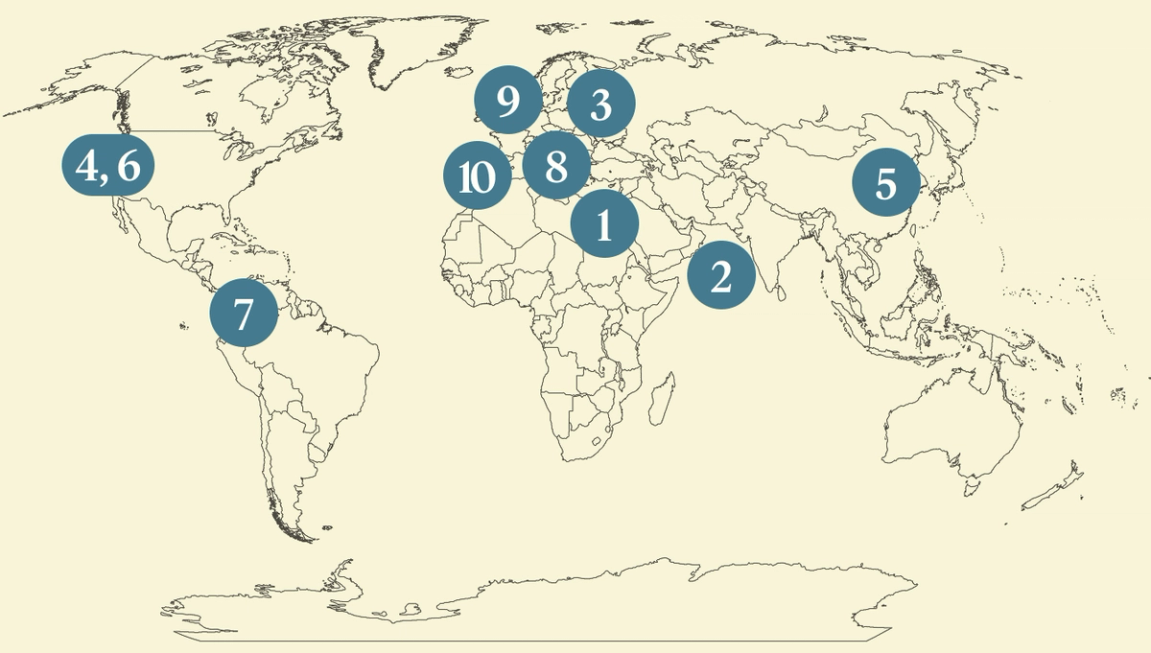 - Kushner meets with Hamas
- US warships stretched thin
- NATO downs drones
- Amodei on AI backlash
- Pressure from China AI model
- AI could entrench fossil fuels
- Mercenaries in Sudan
- Danube’s drop reveals history
- Heat hurts food security
- Scientific peer reviews gamed
 An ‘appealing’ history of punctuation, plus a look at the week ahead. |
|
US, Hamas hold rare direct talks |
 Nathan Howard/Pool via Reuters Nathan Howard/Pool via ReutersUS envoy Jared Kushner met with Hamas’ leader in Egypt on Sunday to push for the group’s disarmament, as Washington attempts to salvage the stalled plan to end one of the region’s ongoing conflicts. Kushner is also expected to meet on Monday with Israeli Prime Minister Benjamin Netanyahu, who rejected US President Donald Trump’s peace plan. Israel has also rejected US calls to withdraw from Gaza and Lebanon, demanding that Hamas and Hezbollah disarm first. Israeli forces bombed Lebanon on Sunday in strikes that Iran regards as violations of a months-old ceasefire, adding pressure to faltering US-Iran negotiations: The White House is searching for new strategies to inflict economic pain on Tehran as Washington prepares measures aimed at creating “economic isolation.” |
|
US leaves Pacific without aircraft carrier |
 US Navy/Handout via Reuters US Navy/Handout via ReutersUS President Donald Trump dismissed reports of poor living conditions on the USS Abraham Lincoln, escalating a fight in Washington over the aircraft carrier’s record 260-plus-day stretch at sea. Multiple sailors have reportedly attempted to jump overboard during the deployment, which was extended to support the Iran war. The US’ top Middle East commander visited the vessel as the military prepared to replace it with the USS George Washington — a rotation that leaves the US without a carrier in the Pacific, signaling “the exact opposite” of Washington’s stated goal of pulling out of the Middle East and refocusing efforts in Asia, a CSIS expert told The Associated Press. The Pentagon’s policy chief visited Southeast Asia last week to address concerns about Washington’s reliability. |
|
NATO counters drone incursions |
 Stringer/Reuters Stringer/ReutersA Spanish fighter jet shot down a suspected Russian drone over Romania on Sunday, two days after NATO downed a similar drone over Latvia. Such incursions have become a “near-weekly occurrence,” The Wall Street Journal noted, as Russia and Ukraine escalate their air campaigns: Ukraine launched one of its largest drone attacks on Sunday in its intensifying campaign against logistics targets, disabling the main warehouse of e-commerce company Wildberries, or “Russia’s Amazon,” according to the Russian defense ministry. Pressure is mounting on Russia’s economy, and experts have suggested that President Vladimir Putin could respond by expanding the war: The Kremlin has recruited hundreds of Orthodox priests as intelligence assets in Moldova in a bid to destabilize NATO’s eastern flank, The New York Times reported. |
|
Amodei addresses AI backlash |
 Denis Balibouse/Reuters Denis Balibouse/ReutersAnthropic CEO and co-founder Dario Amodei pushed back Saturday against criticism that his messaging around AI — that it could centralize power and produce mass job displacement — has stoked the growing backlash against the technology. In rare social media remarks, Amodei acknowledged AI firms “haven’t yet delivered on our big promises to benefit the world” and endorsed the creation of a FINRA-like central regulator, adding that the most effective way to counter criticism is by “actually curing cancer” and other diseases. The US firm’s revenue grew 14-fold in the second quarter to more than $11.5 billion, Bloomberg reported; it’s targeting up to $200 billion in annual revenue by 2028, according to Reuters, as it attempts to woo investors for its IPO. |
|
New Chinese model adds to AI competition |
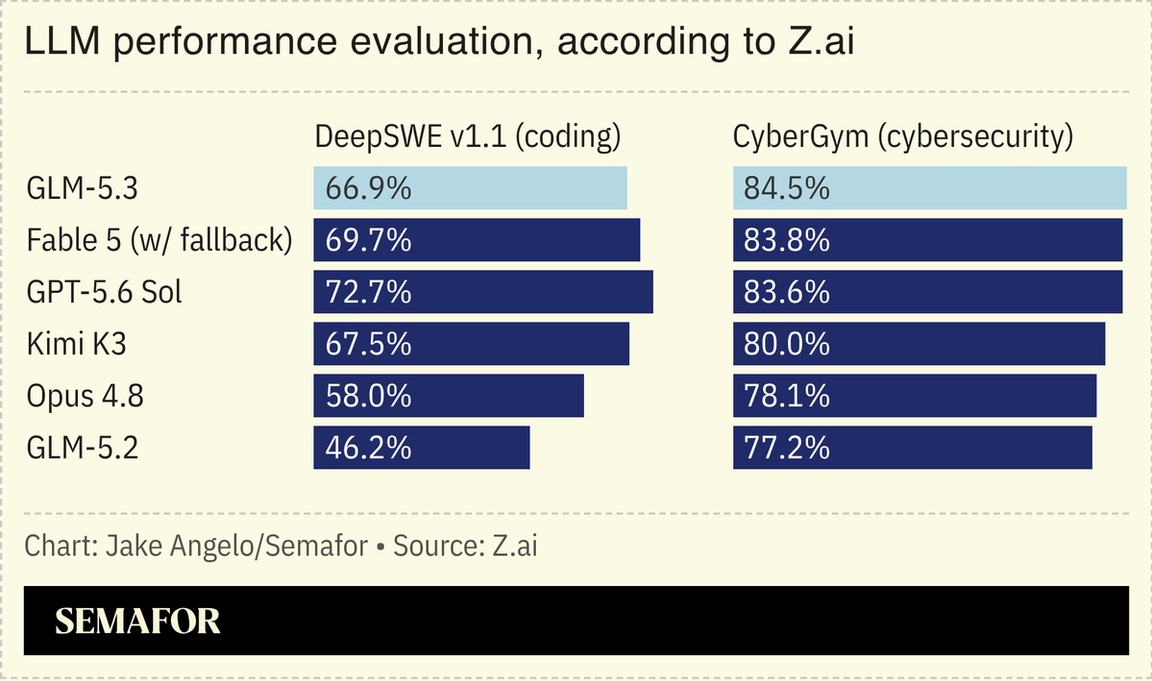 Chinese AI startup Zhipu said its new GLM-5.3 model outperformed Anthropic’s Mythos 5 in a key cybersecurity benchmark and closed the gap on coding capabilities, marking the latest Chinese open-weight model to claim parity with the Western AI frontier. Following its last release in June, Zhipu, also known as Z.ai, is “iterating fast,” Bloomberg noted, as Washington attempts to clamp down on China’s progress: The White House is drafting plans to require countries to pick a side in the US-China AI competition, Reuters reported, demanding they not partake in Beijing’s framework. The Trump administration has expressed concern with China’s open-weight models while walking back restrictions on the sale of some US chips, a policy that a Council on Foreign Relations expert described as “incoherent.” |
|
AI could boost oil and gas |
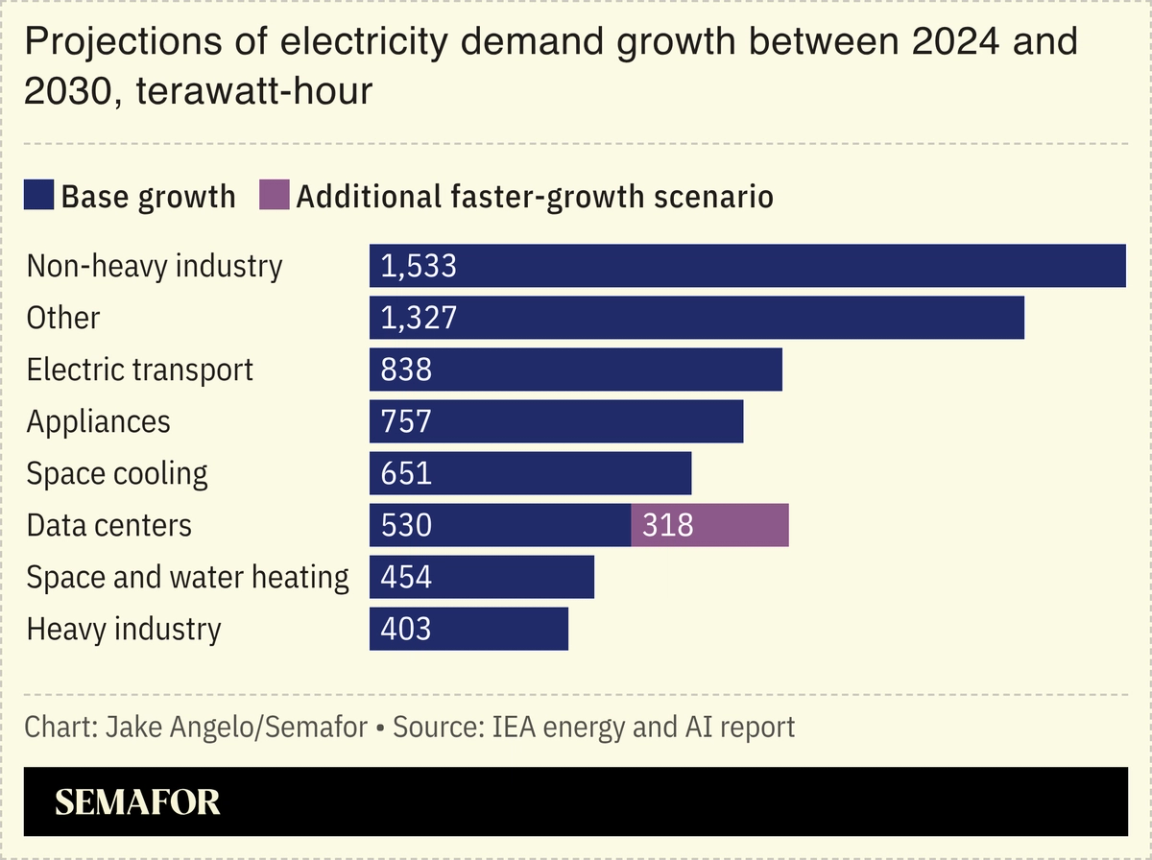 AI could prolong reliance on oil and gas production by making fossil fuel extraction more efficient, a new paper suggested, possibly outweighing the technology’s impact on renewables. The AI-driven efficiencies could raise global carbon-dioxide emissions by an amount equivalent to Mexico’s annual output. AI may also improve efficiency in renewables, the authors suggested, but any gains could be offset by similar efficiency boosts to fossil fuels, what one co-author called “the other side of the same ledger.” The data center buildout itself demands enormous amounts of energy: A Financial Times analysis found the resulting emissions could reach nearly 101.5 million tonnes of carbon dioxide per year in the US, or about 7% of power-sector emissions in 2025. |
|
UAE firm recruits Colombian fighters |
 Mohamed Nureldin Abdallah/Reuters Mohamed Nureldin Abdallah/ReutersA UAE security firm reportedly recruited hundreds of Colombian mercenaries via WhatsApp to fight in Sudan, the Financial Times reported, illustrating the clandestine involvement of foreign powers in Africa’s “forgotten war.” Recruiters targeted cartel members who were coming “straight from an active war zone” in their own country, one Colombian fighter said. The UAE has denied supporting the paramilitary Rapid Support Forces but claims “billions of dollars in business concerns” in-country, the FT noted, including gold mines. Third-party negotiators have struggled to end the three-year civil war, which has laid waste to much of the country, after an initial US push fizzled out: “The Americans have lost interest and don’t have the bandwidth,” one foreign mediator told The Economist. |
|
 What does a record label do in a world where anyone can upload a song to Spotify? On this week’s episode of Mixed Signals, Warner Music Group CEO Robert Kyncl joins Max and Semafor business editor Liz Hoffman, filling in for Ben, to talk about why Warner struck a deal with AI music company Suno while Sony and Universal are still suing it, how he thinks about the nuclear-level leverage labels hold over streaming platforms, and why he thinks Netflix is leaving a massive opportunity on the table by ignoring music.
|
|
Receding Danube River reveals the past |
 Marko Djurica/Reuters Marko Djurica/ReutersRecord-low water levels in the Danube River — the result of brutal summer heat in Europe — revealed the bodies of two German soldiers from World War II, as well as a host of other long-lost items. Parts of the continent have suffered through as many as five heatwaves, hitting Europe’s economy and energy systems in part due to falling river levels. The declining river levels also revealed a well-preserved motorcycle, a wedding ring, and some anti-tank mines near where the Danube cuts through Budapest, which was the site of intense battles between Soviet and German troops during the war. Historians are in the process of identifying the bodies. “Now begins a puzzle,” one investigator told the German newspaper Bild. |
|
Europe’s heat strains global food supply |
|
|


