| | In this edition: South Africa’s presidency tussles with Eskom, the true scale of the Ebola outbreak,͏ ͏ ͏ ͏ ͏ ͏ |
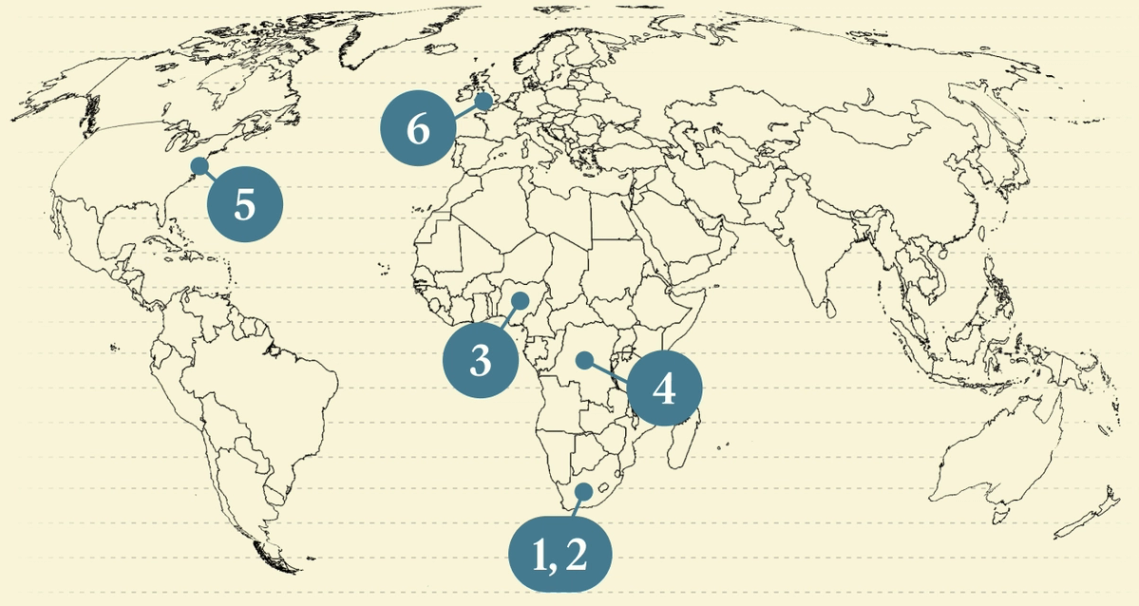
| |  Johannesburg Johannesburg |  Kinshasa Kinshasa |  Yaoundé Yaoundé |
 | Africa |  |
| |
|
 - S. Africa’s tussle with Eskom
- … and rising unemployment
- Nigeria seeks $50B investment
- The true scale of Ebola
- US House to mull AGOA
- A new sovereign bond ETF
 Kenya vies to host the 2029 World Athletics Championships. |
|
Ramaphosa, Eskom spar over energy |
 Esa Alexander/Reuters Esa Alexander/ReutersSouth African President Cyril Ramaphosa clashed with the head of state energy company Eskom over the speed of opening the national power grid to private operators, pitting the government’s flagship energy reform against warnings of bondholder shock. At the heart of the dispute is the transfer of powerline assets to an independent Eskom spinoff to dismantle the utility’s monopoly over the grid and open it to private power generation companies to sell electricity directly to buyers. Eskom board chair Mteto Nyati urged Pretoria to delay the transfer of $6 billion in physical assets, warning that stripping Eskom of its infrastructure — which generates around 40% of its core earnings — could breach existing loan contracts, giving lenders the right to demand their money back. The presidency said it is negotiating safeguards with bondholders and argued that delays jeopardize investor confidence in energy reform. South Africa’s energy reforms have attracted billions of dollars in committed private capital, helping to produce enough power for Eskom to end rolling power cuts that have stymied growth in Africa’s largest economy. Eskom, now sitting with surplus energy, has set its sights on data centers as a new source of customers. — Tiisetso Motsoeneng |
|
South Africa’s job crisis deepens |
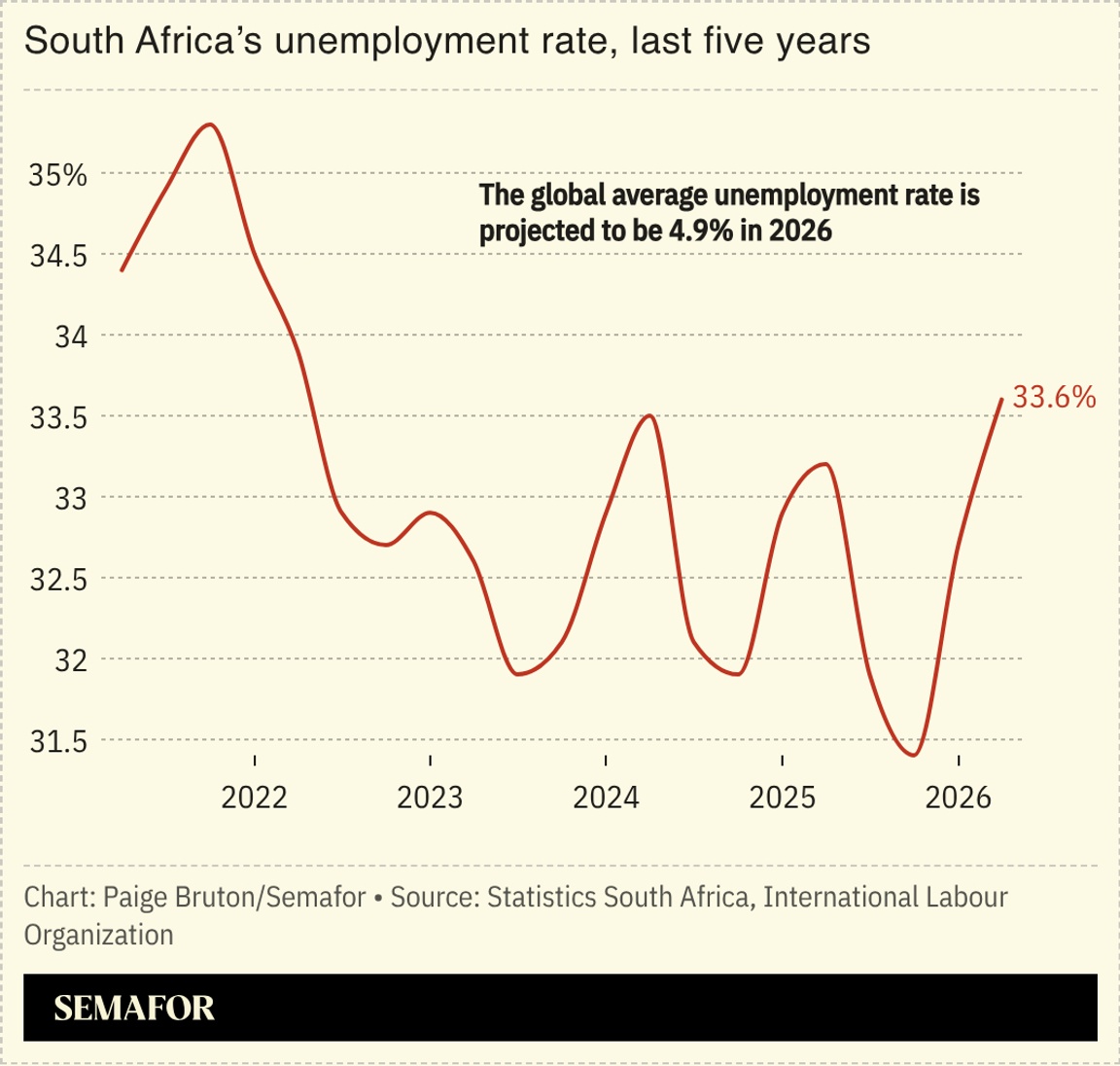 South Africa’s unemployment rate climbed to its highest level since 2022 in the second quarter, official data showed. The figures highlight how improved investor confidence in the two years since the coalition government took office has been undercut by a deteriorating labor market. More than 340,000 people joined the ranks of the unemployed between April and June, pushing the total number of jobless to 8.5 million, an unemployment rate of 33.6%. Youth unemployment rose to 47%. The data punctures the positive market response that followed the formation of the coalition government, which included the country’s first ratings upgrades in 20 years and being removed from a global financial watchdog’s “gray list” of countries under heightened scrutiny. Economic hardship is spilling directly into politics as parties campaign ahead of municipal elections in November. In major urban centers, persistent joblessness has fueled a resurgence of anti-migrant rhetoric and vigilante violence targeting foreigners from neighboring African states, who are frequently accused of taking jobs and overloading local services. — Tiisetso Motsoeneng |
|
Nigeria tax breaks target oil investors |
 Tife Owolabi/Reuters Tife Owolabi/ReutersNigeria is rolling out tax incentives to attract as much as $50 billion in oil and gas investment as it seeks to rekindle international interest in offshore projects. Africa’s largest oil and gas producer is pushing to revive hydrocarbon exploration in deepwater reserves at a time when global oil companies have retreated from their onshore Nigerian assets due to pipeline vandalism. The newly signed executive order, which is based on a framework of tax rebates approved for Shell as it plans to pour at least $10 billion into offshore projects, offers “clear and predictable terms” for new investments, President Bola Tinubu said. The African Energy Chamber, a South Africa-based advocacy group, estimates that African oil and gas investments could reach $41 billion this year alone. Several countries, including Angola and Namibia, are also vying to secure funds, creating a competitive environment for investment. — Alexander Onukwue |
|
Ebola spread undetected for months |
 Thomas Mukoya/Reuters Thomas Mukoya/ReutersThe Ebola outbreak that has killed more than 2,000 people began three months before it was officially declared in mid-May, the World Health Organization said, raising the likelihood that its true scale is far larger than previously thought. The outbreak, centered in eastern DR Congo, is caused by the rare Bundibugyo species of the virus and marks the second-deadliest outbreak on record. WHO Africa director Mohamed Janabi said genomic sequencing showed the outbreak began in February, with some early cases misdiagnosed as malaria and typhoid. “We are chasing the virus, the virus is ahead of us,” he told reporters. WHO experts recently recommended prioritizing Ervebo, the only licensed existing Ebola vaccine, for clinical trials against Bundibugyo as researchers work on a jab to target the new strain. |
|
 Semafor has announced the Semafor Innovation Atlas, a new global editorial initiative spotlighting the most effective real-world applications of AI, robotics, and emerging technology. The editorial project will identify proven initiatives already delivering measurable results across healthcare, workforce development, education, responsible AI, and climate and energy.
Selected projects will debut at Semafor’s Silicon Valley & The World this November, where leaders will examine what is working and what others can learn from initiatives with the potential to scale.
Organizations, governments, universities, schools, nonprofits, and companies are invited to submit active projects for consideration by Friday, August 28, 2026. If your team is using technology to solve real problems and create scalable impact, submit your project for consideration here. |
|
AGOA’s fate rests with US House |
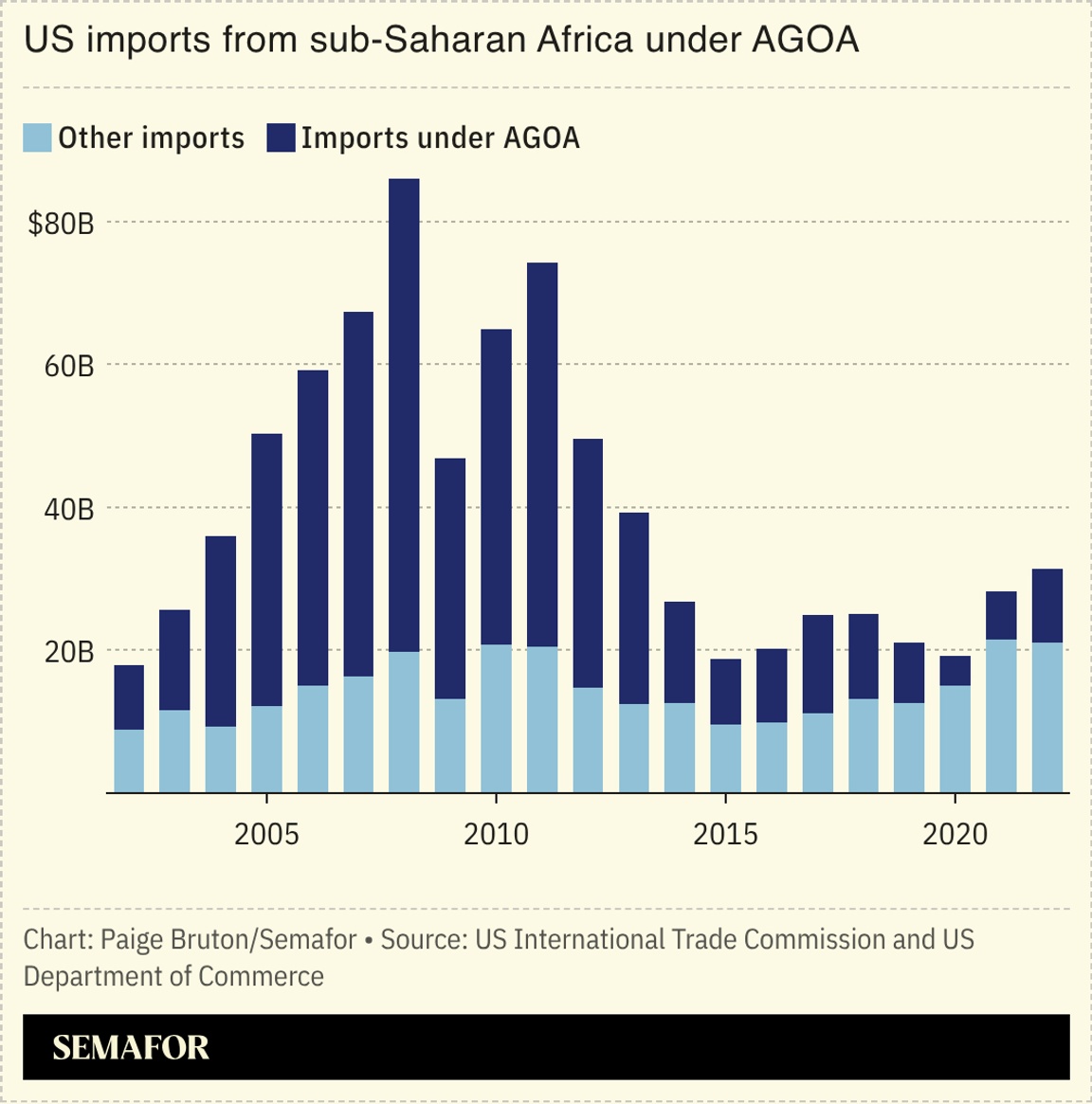 The African Growth and Opportunity Act, the US-Africa trade preference pact, is on the path for a two-year renewal after the Senate passed a government funding bill over the weekend that included an extension for the program. But there’s no guarantee that the bill will pass the House of Representatives, which could ultimately strip out the AGOA extension or adjust it, as one former Hill staffer told Semafor. AGOA has been a key force in driving duty-free African exports to the US since it was first implemented in 2000. The Senate bill would extend the pact, which is set to lapse at the end of the year, until 2028 without any modifications. But AGOA is at odds with the Trump administration’s high-profile push for tariffs. The ex-staffer said the House would want a deal aligned with the US president’s trade agenda, while also giving industry enough certainty to invest, making an outright two-year extension less likely. — Adrian Elimian |
|
 Tiksa Negeri/Reuters Tiksa Negeri/ReutersA new African sovereign bond exchange-traded fund has launched with up to $250 million in commitments. Its backers are betting it can help unlock a much bigger market for African sovereign debt and help reduce borrowing costs. Managed by Legal & General, the ETF tracks an African sovereign bond index created by S&P Dow Jones Indices and the Afreximbank-backed Liquidity and Sustainability Facility (LSF). An ETF is a pooled investment that trades like a stock, in this case giving institutional investors diversified exposure to African dollar-denominated government bonds. “We want to enable a secondary market for African debt,” Vera Songwe, LSF founder and a former head of the UN’s Economic Commission for Africa, told Semafor, adding that greater liquidity could reduce the premium that investors demand — and ultimately lower governments’ borrowing costs. The market needs to reach roughly $1 billion to achieve the critical mass needed to deepen trading, according to Songwe. The UK Foreign, Commonwealth & Development Office is providing seed capital for the fund. — Yinka Adegoke |
|
 Business & Macro
|
|
|


