| | In this edition, how Nvidia’s Wall Street play boosts the value of old chips, Lionsgate gets pressur͏ ͏ ͏ ͏ ͏ ͏ |
| |  | Business |  |
| |
|
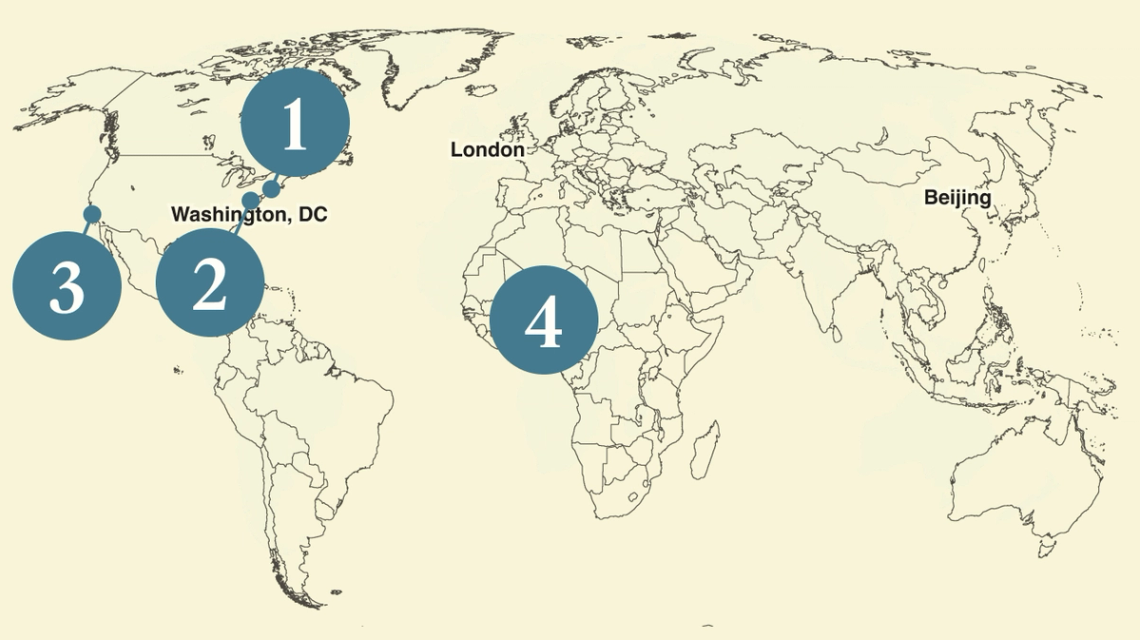 - Nvidia’s value proposition
- US passes on Intel
- Lionsgate’s AI crunch
- Africa’s IPO revival
|
|
 A cardinal rule of finance is “always spend other people’s money.” It’s why leveraged buyouts include as much debt and as little equity as possible, and why the wealthy fund their lifestyles by borrowing against assets. The incentives, though, can be less than ideal. Milton Friedman, the legendary economist, laid out a simple matrix. Spend your own money on yourself and you’re disciplined on cost (it’s your money) and clear on value (you know what you want.). That’s an efficient economy, though not a very vibrant one. Spend your own money on someone else and you keep the cost discipline but lose the value signal (the recipient might not want what you bought them). Spend other people’s money on yourself and you lose the plot on costs and sometimes get a subprime mortgage crisis. And finally, spend other people’s money on other people — that’s why people hate the government. Big Tech is working its way through all four stages, in roughly the order Friedman described. The AI capex supercycle began with tech giants spending their profits on their own infrastructure — chips and data centers for internal use. Then came other people’s money: Intel’s $15 billion stock offering this week follows big capital raises from Alphabet, Meta, Oracle, and Amazon, all deploying shareholder and bondholder capital on their own buildouts. Now big tech companies are spending other people’s money on other people. Nvidia is assembling a $500 billion pot from a who’s who of Wall Street firms which will, in turn, backstop OpenAI’s lease of a SoftBank data center in Ohio and help startups rent access to Nvidia’s chips from CoreWeave. Broadcom is similarly spending Blackstone’s money to help Anthropic buy chips. Google is spending bondholders’ money to help Fluidstack buy compute from TeraWulf. The names aren’t important here, but “[Big Tech Company] is spending [Capital Source]’s money to buy [Expensive Gift] for [Small Tech Company]” is a decent way to think about the current state of AI financing. Wall Street capital sources, rather than tech companies, being the source of AI capital is how it should work. But heed Friedman’s warning nobody in that arrangement is “going to be anything like as careful” as those in the first quadrant of spenders. He never met a hyperscaler, but he’s got their number. |
|
Nvidia to help boost value of old chips |
 Ann Wang/Reuters Ann Wang/ReutersWe still have a lot of questions about Nvidia’s $500 billion fundraising bonanza, which got a splashy rollout yesterday. But one thing caught our eye in CEO Jensen Huang’s post laying out some details: Nvidia will provide a “residual-value support mechanism” for up to 25% of the value of some AI projects. Its chips are constantly being upgraded, meaning older models lose their value. And because those chips are a huge part of the value of AI infrastructure, that depreciation puts at risk the hundreds of billions of dollars of borrowed money that sit on top of them. Think about it like Toyota bumping up the value of a 2025 Corolla after the 2026 model comes out to help customers who borrowed to buy the old model. It’s a sign that Nvidia can’t entirely extricate itself from its role as AI’s biggest financier, even as it passes the baton to Wall Street. Meanwhile, a double-speak alert: The new “investable asset class” of AI infrastructure that Huang says he’s creating won’t be regulated like one. The Securities and Exchange Commission, responding to a request from law firm Latham & Watkins, ruled that packaged loans tied to data centers are exempt from certain investor protections. |
|
US to sit out Intel offering |
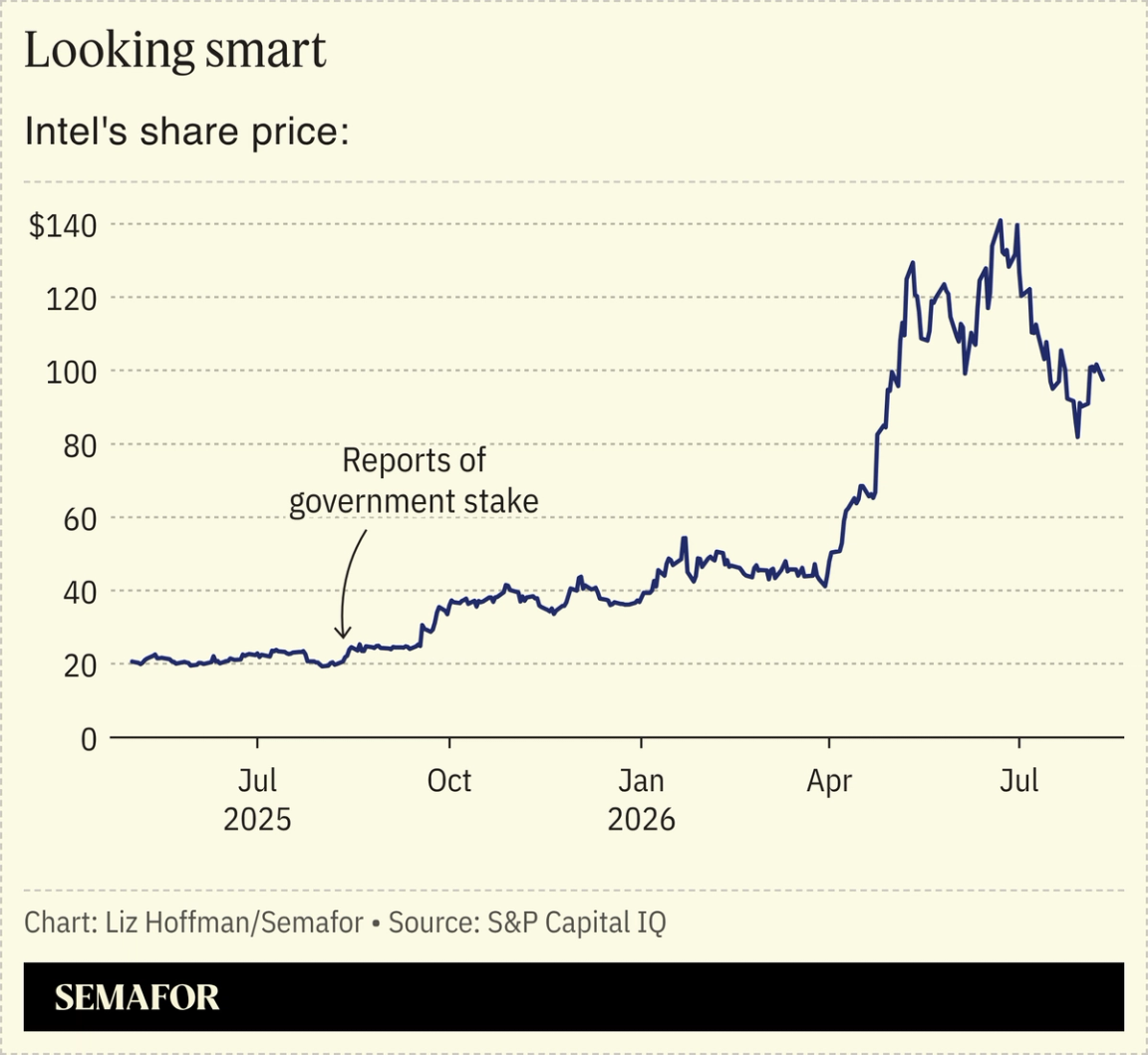 When Intel CEO Lip-Bu Tan was getting ready last week to announce a $15 billion sale of stock, he called his biggest shareholder: Commerce Secretary Howard Lutnick. The government isn’t participating in the new stock sale, which is Intel’s first since 1971 and will fund AI projects including its delayed Ohio chip factory, according to people familiar with the matter, but it approved of the idea. That will dilute the government’s 9.9% stake (the government is not selling into the offering either). But it’s a vote of confidence in Intel’s turnaround and a sign that Intel can sustain itself with private money. (It boosted the share sale to $20 billion this morning on the back of strong demand from investors.) US taxpayers are up 375% since the Commerce Department bought in a year ago in a deal meant to boost Intel’s domestic manufacturing. And Tan, whose resignation President Donald Trump publicly demanded last summer, looks safe in his job. Read more about Intel and the US government here. — Liz Hoffman and Rohan Goswami |
|
Activist pressures Lionsgate to sell |
 Thomas Fuller/SOPA Images via Reuters Thomas Fuller/SOPA Images via ReutersHow do content-rich media studios navigate the age of AI? One activist, Anson Funds, says content licensing is the cure and is pushing Lionsgate to reinvent itself for “the AI era” or put itself up for sale, Semafor’s Rohan Goswami scooped. “The rise of generative AI has led the market to sort companies bluntly into ‘AI winners’ and ‘AI losers,’” Anson’s Sagar Gupta wrote in a July letter to Lionsgate’s board reviewed by Semafor. “Lionsgate’s stock has reacted sharply—and negatively—to the release of new AI video models, including Sora and Seedance, which we believe reflects a default market assumption that a studio is more likely to be an AI casualty than an AI beneficiary.” Lionsgate has been receiving informal advice from at least two investment banks, but has not yet hired either of those banks to run a formal strategic review, according to a person familiar with the discussions. |
|
Africa’s dealmakers bet on IPO wave |
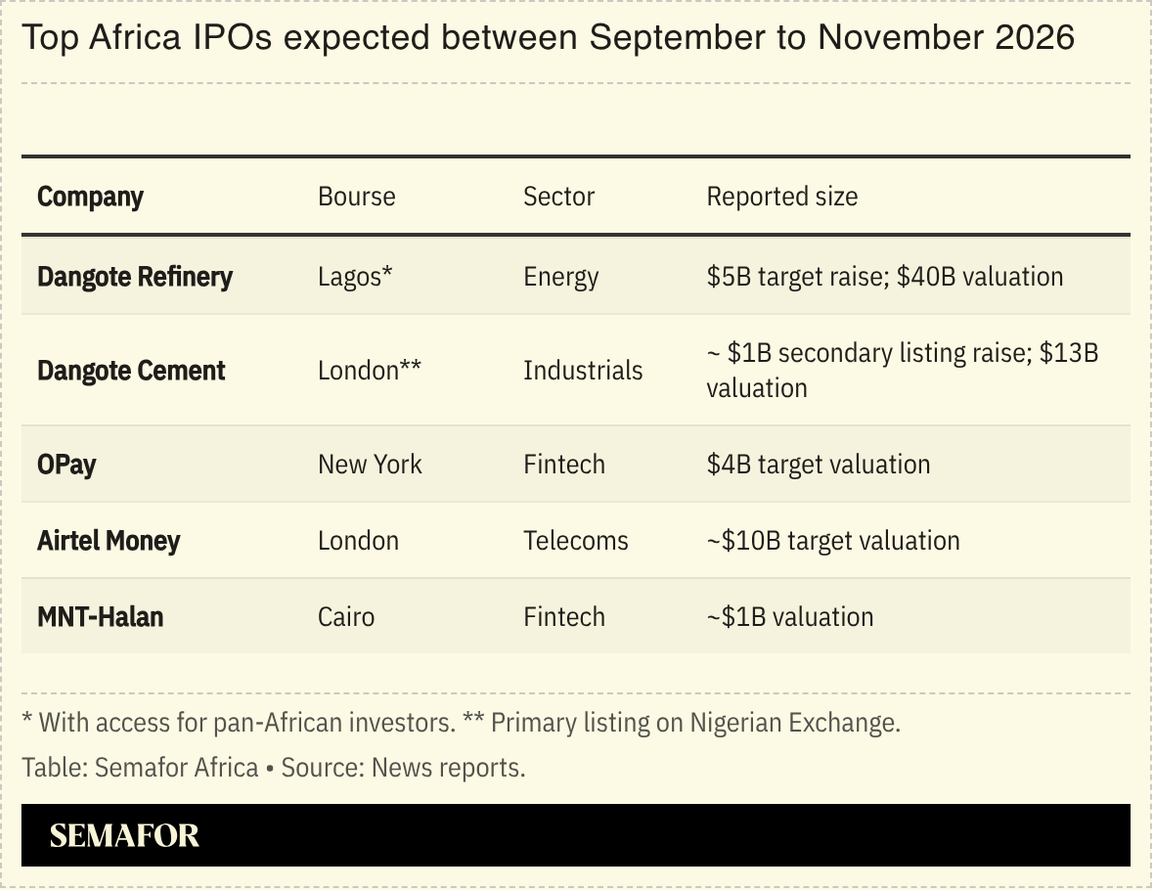 Africa’s dealmakers are betting that the continent’s capital markets are entering a new phase following years of sluggish activity. A burst of IPO and M&A activity kicks off with Aliko Dangote’s anticipated $5 billion listing of his refinery on the Nigerian Exchange, which is expected to be Africa’s largest-ever listing. Strong retail and institutional demand is necessary if Africa wants to show it can broaden the pool of capital for other African companies, Miguel Azevedo, head of investment banking for the Middle East and Africa at Citigroup, told Semafor. “One transaction won’t create a market, but this transaction by its size will change things.” The deal activity is also prompting multinationals to rethink their African portfolios. Diageo’s $2.3 billion sale of its East African beer business to Japan’s Asahi was inked at a higher price than expected, said Funso Akere, Head of M&A Advisory for Standard Bank’s Africa Regions, encouraging other multinationals to explore sales of non-core African assets. — Yinka Adegoke |
|
 Semafor has announced the Semafor Innovation Atlas, a new global editorial initiative spotlighting the most effective real-world applications of AI, robotics, and emerging technology. The editorial project will identify proven initiatives already delivering measurable results across healthcare, workforce development, education, responsible AI, and climate and energy. Selected projects will debut at Semafor’s Silicon Valley & The World this November, where leaders will examine what is working and what others can learn from initiatives with the potential to scale. Organizations, governments, universities, schools, nonprofits, and companies are invited to submit active projects for consideration by Friday, August 28, 2026. If your team is using technology to solve real problems and create scalable impact, submit your project for consideration here. |
|
 Companies & Deals- Explosive allegations: Plaintiffs’ lawyers are lining up to sue Taylor Farms, whose lettuce has been blamed for a deadly cyclosporiasis outbreak, Dealbook reports; “a pretty damn expensive explosive diarrhea outbreak.”
- Growth mode: Anton Levy, the former co-president of General Atlantic, has raised $1.1 billion for his “hypergrowth” VC fund in a tough environment for first-time managers, The Information reports.
- Turbo: Elon Musk has another reason to want to merge Tesla and SpaceX: It’s a fast-track to his $1 trillion payday.
WatchdogsMarkets- Irreconciliable differences: Divorce proceedings kick off this week that could determine control of Two Sigma, the giant hedge fund. The soon-to-be ex-wife of Jonathan Overdeck — who is himself in the middle of a messy (non-marital) divorce from his co-cofounder, David Siegel — is claiming she is owed one-third of the firm.
 New Jersey court filings New Jersey court filings- Take shelter: A TikTok primer on tax-minimizing strategies of the rich and famous
|
|
|


