| | In today’s edition: Prospect of peace dims on compensation question, ADNOC unit benefits from war pr͏ ͏ ͏ ͏ ͏ ͏ |
| |  | Gulf |  |
| |
|
 - US, Iran seek reparations
- Gulf’s united front?
- Saudi data center boom
- Shipping profits surge
- Abu Dhabi’s DC playbook
 A hoard of previously unknown Saudi antiquities. |
|
Iran and US debate the cost of war |
 Mohammed Salem/Reuters Mohammed Salem/ReutersWho will pay for the destruction wrought by the missiles and drones fired in this year’s war between the US and Iran? The question of compensation has suddenly become a key hurdle in negotiations, with both Washington and Tehran demanding money from the other. It may just be a negotiating tactic, but it is undermining hopes for a deal to reopen the Strait of Hormuz. Over the weekend, Iranian officials demanded US reparations for war damage, citing it as one of several conditions for allowing ships to pass through Hormuz. US President Donald Trump responded by saying “now I am likewise demanding compensation from Iran.” Consultations between Iran and Oman are ongoing, but with the prospects for a breakthrough dimming, Iran has reshuffled its senior military and security team, cementing the position of hardliners. |
|
Riyadh and Abu Dhabi can’t go it alone |
 Abdulla Al Bedwawi/UAE Presidential Court/Handout via Reuters Abdulla Al Bedwawi/UAE Presidential Court/Handout via ReutersSaudi Arabia and the UAE need a unified front now more than ever, caught between an “erratic, yet essential” US and a battered but emboldened Iran, the Atlantic Council’s Allison Minor and the Washington Institute’s April Longley Alley write in Foreign Policy. Tehran retains the ability to menace its neighbors, but the Gulf can no longer depend only on Washington for protection, they argue. Qatar is an economic heavyweight and Oman a crucial backchannel, but Riyadh and Abu Dhabi should take the lead because they hold the most leverage over Tehran. That is why the public display of warmth between the two in July mattered so much, after fall-outs over Yemen, OPEC, and other issues. Saudi-Emirati ties have fluctuated before, notes Kristian Coates Ulrichsen in AGSI — differences remain but they are ones officials “may wish to park.” |
|
Hormuz risk pays off for shippers |
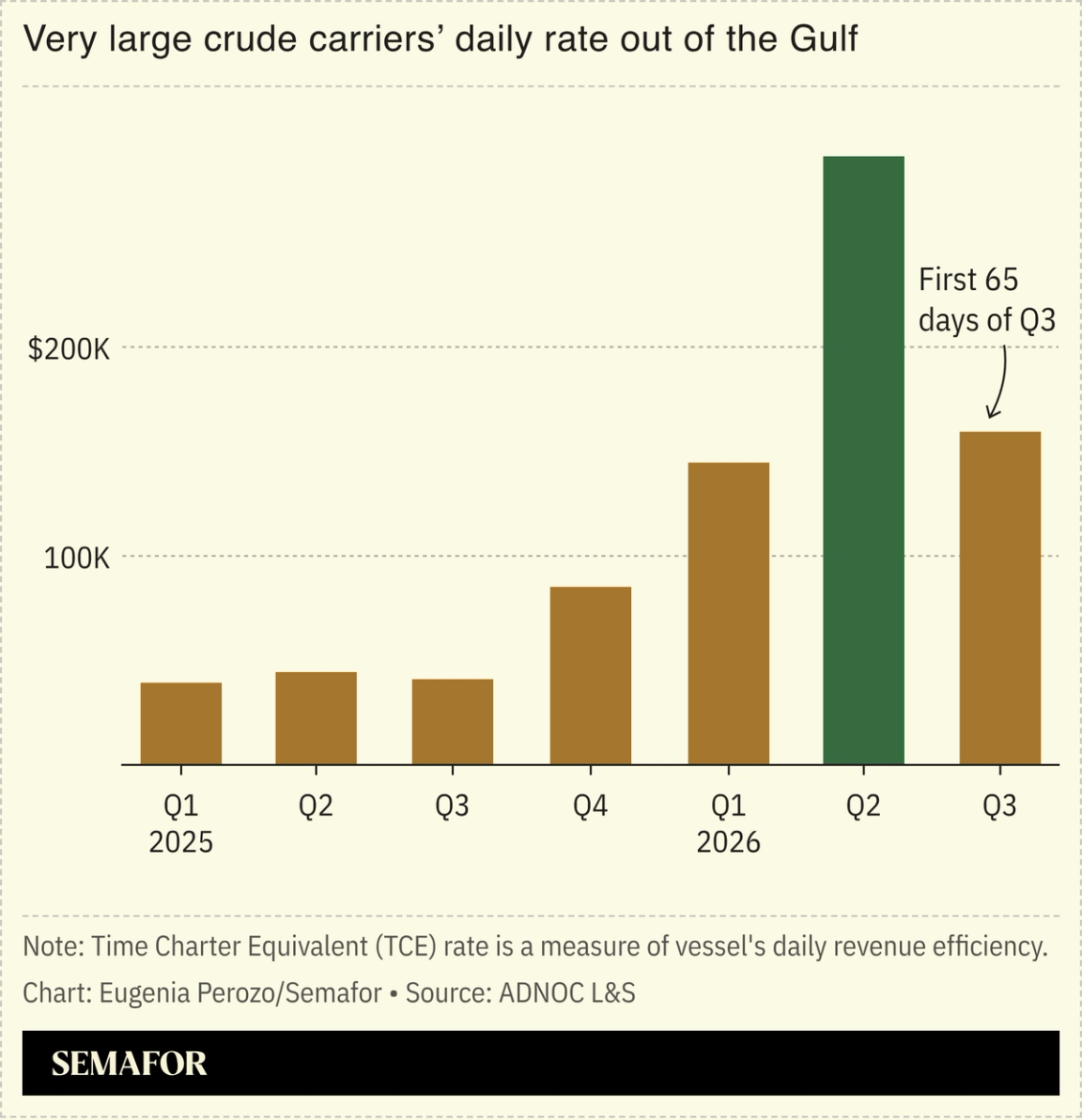 Only a fraction of the ships that used to cross the Strait of Hormuz before the war are making it through. This scarcity has made the payoff substantial for companies willing to take the risk, or for those with alternative sea routes to ply: Last month, Saudi shipper Bahri reported a sixfold rise in quarterly profit, and today, ADNOC Logistics & Services said its profit quadrupled to $951 million in the second quarter. The danger is real — at least two of its vessels were attacked in July, killing one person and injuring several others. Higher charter rates and an expanded fleet drove the Abu Dhabi company’s earnings. ADNOC L&S is committing $2.3 billion this year to buy more oil and gas tankers. It has also raised its profit forecast for a third time this year. — Mohammed Sergie |
|
Saudi data centers reign, but need capital |
 Saudi Arabia’s data center capacity is forecast to reach 1 gigawatt by 2030, making it the fastest-growing Gulf market in a sector awash in cash and FOMO. The pipeline of announced projects is larger still — PIF’s HUMAIN alone is targeting more than 6 GW in the coming decade. Financing even half of that will require up to $32 billion in debt, more than the kingdom’s banks are likely to be willing to assemble themselves, according to a report from consulting firm Alvarez & Marsal. “Digital infrastructure is now one of the largest single sources of new project debt in our pipeline,” Kurt Davis Jr., the report’s author, told Semafor. The pace is being driven by vast government demand, data sovereignty legislation that is keeping caches in-country, and hyperscalers increasingly looking to lease data center space rather than build in new markets. Cheap power and plentiful land further help the pitch. Institutional money is already circling: KKR earmarked part of its massive new infrastructure fund to back more Gulf tech build-outs last week. Such bullishness comes just five months after Iranian drones struck AWS sites in the UAE and Bahrain, casting doubt at the time on the future of the sector in the region. Unlike data centers, the memories of their investors can be short. — Kelsey Warner |
|
How Al Otaiba won over Washington |
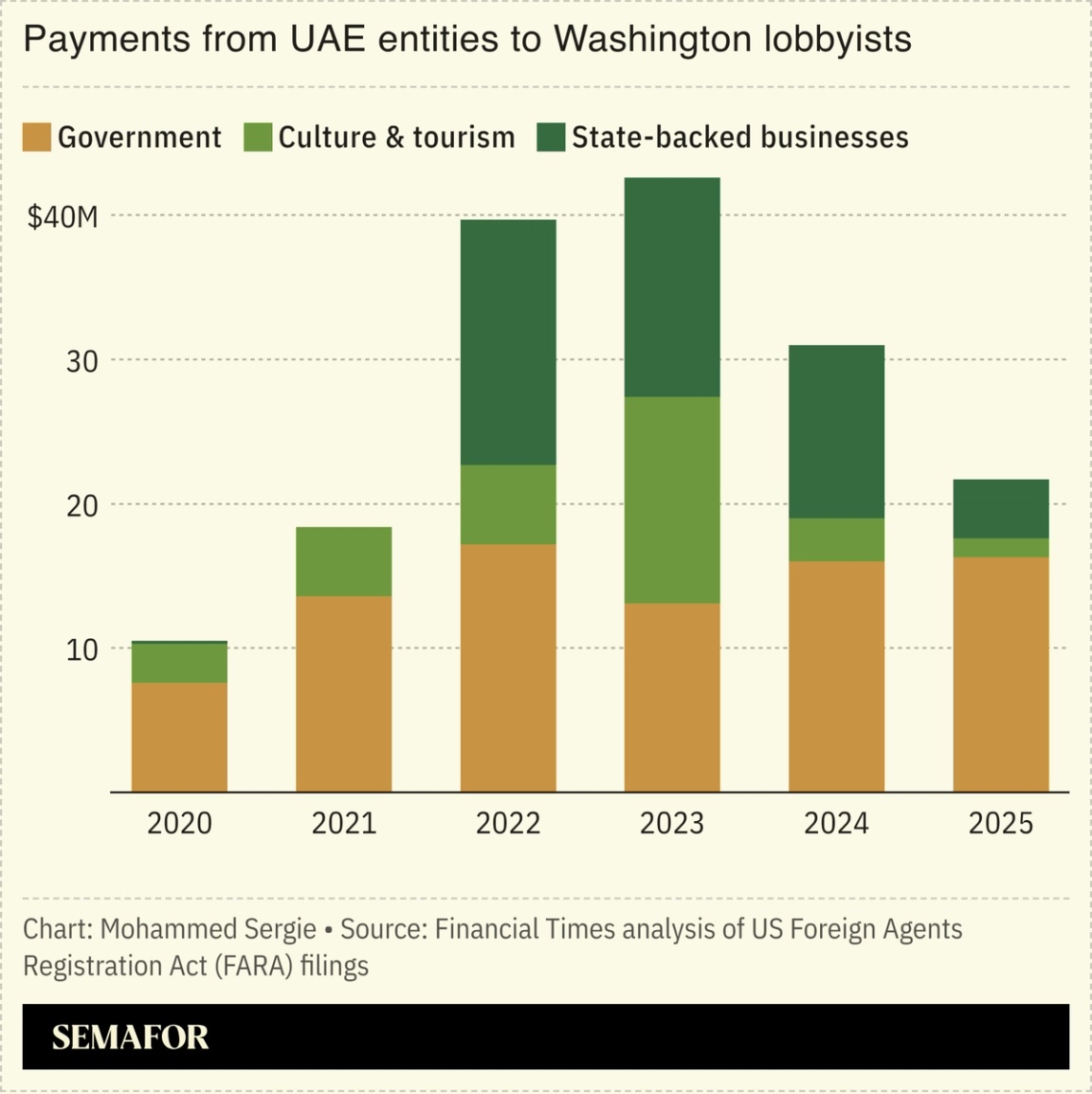 Two decades ago, it wasn’t unusual for US politicians to know little about the UAE — more than a few have referred to “Abu Dubai” when criticizing or praising its policies. Today, the country’s image in Washington has been transformed, mirroring its emergence as a regional power in finance, trade, defense, and now AI. Money helped: The UAE has spent more than $270 million on lobbying in Washington over the past decade, compared with $422 million by Saudi Arabia and $269 million by Qatar, according to the Financial Times. But the paper credits much of the shift to Yousef Al Otaiba, the UAE’s ambassador to the US since 2008, who cultivated politicians, policymakers, universities, and the media while encouraging influential Americans to visit the Emirates. His efforts are the “ultimate case study in how to run a government public relations campaign in DC,” the FT reported. |
|
 Defense- Ukraine’s President Volodymyr Zelenskyy said he discussed a drone deal and food security with Saudi Crown Prince Mohammed bin Salman on Monday. Kyiv signed a military cooperation agreement with Riyadh in March. — Reuters
IndustryMedia- Saudi broadcaster MBC Group, majority-owned by the government’s Public Investment Fund, reported a 28% year-on-year drop in second-quarter revenue, citing “softer advertising demand amid ongoing regional geopolitical uncertainty.” Its profitable streaming platform Shahid was a bright spot, with revenues up 18.5%.
Real estate- Dubai’s $1 billion Trump International Hotel and Tower is moving into the construction phase, with developer Dar Global awarding the contract to build the podium of the 80-floor Sheikh Zayed Road skyscraper. The developer says 80% of the units have already sold. — The National
- Sports Boulevard Real Estate Development and Investment Company announced a 700 million riyal ($187 million) fund with developer Rikaz Properties and investment firm Al Jazira Capital. It will be used to develop a five-star hotel and other assets in Sports Boulevard’s Urban Wadi project in Riyadh.
|
|
 MOCHeritage/X MOCHeritage/XA boulder carved with animal and human figures and inscriptions — one of more than 100 previously undocumented sites found during a Heritage Commission survey of Saudi Arabia’s High Najd central plateau. The finds have yet to be dated, but in Saudi Arabia, the answer can run to 7,000 years. |
|
| |