| | President Trump may be losing his ability to tamp down oil prices with rosy-sounding peace predictio͏ ͏ ͏ ͏ ͏ ͏ |
| |  Abu Dhabi Abu Dhabi |  Beijing Beijing | Baton Rouge |
 | Energy |  |
| |
|
 - ‘Low-keying it’
- ADNOC profits
- New front in solar wars
- ‘Gross’ overpayment
- Data center kerfuffles
 The US scraps two shadow fleet tankers, and China carves a new shipping route through the Arctic. |
|
 Many factors have helped offset the dropoff in crude tankers exiting the Persian Gulf since the Iran war began in February. Gulf exporters ramped up alternative routes, China slashed imports, the US and Europe drew on strategic reserves, and higher prices cut into demand. But it’s becoming clear that another vital, if relatively modest, boost came from increased production in a handful of Western-hemisphere countries outside the top tier of global petrostates. Brazil, Guyana, Venezuela, and Argentina all posted production gains in the first half of this year that outpaced analysts’ prewar forecasts, underscoring how the ongoing blockage of the Strait of Hormuz is proving a moment to shine for smaller oil-producing countries that are capitalizing on being far away from active warzones. The price bumps of the past few months have “triggered a surge in production that far exceeded the levels embedded in our models,” JP Morgan’s head of global commodities research, Natasha Kaneva, wrote on Friday. In total, production growth this year in non-OPEC countries — about 2.5 million barrels per day — was the highest in at least a decade, she said. To be clear, the US remains the leader on that list: This week, the country’s oil rig count is the highest since May 2025. But the others are gaining strategic significance in a post-Hormuz world. 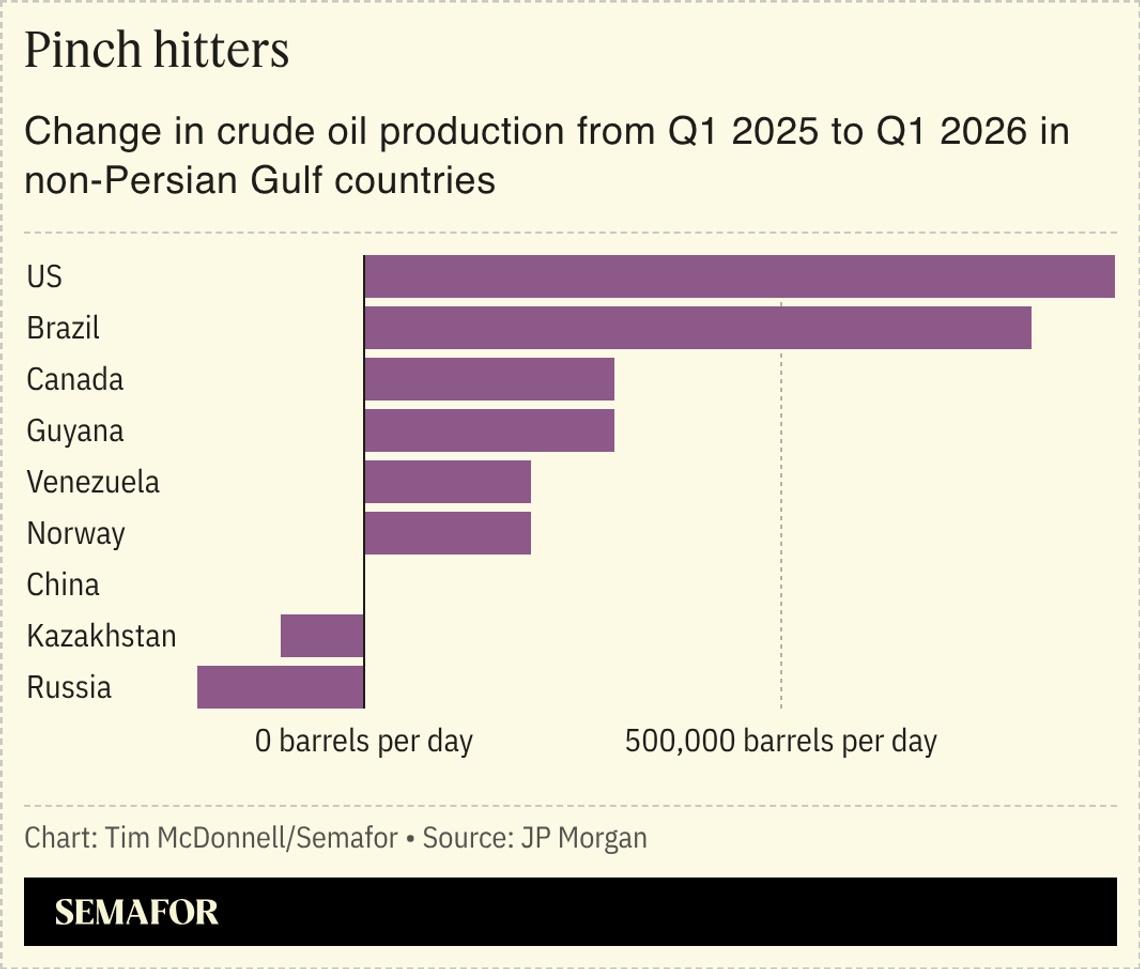 Take Guyana, where US Deputy Secretary of State Christopher Landau will today meet with President Irfaan Ali for talks about “enhancing collaboration in strategic sectors, including energy and critical minerals,” a spokesperson said. Production there is expected to surge this year thanks to a new offshore drilling rig from ExxonMobil, which has essentially become the country’s anchor tenant. Other US oil companies are also knocking on the door, said Samantha Carl-Yoder, a former State Department energy official and co-chair of critical minerals at the consulting firm Brownstein. President Ali has a warm relationship with Trump, and the country is a useful ally for US interests across Latin America and the Caribbean, said Carl-Yoder, who visited Guyana last week. Guyana’s crude has also proven useful to refineries in Europe, its leading importer, in replacing Russian barrels. Historically one of Latin America’s poorest countries, Guyana will need more support to build out its grid and port infrastructure if it’s going to capture its massive oil potential. It’ll also need a stronger plan for how to manage oil revenue effectively and transparently. Neighboring Venezuela has already found that, even with a deluge of interest from drillers since former leader Nicolás Maduro was arrested, tangible deals have been held up by earthquakes, an overwhelmed local oil bureaucracy, and Trump administration turf wars. Still, China is already benefitting from Latin America’s oil boom: It bought nearly half of Brazil’s exports in the past few months and about 8% of Guyana’s, according to data firm Vortexa. The new cohort of LatAm petrostates is emerging as an OPEC counterweight the US can’t afford to neglect, especially since its barrels don’t have to move through any dangerous straits. “It’s very important to bring this oil online,” Carl-Yoder said, “and provide a foil to the Middle East.” |
|
Can ‘low-keying it’ fix the oil market? |
|
Shippers rewarded for Hormuz risk |
| |  | Mohammed Sergie |
| |
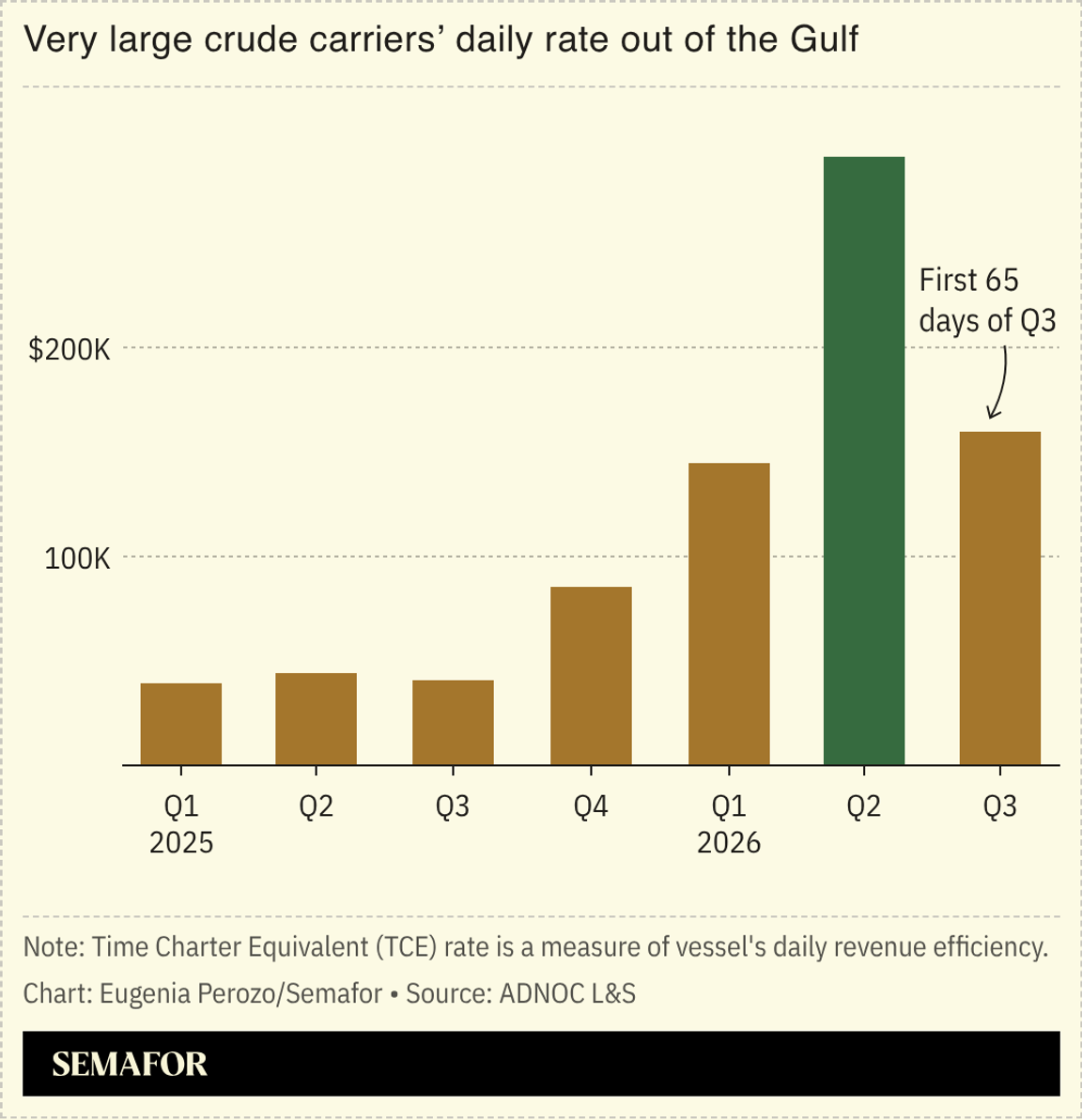 Only a fraction of the ships that used to cross the Strait of Hormuz are making it through, creating substantial payoffs for companies willing and able to take the risk. Last month, Saudi shipper Bahri reported a sixfold rise in quarterly profit; today, ADNOC Logistics & Services said its earnings nearly quadrupled to a record $917 million, driven by higher charter rates and an expanded fleet. ADNOC L&S is boosting capacity, committing $2.3 billion this year to buy oil and gas tankers. It also raised its profit-growth forecast for the year for the third time to more than 110%, from around 60%. ADNOC Gas, meanwhile, hasn’t been able to export much liquefied natural gas or other products since late February, but the company has kept its investment plans intact thanks to domestic demand. The listed unit of Abu Dhabi’s state-owned energy company reported a 52% decline in second-quarter profit to $665 million. While the company has remained profitable during the war — and absorbed losses at facilities hit by Iranian strikes — it’s still reliant on passage through the Strait of Hormuz for much of its revenue. ADNOC Gas forecasts full-year earnings of up to $4 billion if normal flows resume through Hormuz by the fourth quarter, down from $5.2 billion last year. |
|
New front in US-China solar wars |
 Maxim Shemetov/Reuters Maxim Shemetov/ReutersThe Trump administration’s latest trade campaign against China’s dominant solar industry could do little more than raise consumers’ costs, industry insiders warn. On Friday, Washington imposed a 15% tariff and price floors on all imported polysilicon, a crucial material in solar panels. The measure is intended to get ahead of Chinese manufacturers, who have dodged previous US trade barriers by shifting production between a litany of third countries. In the near term, the move may not be noticeable to consumers, as solar installers run down healthy inventory levels. But prices will inevitably rise by 2028, according to a BloombergNEF forecast, and some projects will inevitably be canceled, because the US solar manufacturing base, especially for highly specialized components like solar wafers, is far smaller than demand. Although US manufacturers saw their share prices jump on the news, “this may not drive a ton of domestic manufacturing,” Aaron Hall, president of the solar software provider Anza, told Semafor, because some China-linked exports could remain cost-competitive even with the tariffs. Instead, he said, the tariffs are likely to become a negotiating chip the administration can trade to induce preferred investors to back new manufacturing projects. |
|
US ‘overpaid’ for wind leases |
 A German power company agreed with the Trump administration to cancel offshore wind development leases, the fifth such cancellation, bringing total reimbursements owed by US taxpayers to nearly $4 billion. RWE, like other companies that negotiated such deals, agreed to reinvest in a series of US fossil fuel projects instead. While climate advocates have lamented the loss of clean power, and Congressional Democrats have promised to investigate, the strangest thing about the deals is that the government appears to have “grossly” overpaid, a University of California researcher argued: The projects in question were not under construction and had a shaky future on economic grounds, so the leases would likely attract lower bids if auctioned today. |
|
Amazon’s rising data emissions |
 Brian Snyder/Reuters Brian Snyder/ReutersThe environmental and political costs of the data center energy boom are coming into focus. Last month, Semafor reported that Amazon’s sustainability chief foresees a multi-year uptick in the company’s carbon footprint. Now, one key driver is evident: A gas-fired power plant Amazon is building to run a data center in Texas could be the largest single source of power-related emissions in the US, the New York Times reported. Separately, research by former Microsoft engineers concluded that the use of AI by fossil fuel companies to streamline drilling will create an emissions spike that offsets reductions from AI use by clean energy companies. Policymakers across the political spectrum are increasingly at odds about what to do: While the Republican governor of Texas imposed a moratorium on new data center permits, the Democratic governor of Virginia said she would personally intervene in a massive power company merger that she warned could raise household bills. And in Congress, Democrats are divided about whether to seek a moratorium on the buildout, or merely cut tax credits that enable it. |
|
 New Energy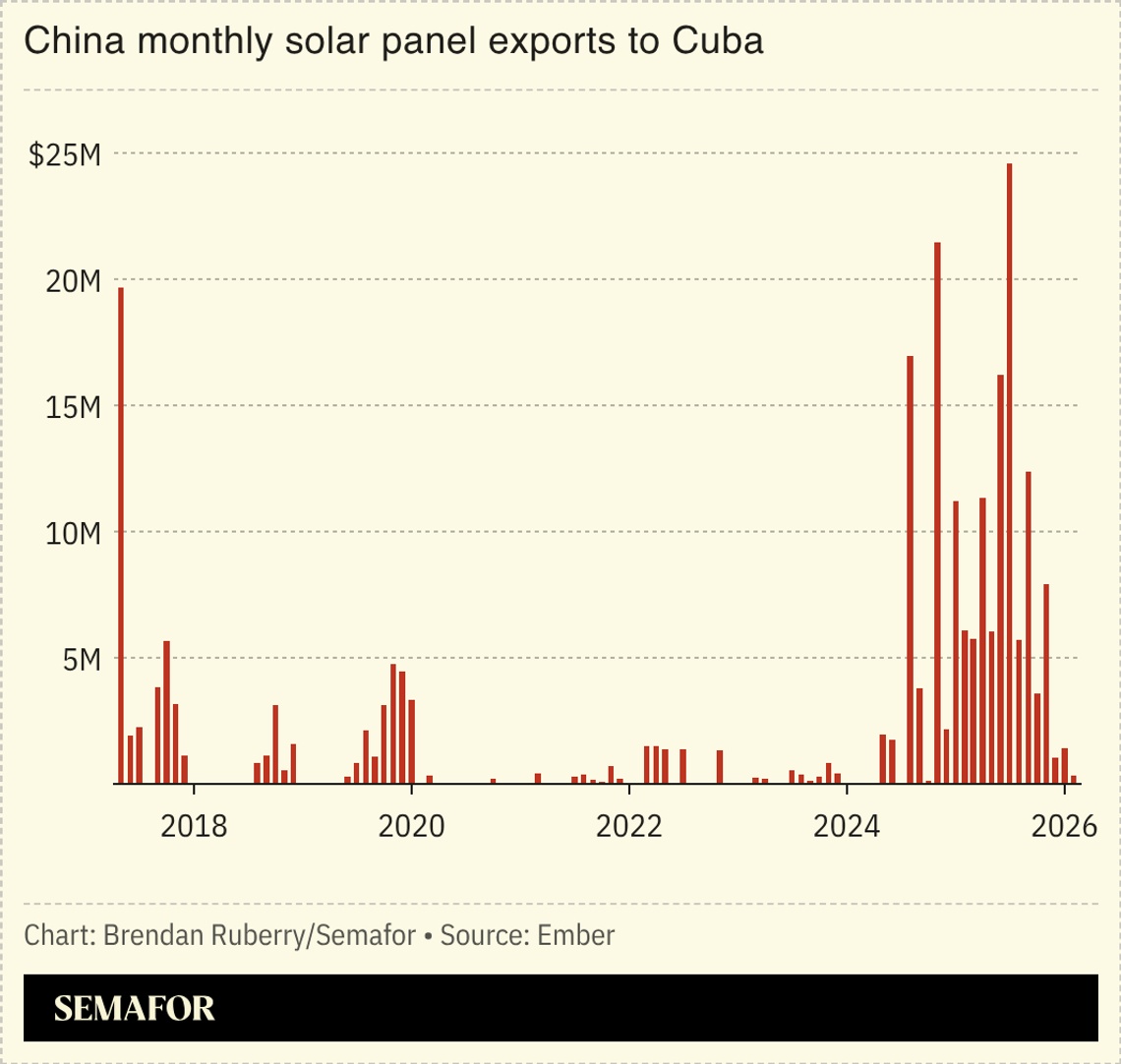 - Faced with an energy crisis and island-wide power cuts, the Cuban government has turned to Chinese-provided solar panels, with at least 41 midsize and 18 smaller-scale solar parks popping across the country in the last two years, the Wall Street Journal reported.
Fossil Fuels- The US sold for scrap two sanctioned vessels that were seized immediately after Washington’s raid on Venezuela.
- Power outages have plagued Indonesia, one of the world’s biggest coal producers, since the country cut mining quotas in a bid to boost prices for producers. That, combined with rising costs linked to the war in Iran, have slowed output.
- Russia launched a massive attack on the facilities of Ukraine’s state energy company across several regions over several days, halting operations at sites run by Ukrnafta, the country’s largest oil producer.
- Germany can still reach its 70% gas reserves target, Uniper CEO Michael Lewis said, but added that “we do have to see the market prices move to incentivize the filling of the storage.”
Tech- The world’s largest carbon removal plant in west Texas is due to open at the end of 2026, the facility’s operator said, after years of delays.
Politics & Policy- The Arctic is emerging as a promising shipping route for Chinese vessels seeking to avoid chokepoints, particularly as melting ice caps have shortened the journey between Europe and Asia.
- A US judge ordered the Pentagon to lift its freeze on reviewing new onshore wind project proposals, imposed on national security and military operations grounds.
- Green groups seem likely to continue backing New York Governor Kathy Hochul in her state’s primary election, even though she bulldozed the strongest climate law in the country this year, Politico reported.
Minerals & Mining- A flurry of US federal investments in minerals and mining supply chains could help the country’s EV sector, Axios reported.
Personnel- The Trump administration has piled pressure on Florida oil magnate and billionaire Republican Party donor Harry Sargeant III, who long acted as a back channel between the US and Caracas, to divest from Venezuela.
|
|
|


