| | In today’s edition: Tehran’s infighting slows deal, PIF pushes food exports, and Washington’s alumin͏ ͏ ͏ ͏ ͏ ͏ |
| |  Riyadh Riyadh | Muscat |  Washington, DC Washington, DC |
 | Gulf |  |
| |
|
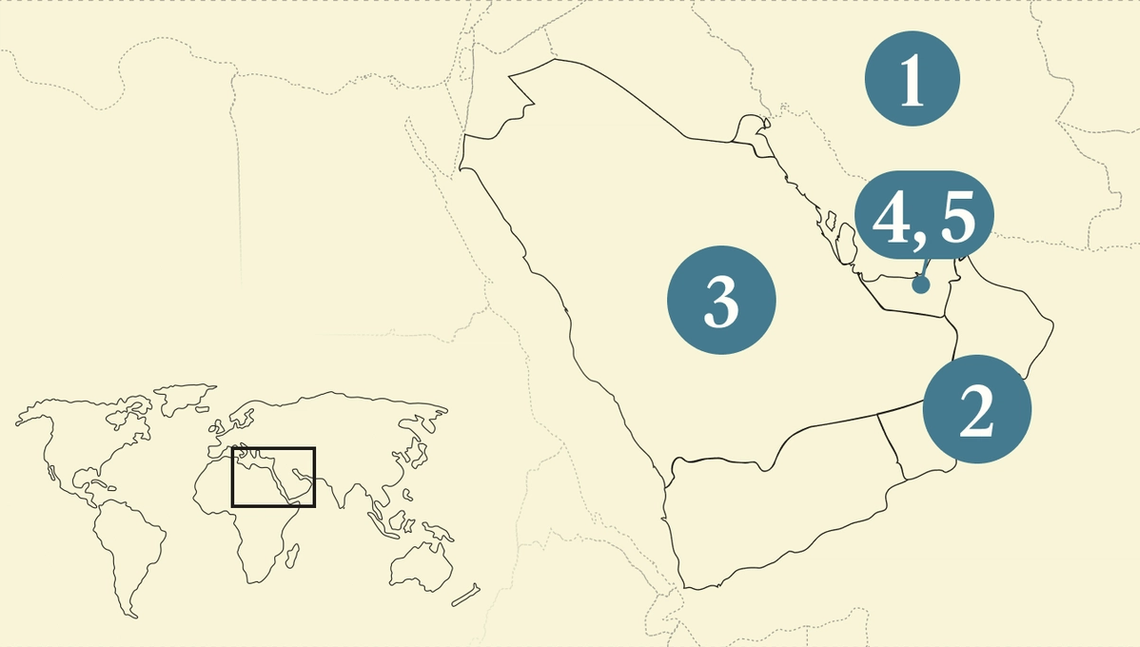 - Iran says Hormuz deal near
- The lanes through Hormuz
- PIF pushes food exports
- UAE aluminum bets
- Dubai toll operator slump
 Saudi startup inspired by Solomon’s wise bird. |
|
Deal near despite Iran leadership splits |
 Mohamed Azakir/Reuters Mohamed Azakir/ReutersIran said it was in the “final stages” of reaching an agreement with Oman on a commercial route through the Strait of Hormuz. Iranian officials have blamed US “interference” for delaying the process, but dysfunction at the top of the Iranian regime is also likely slowing talks. Iran’s president said interaction with Supreme Leader Mojtaba Khamenei was “very difficult.” Khamenei was wounded early in the war and hasn’t been seen in public since. The regime is split among three groups competing for control: those who favor a deal at any cost, those who support talks but want complete control of Hormuz, and hardliners who oppose all dialogue with the US. In a Fox News interview, US Vice President JD Vance said that talks with Iran would “be messy,” calling the regime a “fractured system.” That said, Iran views the Trump administration as similarly divided. Meanwhile, Iran’s Yemeni allies, the Houthis, attacked Saudi tankers in the Red Sea and the Gulf of Aden. |
|
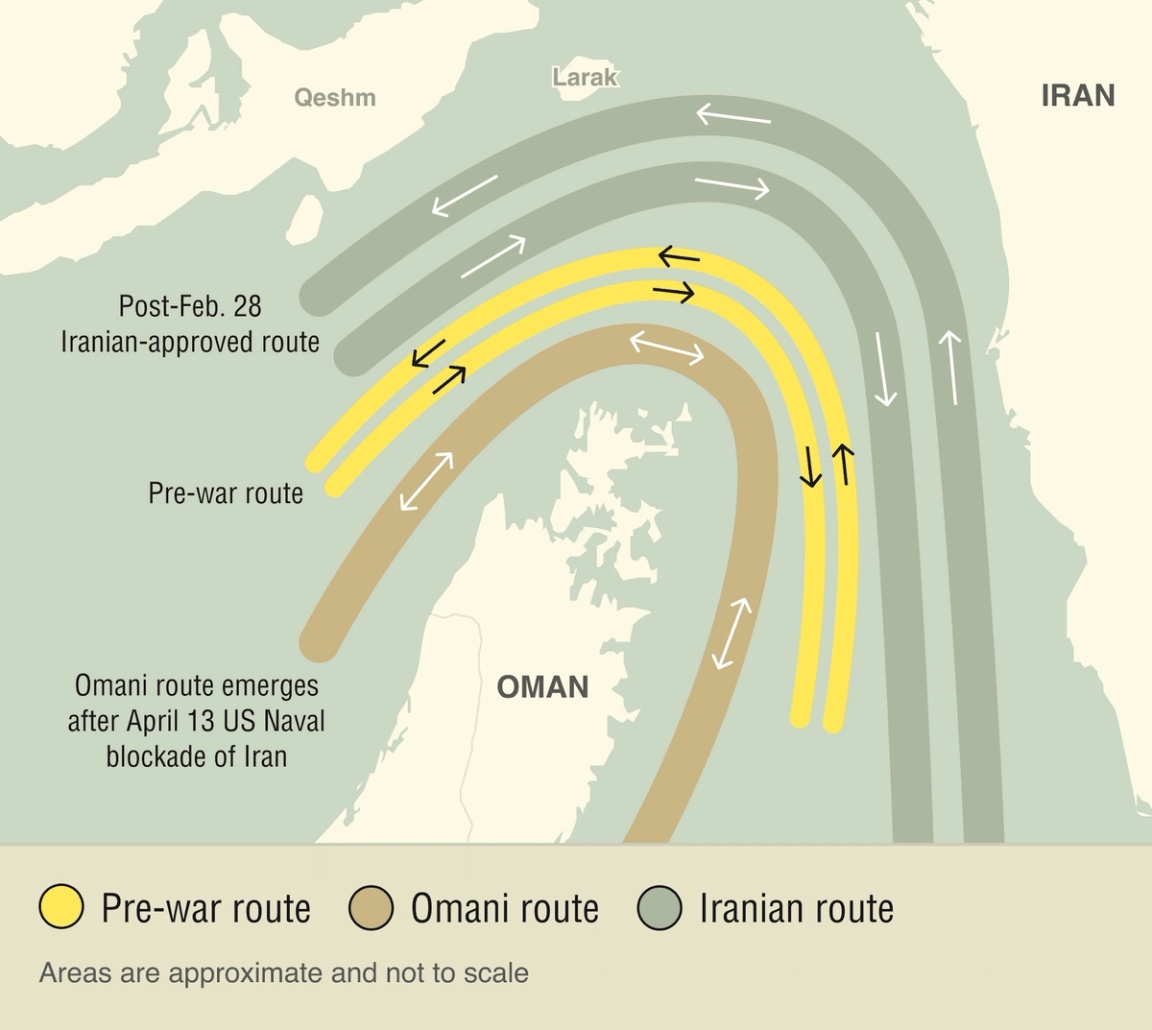 Joey Pfeifer Joey PfeiferBefore the mines, the drone strikes, and the tolls, the Strait of Hormuz functioned like a freeway, with two-mile-wide lanes for ships passing in either direction. A fifth of the world’s oil and LNG transited daily, alongside crucial foodstuffs, petrochemicals, and other goods, mostly through the deep territorial waters of Oman. The traffic scheme was jointly proposed by Iran and Oman and adopted by the UN’s maritime body in 1968. Today that route is empty: Ships are steering clear because of Iranian mines, and a trickle of traffic is instead routing through temporary corridors hugging the Iranian and Omani coasts. Yet a new route is likely to emerge out of the expected agreement between Tehran and Muscat this week. Those who predict the strait’s waning influence due to pipelines that bypass the maritime corridor, and the relocation of refineries and port operations are overestimating the ease of rerouting trade and underestimating the ability of Iran to retain strategic leverage, according to The Economist, which predicted Tehran’s hold on Hormuz will outlast the war with the US. — Kelsey Warner |
|
PIF units unite to push food exports |
 Courtesy of Milaf Global Courtesy of Milaf GlobalThe Saudi government’s Public Investment Fund is making a fresh push to sell its food and drinks brands overseas by bringing several homegrown brands together to share distribution, marketing, and export infrastructure. PIF’s Milaf Global arm is overseeing the initiative, which involves brands such as Noug camel milk and ice cream, Saudi Coffee Company’s Jazean coffee, and Milaf dates and date-sweetened cola, reported EnterpriseAM. The export drive is a sign of how PIF is trying to improve the commercial performance of its sprawling portfolio at a time when it is under pressure to cut costs and scale back its ambitions for megaprojects such as NEOM. Jazean also features in Milaf Global’s summer takeover of a corner of London department store Selfridges. Another PIF company, Riyadh Air, serves Milaf Cola and Jazean coffee on board its planes. |
|
War validates UAE metals move to US |
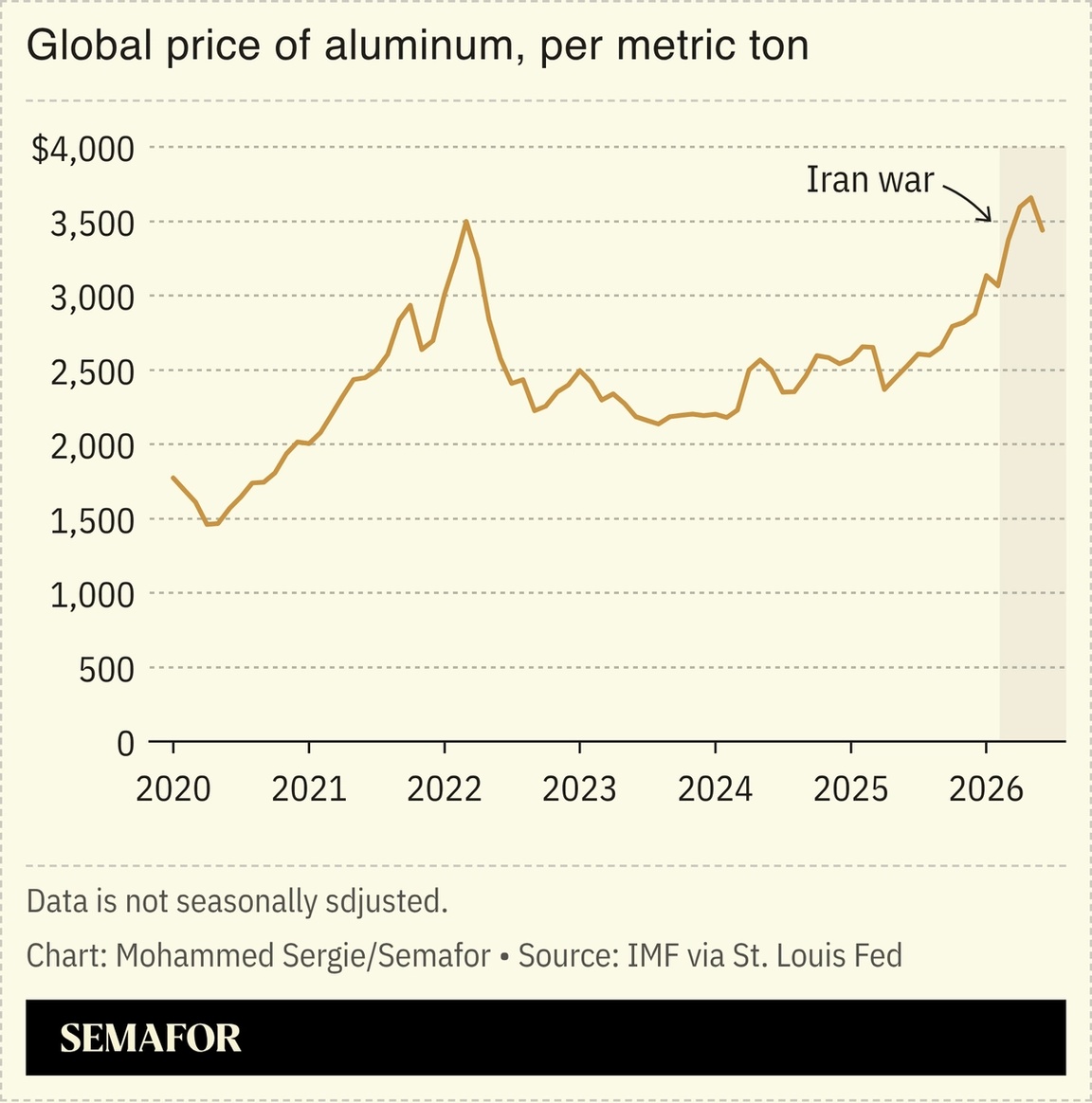 A war gaming exercise held by US officials last year examined how the country’s aluminum supply chain would fare in the event of a large global conflict. High-purity aluminum, the kind used to make fighter jets and other defense equipment, “emerged as a critical vulnerability,” according to Bloomberg, noting that almost 90% of that metal comes from the UAE. Aluminum plants in Bahrain and the UAE have been hit in Iranian strikes this year, causing prices to surge. Emirates Global Aluminum has restarted its plant but is not expected to return to full capacity until the end of the year. EGA is building capacity in the US and is the majority owner of a $4 billion Oklahoma aluminum smelter project, which is due to start production by the end of the decade. The facility, which would be the first of its kind built in the US since 1980, could help ease Washington’s concerns about access to the metal, and gives EGA a break from tariffs on its exports to the US. — Kelsey Warner |
|
Dubai traffic picks up after wartime dip |
 Salik_ae/X Salik_ae/XThe lighter traffic on Dubai’s roads during the Iran war has now been quantified. Salik, the city’s monopoly toll operator, said second-quarter toll revenue fell 16.5% in the first full quarter since the conflict began on Feb. 28. The company attributed the decline to the euphemistically phrased “exceptional regional events.” Fines remained a growth business, despite fewer drivers, and now comprise 11% of the company’s revenue. Salik, which offers an important indicator of economic activity in Dubai, said traffic gradually recovered in April and May, returning to almost normal in June. That aligns with recent population data showing Dubai has climbed back above its pre-war level. |
|
 Commodities- The UAE was the only Gulf oil producer to exceed prewar levels of seaborne exports in June and July, according to industry tracker Vortexa. Tankers leaving the Gulf have been switching off their transponders to avoid detection by Iran, helping to keep crude prices from surging. — Bloomberg
Deals- Mubadala led a $250 million Series C funding round in Moove, valuing the Dubai-based fleet financing company at $2.1 billion, close to triple its 2024 mark. The money will be spent on autonomous vehicle ownership and robotics-run depots as Moove extends its Waymo partnership from Phoenix and Miami into London.
- Qatar Development Bank has joined a €500 million ($577 million) financing round for Spain’s Multiverse Computing, whose technology reduces the size, cost, and energy needs of large AI models. As part of the arrangement, Multiverse will set up a regional headquarters in Qatar.
Earnings- International Holding Co., the conglomerate controlled by Abu Dhabi deputy ruler Sheikh Tahnoon bin Zayed, almost tripled its second-quarter profit to 18 billion dirhams ($4.9 billion) from a year earlier, driven by its energy, mining, and hospitality businesses. The firm increased its stakes in Anthropic, Cerebras, OpenAI, and SpaceX this year, and committed to an $11.5 billion aluminum project with India’s Adani Group.
|
|
 Courtesy of Hudhud Courtesy of HudhudDriving in Saudi Arabia takes local knowledge: Cities run on wide, fast highways where exits stack close together and left turns are made by U-turn. A driver caught in the wrong lane can lose half an hour to Riyadh traffic. Standard maps are of little help when the capital redraws itself weekly, with closures and new interchanges outpacing the Big Tech cartographers. Hudhud, a Saudi navigation app, was built as a local insider’s guide to help drivers through otherwise poorly mapped cities. Its camera cars photograph streets every few meters, reaching roads and towns that others haven’t. The app’s guidance runs lane by lane, with countdowns to roadworks, speed bumps, and cameras. Launched in Riyadh, it now covers the kingdom and has, among other things, steered pilgrims through Mecca’s historical sites. Aptly, the service is named after the hoopoe bird that features in the Quran, scouting for Solomon and returning with news of a land he did not know. — Manal Albarakti |
|
| |