| | In today’s edition: The war spills into the Mediterranean, Riyadh presses for F-35s, and a gold rush͏ ͏ ͏ ͏ ͏ ͏ |
| |  | Gulf |  |
| |
|
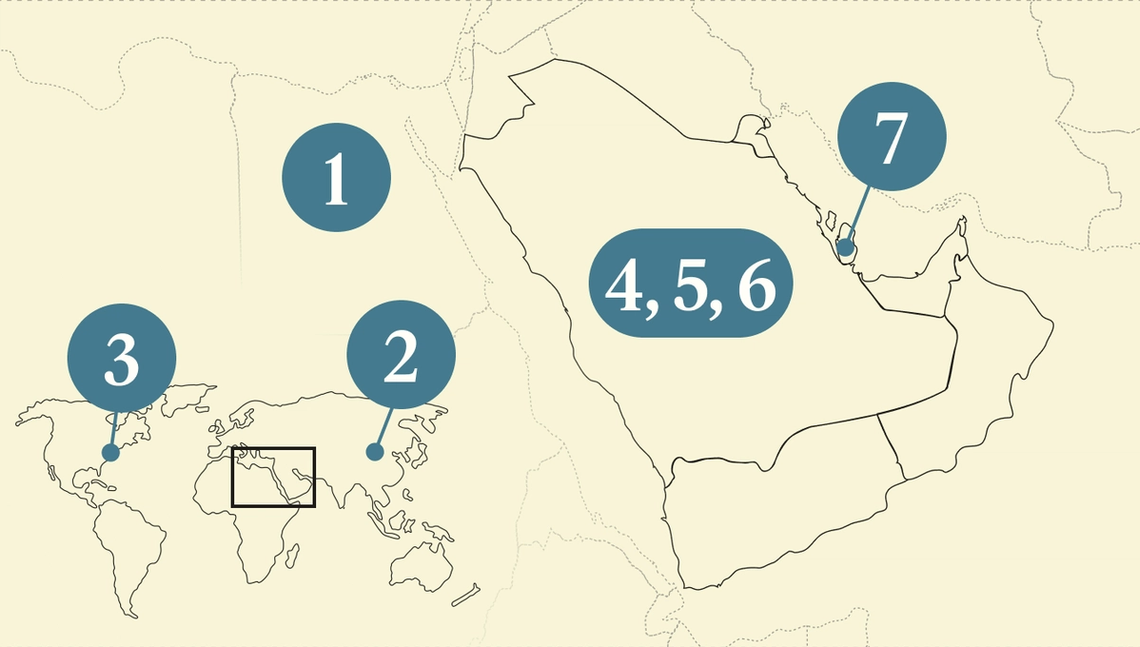 - Drones strike ships in Egypt
- Russia, China support for Iran
- Riyadh lobbies US for F-35s
- Saudi GDP contracts 4.8%
- The Gulf oil ‘gold rush’
- Saudi tempers soccer dreams
- Qatari for FIFA presidency?
 Saddam’s historic folly still reverberates in the region. |
|
War spreads to the Mediterranean |
 Oleksandr Lisyanskyy/Handout via Reuters Oleksandr Lisyanskyy/Handout via ReutersThe war is spilling into new waters. A drone attack led to two ships — a US-owned gas storage tanker and a Greek-operated LNG carrier — catching fire at Egypt’s Mediterranean port of Damietta on Wednesday; two Iranians told The New York Times the strike was designed to show how much further global shipping and energy supplies could be disrupted. Riyadh, meanwhile, is trying to assemble an international coalition to protect Red Sea shipping, with dozens of countries said to be involved in discussions. The Houthis — who declared a maritime blockade on Saudi Arabia on July 20 and began attacking Saudi vessels — are reportedly weighing transit fees on most Bab el-Mandeb traffic, a plan Iranian advisers travelled to Yemen to help shape and from which Chinese ships would be exempt. Traffic through Bab el-Mandeb is down a fifth in the past 10 days, while traffic via Hormuz remains below a tenth of prewar levels. If Washington escalates further, CENTCOM chief Adm. Brad Cooper has a response ready: 10 to 14 days of intensive strikes, an idea backed by Secretary of War Pete Hegseth but complicated by dwindling US interceptor stocks. — Ed Clowes |
|
China and Russia’s covert support for Iran |
 Sputnik/Oleg Molchanov/Pool via Reuters Sputnik/Oleg Molchanov/Pool via ReutersChina and Russia are not direct participants in the Iran war, but behind the scenes they are both exerting their influence through acts of commission and omission. The pair are putting their long-standing economic and military ties with Tehran to use, in part to make life difficult for their global rival, the US. According to Reuters, Washington suspects that Moscow has provided targeting information to Iran, enabling it to hit US military assets and perhaps even CIA facilities in the Gulf. Russia may also have enhanced the effectiveness of Iranian drones by supplying a more advanced satellite navigation system. China, which signed a 25-year cooperation deal with Iran in 2021, is also reportedly providing satellite imagery and shoulder-fired air-defense systems, though Beijing has generally kept further back from the conflict and the diplomatic efforts to end it. — Dominic Dudley |
|
Semafor Exclusive Saudi defense minister lobbies for F-35s |
 Kevin Lamarque/Reuters Kevin Lamarque/ReutersSaudi Arabia is ramping up its lobbying for a deal to buy F-35 fighter jets — including through a personal push by Defense Minister Prince Khalid bin Salman, who met with senior Trump administration officials in Washington this week. The kingdom sees a window of opportunity closing: With the midterms approaching, Saudi officials want to build on momentum from last week’s nuclear agreement with the US to get an F-35 deal done, according to people familiar with the defense minister’s plans. F-35 sales and wider security cooperation were on the agenda for Prince Khalid’s Washington visit, the people added. One of the people familiar with the defense minister’s plans said he also met with Vice President JD Vance. Axios reported the prince met US President Donald Trump on Wednesday, telling him that Saudi Arabia “favors de-escalation with Iran.” — Lauren Morganbesser and Matthew Martin |
|
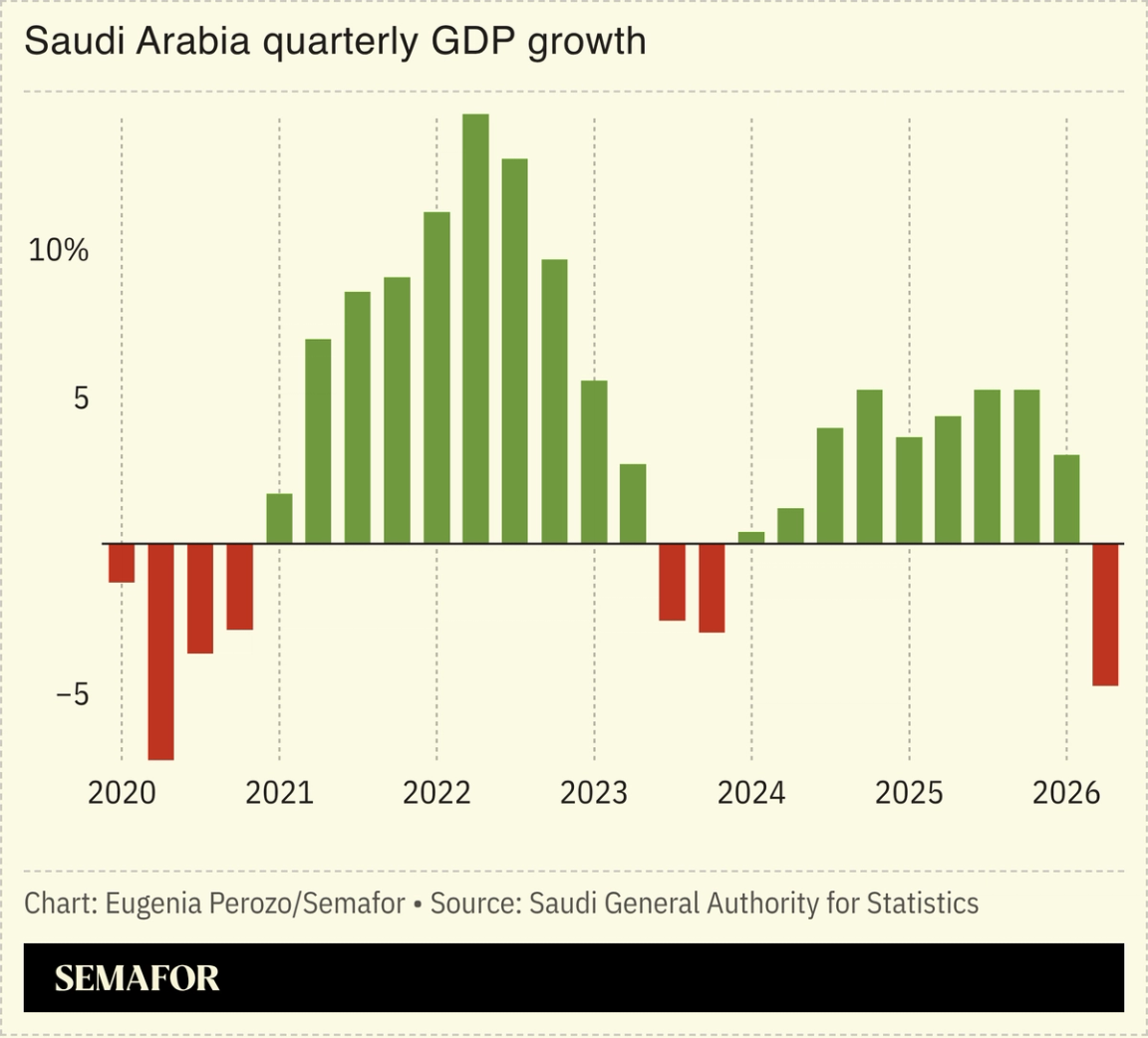 Saudi Arabia’s GDP shrank 4.8% in the second quarter as oil output was hit by the closure of the Strait of Hormuz, marking the sharpest economic contraction since the pandemic. The non-oil economy, the main engine of job creation and economic diversification, expanded on an annual basis, although its growth slowed to 0.6%, according to flash estimates published Thursday. The IMF said in a statement Wednesday that the Saudi economy had “proven resilient in the face of the war in the Middle East, supported by strong fundamentals, diversified oil and logistics infrastructure,” but warned “the outlook remains highly uncertain, with risks to the downside.” Still, Riyadh should get a windfall from higher oil prices offsetting lower export volumes, the IMF said. — Matthew Martin |
|
US-Saudi group plans new Gulf refinery |
 A gold rush is shaping up as investors seek new ways around the Strait of Hormuz. A group of US and Saudi investors is closing in on a site for a $5 billion oil refining complex: It will be somewhere in the Gulf, but outside the strait, the project’s backers told Semafor’s Tim McDonnell. The facility would process up to 200,000 barrels of crude a day into fuels, plastics, fertilizers, and other products. The project — backed by Saudi Arabia’s AHQ Group, the Patel Family Office, and Texas-based MWG Enterprises — is part of a larger tide of capital flowing into Gulf energy infrastructure. Chevron is expanding in Iraq, the UAE is building new pipelines and ports, and Blackstone and KKR this week signed a $16 billion lease on Kuwait’s national pipeline network. |
|
Semafor Exclusive Saudi rethinks runaway soccer spending |
 Stringer/Reuters Stringer/ReutersSaudi Arabia’s push to become a global soccer power is entering a leaner phase. Saudi clubs have paid roughly $2 billion in transfer fees since summer 2023, comparable to large European leagues, despite generating a fraction of the revenue. But reigning champions Al-Nassr have yet to make a single signing during the current transfer window — and will only be allowed to if they can fund a deal from their own commercial revenue. The club’s owner, the Public Investment Fund, is moving to address a financial crisis after years of high spending on stars like Cristiano Ronaldo, and is reportedly considering a partial sale, bringing in outside consultants, or stripping Al-Nassr’s management of financial authority. Meanwhile, the club has signed a sponsorship deal with HUMAIN, the PIF-owned AI company, bringing in some much-needed capital. — Adrian Elimian |
|
FIFA turmoil boosts Qatar’s Al-Khelaifi |
 Phil Noble/Reuters Phil Noble/ReutersFIFA President Gianni Infantino’s efforts to bring in Josh Kushner’s Thrive Capital and other investors to the World Cup has triggered a revolt among global soccer officials. According to Politico, the proposal has also raised the prospect of a challenger for FIFA’s top job Qatar’s Nasser Al-Khelaifi, the president of Paris Saint-Germain, chairman of beIN Media, and one of the most influential figures in European club soccer, has been floated as one possible candidate. Infantino’s term ends in March; a representative for Al-Khelaifi told Politico: “Nasser has absolutely no ambition, no intention, no interest in the FIFA role.” UEFA, European soccer’s governing body, called an emergency meeting of its 55 member federations on Thursday to discuss Infantino’s proposal, with some officials considering a boycott of the next World Cup. |
|
 Culture- Guggenheim Abu Dhabi, the Frank Gehry-designed museum set to be the largest in the network, will open on Saadiyat Island on December 11. The opening lands a day after Abu Dhabi Finance Week wraps. — The National
Real estate- Saudi Arabia’s Diriyah giga-project is getting a Waldorf Astoria, with Egypt’s Hassan Allam winning a 2.7 billion riyal ($720 million) contract to build the hotel, 47 branded residences, and a mixed-use block. — Arab News
- Saudi Arabia’s Public Investment Fund backed developer Red Sea Global has picked a shuttered island resort off Sardinia for its first project outside the kingdom, holding 90% of the venture alongside Italy’s Benetton family. — AGBI
- Dubai’s residential sales fell by nearly a third in the second quarter as the Iran war cooled a five-year property boom, but the ultra-rich are still buying. Two deals closed this month: a $76-million villa on Jumeirah Bay Island and a $152-million plot on the yet-to-be-reclaimed Naia Island. — AGBI
Regulation |
|
|


