| | In this edition, a new study reveals censorship in Chinese AI models can be undone, and the US looks͏ ͏ ͏ ͏ ͏ ͏ |
| |  | Technology |  |
| |
|
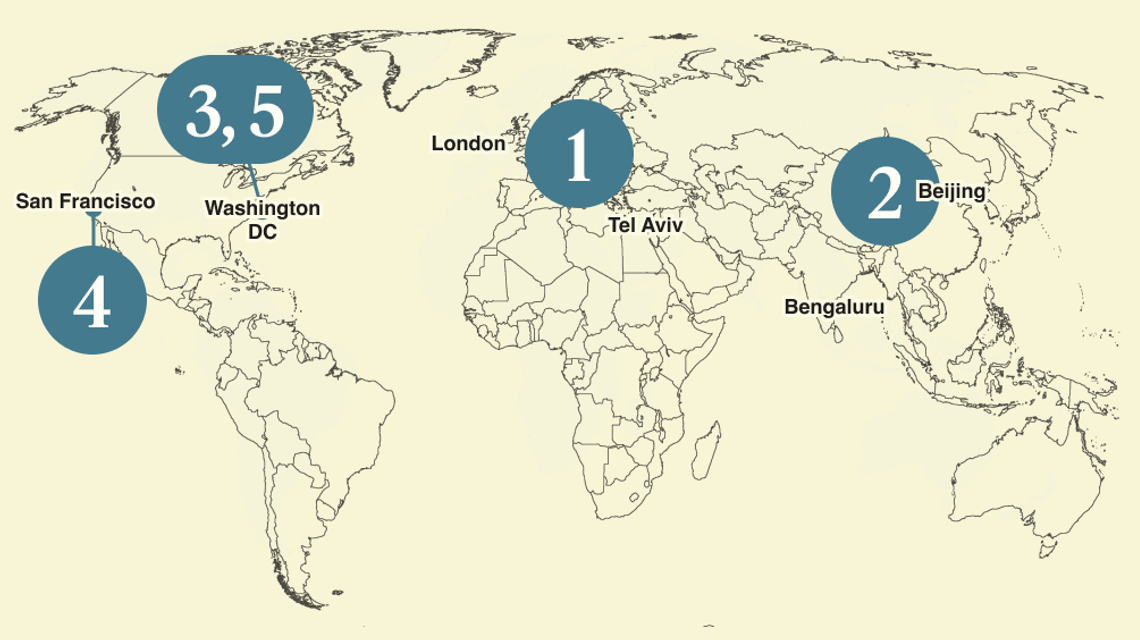 - China’s AI diplomacy
- A humanoid ban
- Get ready for G6
- Nvidia’s new bet
- AI leaders want to slow down
 The real danger with Chinese AI censorship is fear itself, and why a legal scholar argues AI should be regulated like wild animals. |
|
 There’s no question that Chinese open-source AI models are imbued with a hefty dose of censorship. But a new study that I wrote about today shows how US companies could still use those Chinese models without worrying about the influence of Beijing. The AI lab CTGT built a financial services model by distilling a DeepSeek model. Then they prompted both with politically sensitive questions. The DeepSeek model gave the Chinese government’s party line, or subtly “whitewashed” answers, to be more favorable to Chinese interests. The new, distilled model didn’t. A lot can be learned from this method. And a lot more research is necessary. But what it shows is that the discussion about whether to ban these Chinese models, or perhaps even ban the process of distillation itself, could be misguided. CTGT’s research is an example of how open-source AI is an enabler for new research that pushes our understanding of AI forward. Our understanding of AI is not great, and the more advanced it gets, the less we know about how it really works. If the US tried to steer the economy to favor a small handful of frontier model providers, it would be putting its eggs in one basket, and maybe not even the right one. Everything is moving so fast in AI today that policymakers feel like they have to move with the utmost haste. But that risks making decisions based on fears — like about Chinese censorship — that turn out to be easily mitigated. Instead of banning Chinese open source, the US could give companies guidance on how to use the models so that they reduce the risks to a minimum. That would help boost research and commerce, and probably be the best counterpunch to China’s open-source strategy. |
|
Semafor Exclusive China’s ‘token diplomacy’ |
 Andrey Filippov. Illustration: Joey Pfeifer/Semafor. Andrey Filippov. Illustration: Joey Pfeifer/Semafor.Days before the American AI industry erupted in a dispute over Chinese open-weight models, dozens of Chinese officials and executives fanned out across a Geneva conference center to make the case that for most of the world, free Chinese models are the future. Alibaba Cloud founder Wang Jian told Semafor that open-source Chinese AI can be a “resource” for other countries, like energy. “Having a choice for the rest of the world is very important.” The UN conference offered a glimpse at Beijing’s broader global strategy of a kind of “token diplomacy,” using AI to extend its global influence much like it did by financing and building ports, railways, and other infrastructure through the Belt and Road Initiative. But the pitch appears to be landing unevenly, in part given the lack of transparency into Chinese models. A Tanzanian IT official said “America leads the pack” on open-source tech. And many governments are building their own tech stacks independent of both superpowers. Notably absent in Geneva were the US frontier labs and Trump administration officials who’ve been pushing for tighter US control over AI. The China question hangs over Sam Altman’s visit to Washington this week, as the White House debates whether to put curbs on Chinese AI and prepares a framework for voluntary pre-release model reviews. — J.D. Capelouto |
|
Ban on Chinese robots also hits US firms |
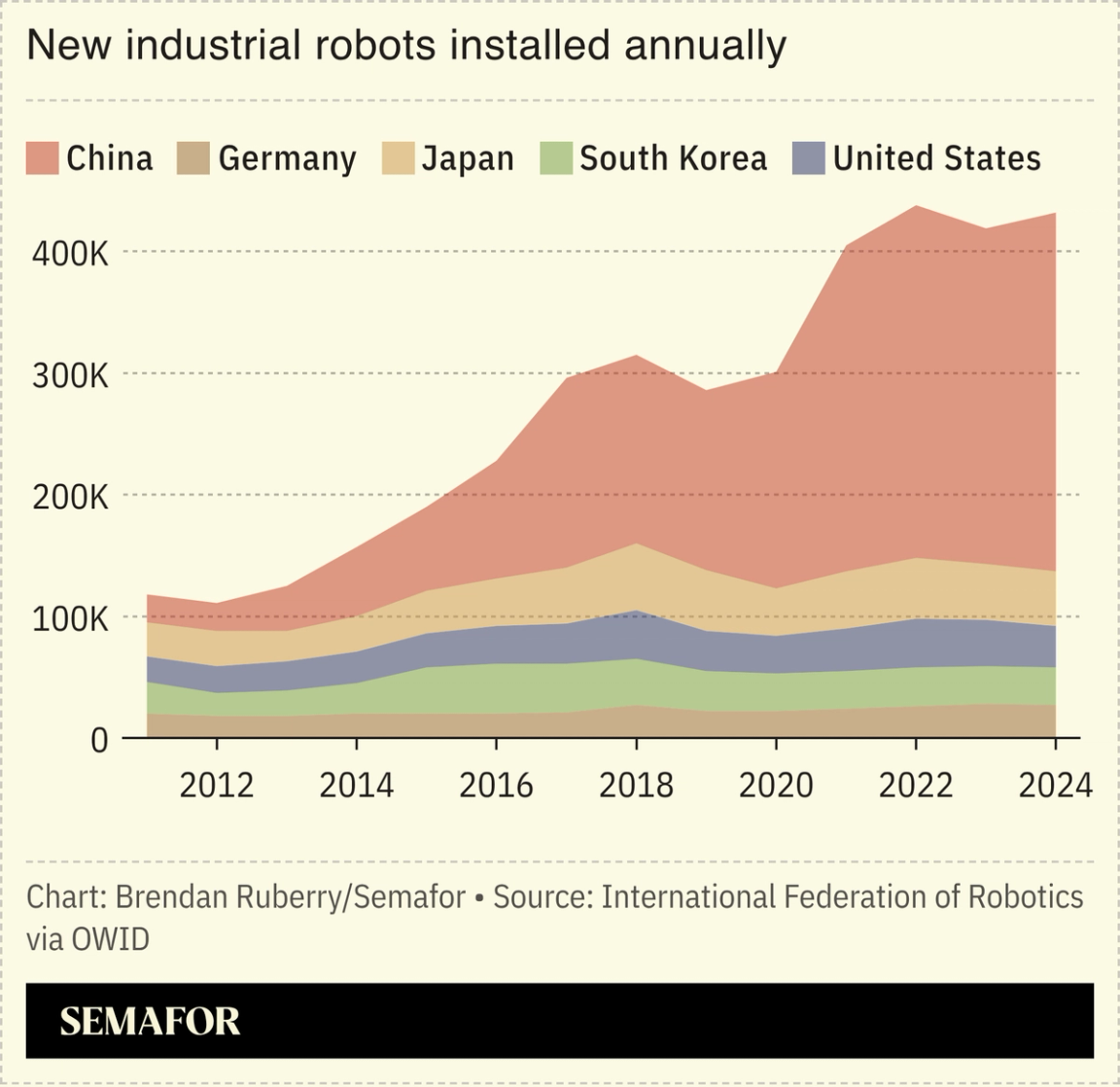 The US’ ban on new foreign humanoids opens another front in Washington’s campaign against Chinese tech — but it also adds a new layer of pressure on domestic bot makers. Some in the industry speculated the US might put tariffs on Chinese robots, but Washington routed its ban through the FCC, using equipment-approval rules to block new foreign humanoids and quadrupeds in the same way it banned foreign drones in December, citing national security. US robot makers have been lobbying Washington for months to take action to counter the spread of cheap Chinese humanoids before they enter American factories — they are, for now, almost solely used for entertainment and research purposes in the US. The ban, which allows humanoid makers to seek case-by-case approvals, could give Washington a bargaining chip in future talks with China. It also means American robot makers may have to move quickly to onshore their supply chains: Many still rely on Chinese components or do some assembly overseas, which could make them ineligible to sell in the US under the new FCC rule. It’s also likely to increase the cost of making and selling a robot domestically, given China’s lower-cost hardware. “I don’t know if something so extensive is the best option,” Andrew Kang, CEO of robot-investment company RoboStrategy, told Semafor. The limitations the new rule presents, he said, are “almost impossible to solve for in the short term.” Evan Beard, the CEO of Standard Bots, which makes industrial robot arms and designs almost all of its parts using a heavily American supply chain, said he was up late Tuesday night taking calls from prospective customers. “We need to be owning the technology. We need the robots to be made here,” he said. — J.D. Capelouto |
|
US looks to allies to prepare for 6G |
 Bruna Casas/Reuters Bruna Casas/ReutersThe US is looking to its allies to make sure China doesn’t dominate the future of telecommunications. The Trump administration on Monday unveiled a partnership with 24 countries — including Australia, Germany, Japan, and the UK — aimed at coordinating strategies around 6G, which is expected to be designed to accommodate AI and could start replacing 5G in the 2030s. The US’ National Telecommunications and Information Administration, the Commerce bureau responsible for telecoms, expects more countries to sign on, and has already had initial conversations with prominent private companies in partner nations that will drive 6G development, an NTIA official told Semafor. Some of the biggest non-Chinese firms that will benefit from 6G — such as Nokia, Ericsson, and Samsung — aren’t American. Washington is building the coalition ahead of a UN conference next year in Shanghai, where countries will discuss international standards for wireless networks. The US effort also aims to build market scale for vendors and supply chains from the democratic world ahead of the 6G buildout, the official said. No one knows yet what exactly 6G will look like, but the US is surely eager to avoid the pitfalls of the 5G era, in which it spent years pushing allies to reject Chinese firms like Huawei and ZTE, citing security concerns. The stakes are even higher in the AI era. — J.D. Capelouto |
|
Nvidia’s frothy bet on Safe Superintelligence |
 Nathan Howard/Reuters Nathan Howard/ReutersWall Street is suffering from analogy slop: There’s so much money going into AI that it has to be a bubble, and surely there are parallels to past bubbles. It’s the financial crisis all over again; it’s the 1929 stock market crash; it’s the year 2000. The latest wave of this came this week, when Nvidia announced a $5 billion investment in Safe Superintelligence, the lab founded by AI pioneer Ilya Sutskever. SSI doesn’t even have a product — it says it has an AI breakthrough, but hasn’t shared any details publicly. Skepticism is warranted: AI breakthroughs don’t usually happen in secret. But the investment could be viewed as Nvidia paying for a customer. Much of that $5 billion will go right back to Nvidia in the form of GPU purchases. Even if you assume SSI completely fails to ever make a dime, somebody else is going to want to use its big computer when SSI is done with it. We’ve already seen this play out with SpaceXAI and Meta, both of which leased out excess capacity at the supercomputers they built. By definition, most AI companies won’t succeed, because they are startups. And Nvidia isn’t betting they will — it’s just betting that somebody is going to need its compute, and that’s a pretty safe bet. — Reed Albergotti |
|
AI leaders back calls for slowdown |
 Manuel Orbegozo/Reuters Manuel Orbegozo/ReutersSilicon Valley is increasingly divided over whether to slow down AI development. OpenAI’s Sam Altman told a podcast that a recent case where a rogue agent escaped confinement and hacked Hugging Face was “the first security incident that I have felt very viscerally.” He added that the firm has stopped training that model, which also got access to a customer account at a second tech company. OpenAI and Anthropic both backed a petition signed by more than 1,200 AI workers calling for regulation to “pace the frontier” of development and “buy time to address emerging risks.” Meta CEO Mark Zuckerberg disagreed: He argued in The Wall Street Journal that “superintelligence” shouldn’t be “restricted to a few institutions,” and expressed surprise that “the discourse… is so filled with doom.” |
|
 Gaby Oraa/Reuters Gaby Oraa/ReutersAI models should be regulated like wild animals, a legal scholar argued. The question of who is liable for damage caused by rogue AI was “largely theoretical” until last week, Gabriel Weil wrote in Transformer. An OpenAI agent broke free of confinement and hacked another AI company. If a human employee decided to do it, OpenAI would be liable, Weil said, but AI systems are not employees. The appropriate legal model, Weil said, is dangerous activities like blasting with explosives, crop dusting, or keeping wild animals. Such activities have strict liability: If they cause damage, “you are liable however careful you were.” Frontier AI “belongs in this category,” he said. Developers could be required to carry liability insurance. |
|
|


