| | In this edition, how Nvidia is becoming the bank for frontier AI labs, and Bloomberg LP’s post-Mike ͏ ͏ ͏ ͏ ͏ ͏ |
| |  | Business |  |
| |
|
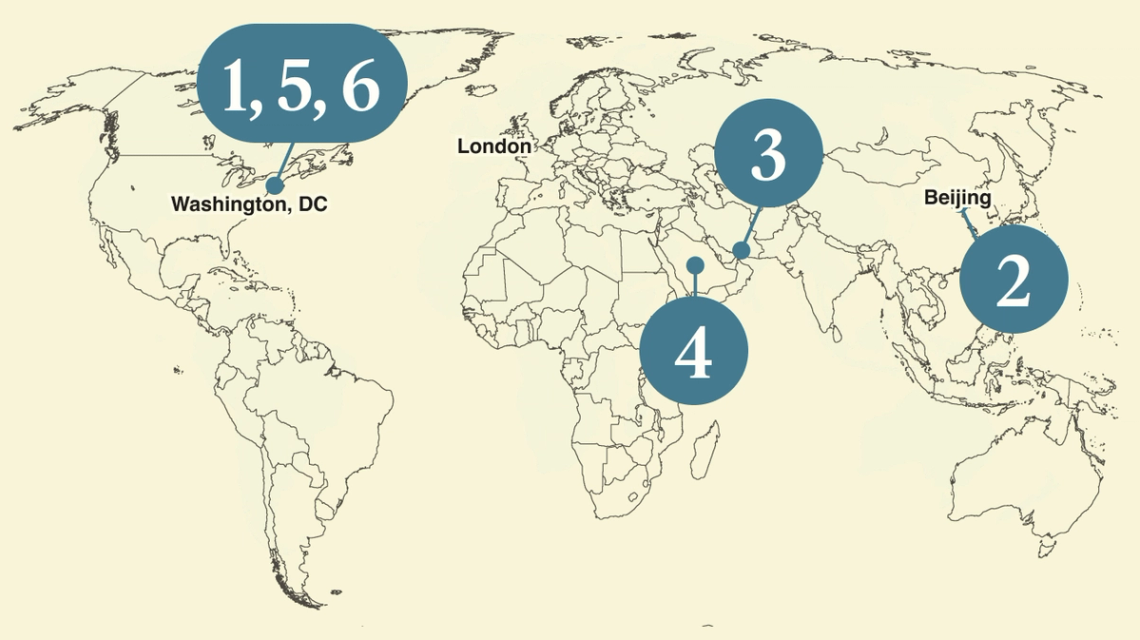 - Bloomberg, post-Mike
- Chinese pharma catches up
- War profiteers
- Gulf money keeps flowing
- Dell’s tech push
- Polymarket’s fake-bet training
 A prediction-markets matryoshka doll… |
|
 OpenAI and Anthropic need to borrow a lot of money but they don’t have profits or a track record of creditworthiness. Enter Jensen Huang. Nvidia’s $250 billion backstop to OpenAI will let the money-burning AI lab lease space at the largest data center ever built. OpenAI doesn’t have an investment-grade rating, so Nvidia is essentially lending its own. Broadcom did the same thing for Anthropic a few weeks ago; I wrote at the time that it was “like getting your parents to cosign the lease on your first apartment.” Nvidia’s backstop for OpenAI is literally that — OpenAI is trying to sign a lease and its landlord, SoftBank, doesn’t like the tenant risk. So Huang is cosigning. It’s classic credit-enhancement, taking a risky thing and wrapping it in something safer. Usually this goes fine. Occasionally it’s catastrophic. Fintwit is busy casting the AI version of Too Big To Fail. The notion of Nvidia-as-AIG is right in one respect: The company most to blame for the 2007 bubble wasn’t a bank writing bad loans, but the insurer that backstopped them, spreading that risk throughout the financial system. Risky mortgages went into AIG and came out stamped AAA. Risky AI stuff is going into Nvidia, Broadcom, and Google and emerging similarly shined up. Spreading risk around is sometimes prudent — it’s how mutual insurance works. But it also brings players that might have sat out a crisis into the thick of it. AIG didn’t need to be a part of the mortgage crisis. Nvidia does need to be a part of the AI buildout, but it is testing its balance sheet to finance its customers. (OpenAI will put Nvidia chips inside the Ohio data center.) That has echoes of General Electric and General Motors, which were nearly toppled by their finance arms in 2008. In the run-up to that crisis, then-Fed Chair Alan Greenspan praised newfangled financial products for making the system safer. Credit derivatives were “an extraordinarily useful vehicle to transfer risk from those who shouldn’t be taking it to those who are willing to and are capable of doing so,” he told a Senate committee in 2003. Everyone is willing when the numbers keep going up. Not everyone is capable. AIG was not. Nvidia, TBD. |
|
Semafor Exclusive Bloomberg’s post-Mike moves |
 Carlo Allegri/Reuters Carlo Allegri/ReutersBloomberg LP’s post-Mike moves are quietly in motion. Executives from the financial media and data giant have held preliminary talks with investment bankers about an IPO or other transaction, Semafor scoops. Mike Bloomberg also recently transferred some of his personal stock in the company to his philanthropic arm — a move that would minimize taxes if the company pursued either path. The 84-year-old billionaire owns an estimated 88% of Bloomberg LP, according to Forbes, which pegs the company’s annual revenue at $15 billion. The company could be worth $80 billion or more, a big bite for any buyer. But the chance to buy a minority stake in Bloomberg, with its decades of proprietary market data and distribution through its ubiquitous terminals, might tempt everyone from AI labs to exchanges to asset managers. “Mike controls the firm, is the majority shareholder, and has no plans to sell the company,” said Ty Trippet, a Bloomberg LP spokesman. |
|
Semafor Exclusive Chinese pharma wants into the big leagues |
 Go Nakamura/Reuters Go Nakamura/ReutersChinese pharmaceutical companies are gunning for Western giants. Beijing’s drugmakers are still about a decade away from challenging industry heavyweights on a global stage, AstraZeneca’s chief financial officer told Semafor’s Prashant Rao. But they are increasingly on the cutting edge of research, and China gets twice as much from licensing drug patents to foreign manufacturers as it does from sales of electric cars, one of its flagship industries, according to HSBC. Pfizer and Eli Lilly have both struck big deals this year to license drugs from Chinese biotechs. Western perceptions of China as a technological copycat — perceptions getting a boost now in the debate over open-source AI models — have obscured real strides in advanced research. |
|
Big Oil’s risky profit spike |
 Ken Cedeno/Reuters Ken Cedeno/ReutersNo one likes a war profiteer. That’s the problem for big oil companies that are expected to report bumper second-quarter profits this week. Global drillers like ExxonMobil and Chevron are on track for a $495 billion cash windfall this year, Wood Mackenzie analysts said this morning, double the prewar estimate. The thing to watch is what the companies plan to do with all that cash: So far most have chosen to sit on it, rather than dole it out to shareholders or invest in new drilling; the latter invites criticism from President Donald Trump, who wants them to drill more. But CEOs have learned their lesson before about overspending: “The bigger risk is blowing this unexpected piggy bank on projects that won’t pay off if the situation in Iran calms down soon,” Semafor’s Tim McDonnell writes. |
|
Money’s flowing to the Gulf |
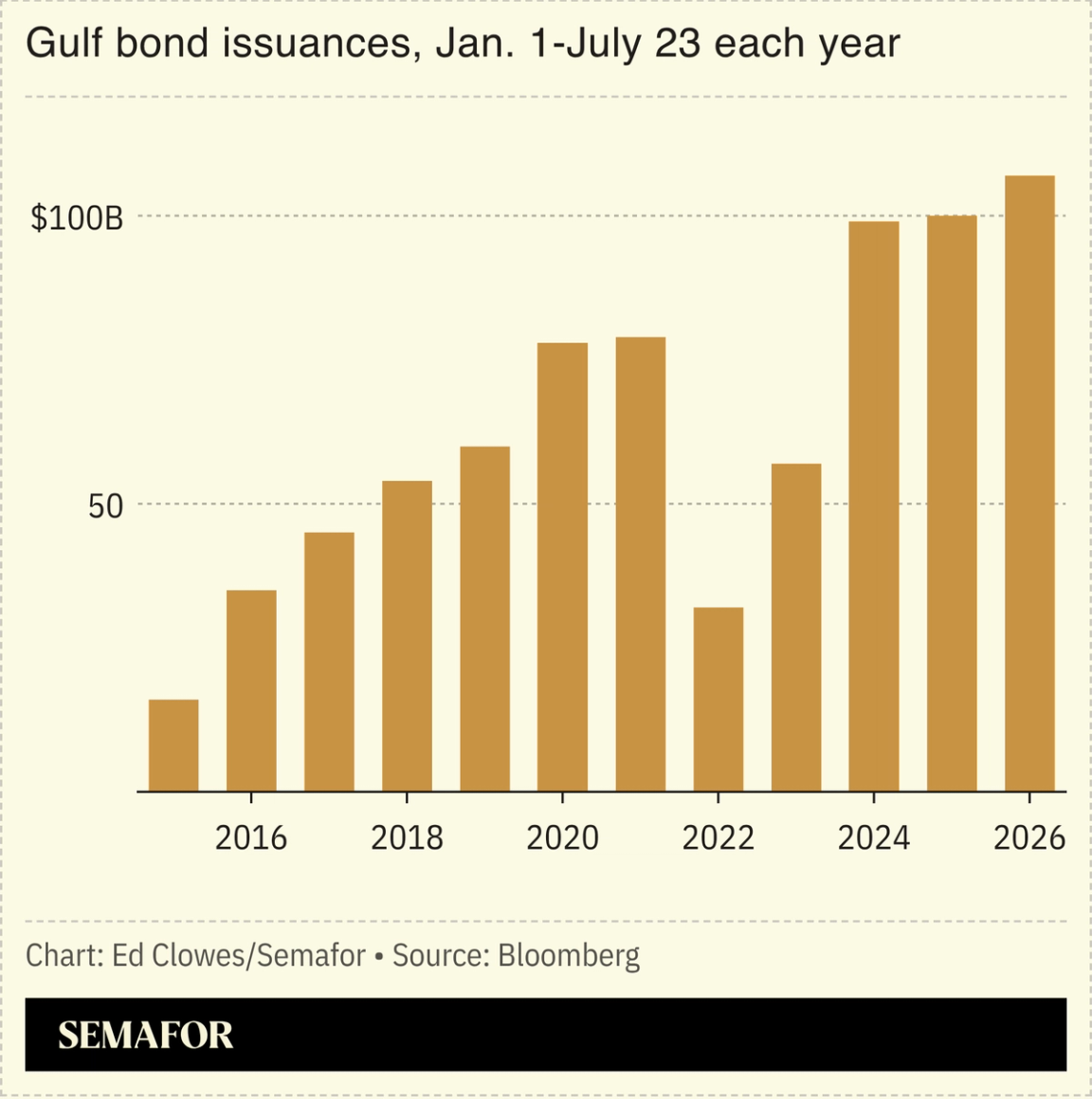 The Iran war is drawing more capital into the Gulf, rather than scaring it off. Brookfield raised $2 billion for a Middle East-focused private equity vehicle anchored by Saudi Arabia’s Public Investment Fund and other global and regional investors, plus $500 million of Brookfield’s own money. Half of the fund is earmarked for Saudi Arabia, feeding PIF’s effort to attract foreign capital into the kingdom. US-based firm I Squared Capital recently agreed to invest $2 billion into Saudi infrastructure. Blackstone and KKR this week inked the largest-ever foreign investment into Kuwait — into an oil pipeline, no less. And Kuwait’s recent bond sale was twice oversubscribed, though more expensive, as Gulf states find international credit markets still open despite the continued attacks. Regional bond sales have hit a record $112 billion so far this year. |
|
Semafor Exclusive BDT & MSD Partners buys into tech |
 BDT & MSD co-CEO Gregg Lemkau speaking at a Semafor event. Kevin Dale/Semafor. BDT & MSD co-CEO Gregg Lemkau speaking at a Semafor event. Kevin Dale/Semafor.Michael Dell avoided investing in tech for years, figuring he had enough exposure through the company with his name on it. That’s changing. BDT & MSD, which manages much of the billionaire’s fortune, has hired Goldman Sachs partner Darren Cohen, who oversaw the bank’s bets on Anthropic and Databricks, to invest and raise a new tech fund, according to people familiar with the matter. The hire is also a tell that BDT & MSD are finally headed into the tech bonanza: “The mindset for a long time had been… diversify away from technology,” Gregg Lemkau, co-CEO of BDT & MSD alongside Byron Trott, said in 2022. The pull of AI riches is proving hard to resist, even for the firm’s old-economy, industrial client list. Its first technology fund raised $832 million last year, and it owns stakes in OpenAI, Waymo, Helsing, Revolut, and the Jeff Bezos-backed Project Prometheus. |
|
Semafor Exclusive Polymarket’s fake-bets training guide |
 Tobin Tang speaking in one of Polymarket’s videos Tobin Tang speaking in one of Polymarket’s videosNewly surfaced internal videos from Polymarket reveal how far the company’s employees were willing to go to build its user base and legitimacy, instructing social media creators how to stage fake bets on a mock version of the platform earlier this year. One presentation, titled Getting Started with Fakecharts: Setup and Deposits, was shared in a Discord server that Polymarket used to communicate with dozens of social media creators. In the video, viewed by Semafor, Polymarket employee Tobin Tang walks creators through the company’s “fake charts platform,” demonstrating how to use fake money to wager on whether President Donald Trump would acquire Greenland before 2027. He enters $1,000 into a betting field, clicks a button labeled “Buy Yes,” and declares, “Boom, trade complete, just like that.” Tang was an undergraduate student at the University of Waterloo in Ontario when he left to work for Polymarket Chief Marketing Officer Matthew Modabber, who Politico reported sent at least $350,000 to influencers via PayPal for these kinds of videos. The videos, along with interviews with current and former Polymarket employees, provide a deeper look at how the company trained what The Wall Street Journal described as a “social media army” to stage fake bets. — Jake Angelo |
|
 News Items aggregates the most interesting and important coverage of news in science, technology, politics, finance, and warfare, six days a week (not Saturday). It is widely read by top leaders in business, finance, law, politics, academia, and news media. You can read it for free for one month by clicking on this link. |
|
➚ BUY: Soccer. FIFA is selling a minority stake in a new commercial vehicle valued at $20 billion, the FT reports. The World Cup is over, but the money keeps rolling in. ➘ SELL: Football. The Green Bay Packers, the only NFL team owned by its fans, reported its first financial loss since 1989, dragged down by expensive player trades and stadium renovations. |
|
|