| | While oil profits rise on the Iran war, energy giants risk political backlash; General Motors innova͏ ͏ ͏ ͏ ͏ ͏ |
| |  Riyadh Riyadh |  Addis Ababa Addis Ababa |  Kuwait City Kuwait City |
 | Energy |  |
| |
|
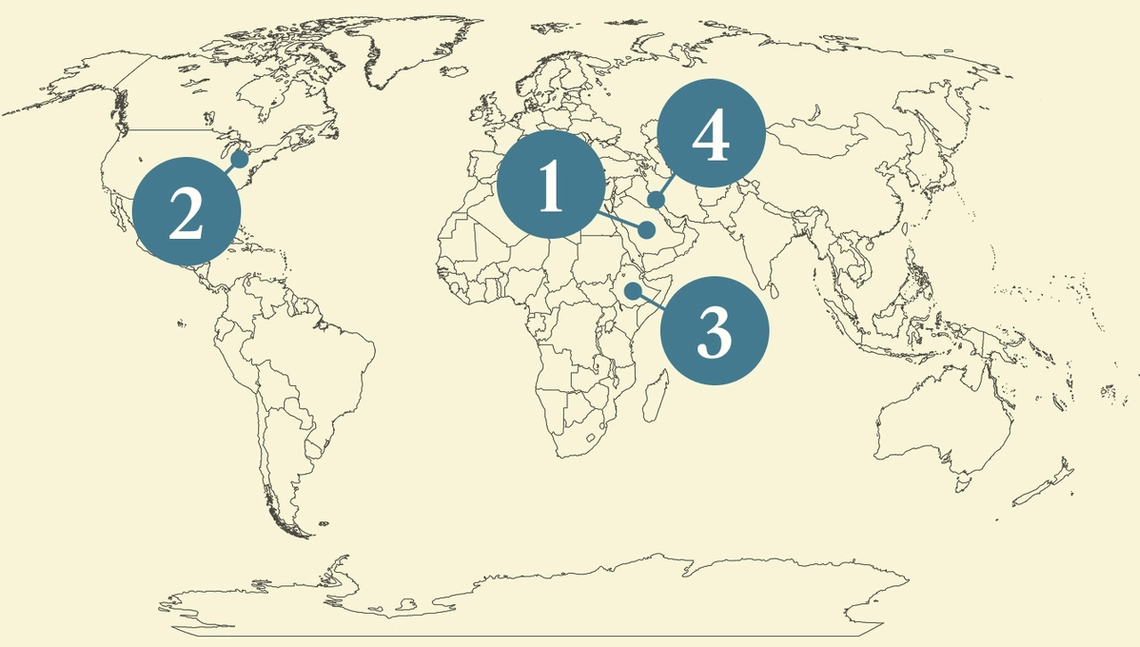 - Saudi’s new bypass
- GM’s battery backup plan
- Green investment surge
- PE piles into pipeline
 Macron battles wildfires, and a shuttered nuclear plant struggles to restart. |
|
 Big Oil will be back in the hot seat this week, as companies post what are expected to be bumper second-quarter profits driven by the war in Iran. What’s good for consumers is bad for oil investors: Share prices for Chevron and ExxonMobil ticked down over the past couple of days in tandem with a modest fall in oil prices. Still, both companies’ stock is up nearly 40% in the past year, as they ride the swell of an unprecedented energy crisis. Their European peers are doing very well too, thanks especially to their busy trading desks. And more good news for their shareholders is likely coming soon. When Exxon reported a dip in profits during the first quarter, CEO Darren Woods explained that two forces were at work to counteract the apparent benefits of higher crude prices. One was disruption to the company’s Middle East operations, which cut into production. The other was the hedging contracts the company and its peers routinely use to protect themselves from market volatility, which means that during price spikes, the company will initially — somewhat counterintuitively — book losses. But later, once energy companies actually collect payment for delivered barrels, the real profits roll in. That’s what we should expect to see later this week: Globally, oil producers as a group are on track to pocket a half-trillion-dollar cash windfall this year, Wood Mackenzie analysts said on Tuesday, double the pre-war estimate. The other thing to watch is what the companies say they plan to do with all that cash: So far most have chosen to sit on it, rather than dole it out to shareholders or invest in new drilling. No one likes a war profiteer. It’s a safe bet this week’s earnings reports will reinvigorate outrage from US President Donald Trump, members of Congress, and their peers in Europe. Power utilities, which will also likely report higher profits driven by the AI data center boom, will be in for the same tongue-lashing. But I don’t see any real punishment coming their way. For energy CEOs, the bigger risk is blowing this unexpected piggy bank on projects that won’t pay off if the situation in Iran calms down soon. |
|
Oil price falls on Iran war lull |
 Ahmed Jadallah/File Photo/Reuters Ahmed Jadallah/File Photo/ReutersOil prices hit their lowest level in a week on Tuesday following a lull in conflict between the US and Iran, but new risks continue to abound. Saudi Arabia said on Monday that it intercepted drones targeting its oil facilities, apparently launched by Iran-backed militias in Iraq. One attack may have damaged Saudi’s Abqaiq oil processing facility, the world’s largest, which Rapidan Energy Group analysts said “would be über bullish” for crude prices. The kingdom is now tapping a second alternative to the Strait of Hormuz, sending more crude north out of the Red Sea through Egypt, rather than south through the Bab el-Mandeb strait, which is under increasing threat from Yemen’s Houthis. But that route is limited, and ramping it up further could be time-consuming and expensive. In the meantime, US and UK officials are expected to convene a meeting in London this week on the future of Hormuz governance and security; Reuters reported that Oman has proposed a plan that would allow Tehran to join a regional organization to collect voluntary fees from transiting ships. |
|
Semafor Exclusive GM enjoys data center boom |
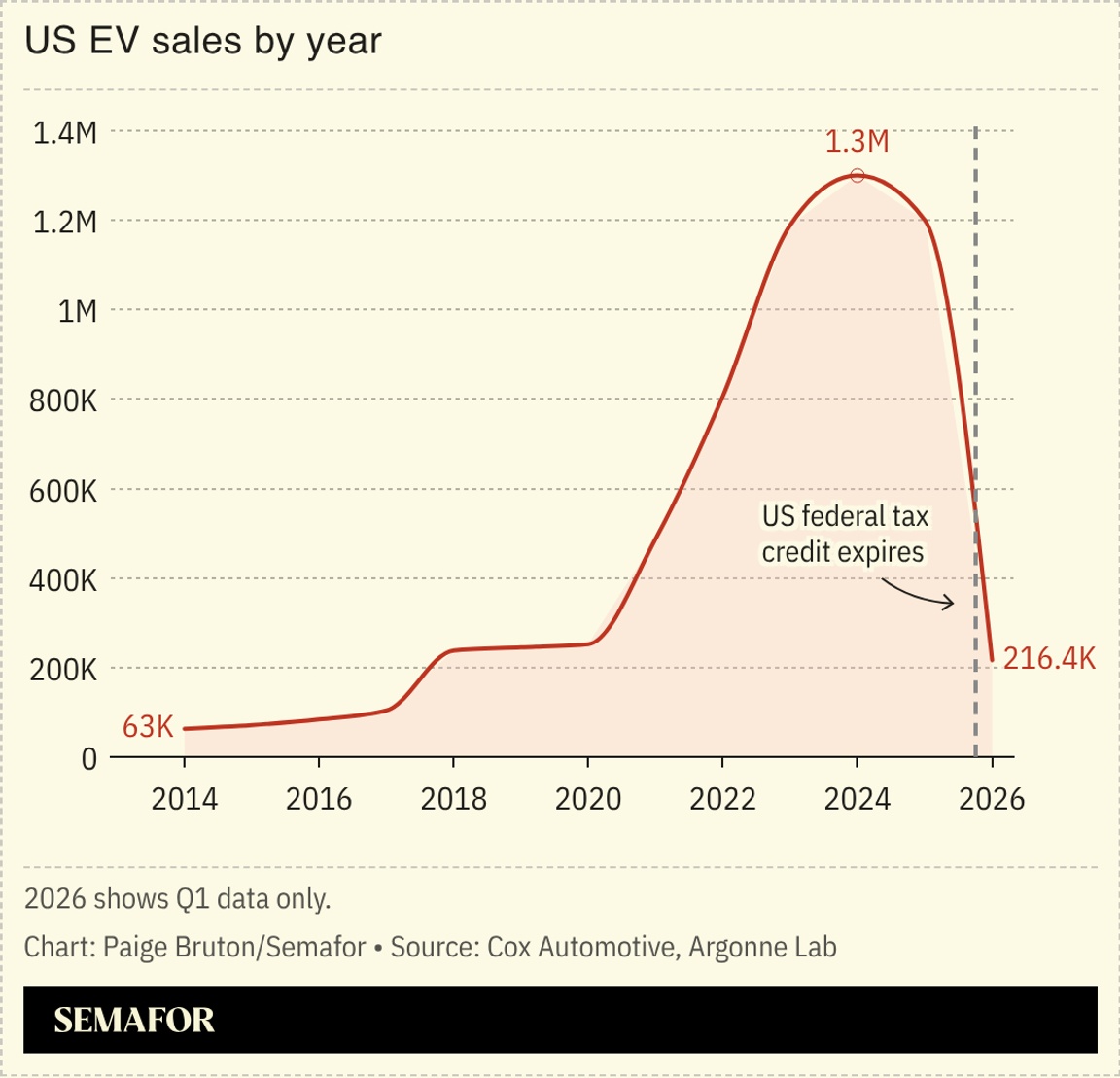 The data center boom is helping General Motors advance work on battery innovation despite flagging demand for EVs, a senior executive told Semafor. In its first-quarter earnings last week, GM reported $2.3 billion in costs stemming from the scale-back of the company’s EV ambitions, which have totalled nearly $11 billion since last year. But in the meantime, GM has been ramping up its production of stationary batteries for data centers and grid storage, Kurt Kelty, its VP of battery and sustainability said. Those growth opportunities have allowed the company to find new uses for its existing battery labs and engineers, Kelty said. They have also driven GM to keep pushing the envelope on new battery technologies, like sodium ion, that can be divorced from Chinese supply chains and eventually beat Chinese alternatives on quality and cost. One problem, Kelty said, is that even the most bullish forecasts for stationary storage are an order of magnitude lower than the original EV demand forecasts. So, GM is still ultimately counting on EV demand to pick up when production costs are low enough to offset the Trump administration’s axing of federal tax credits. “When that’s going to occur is still a little bit unclear,” he said, “but it’s coming.” |
|
Chinese Africa energy investment triples |
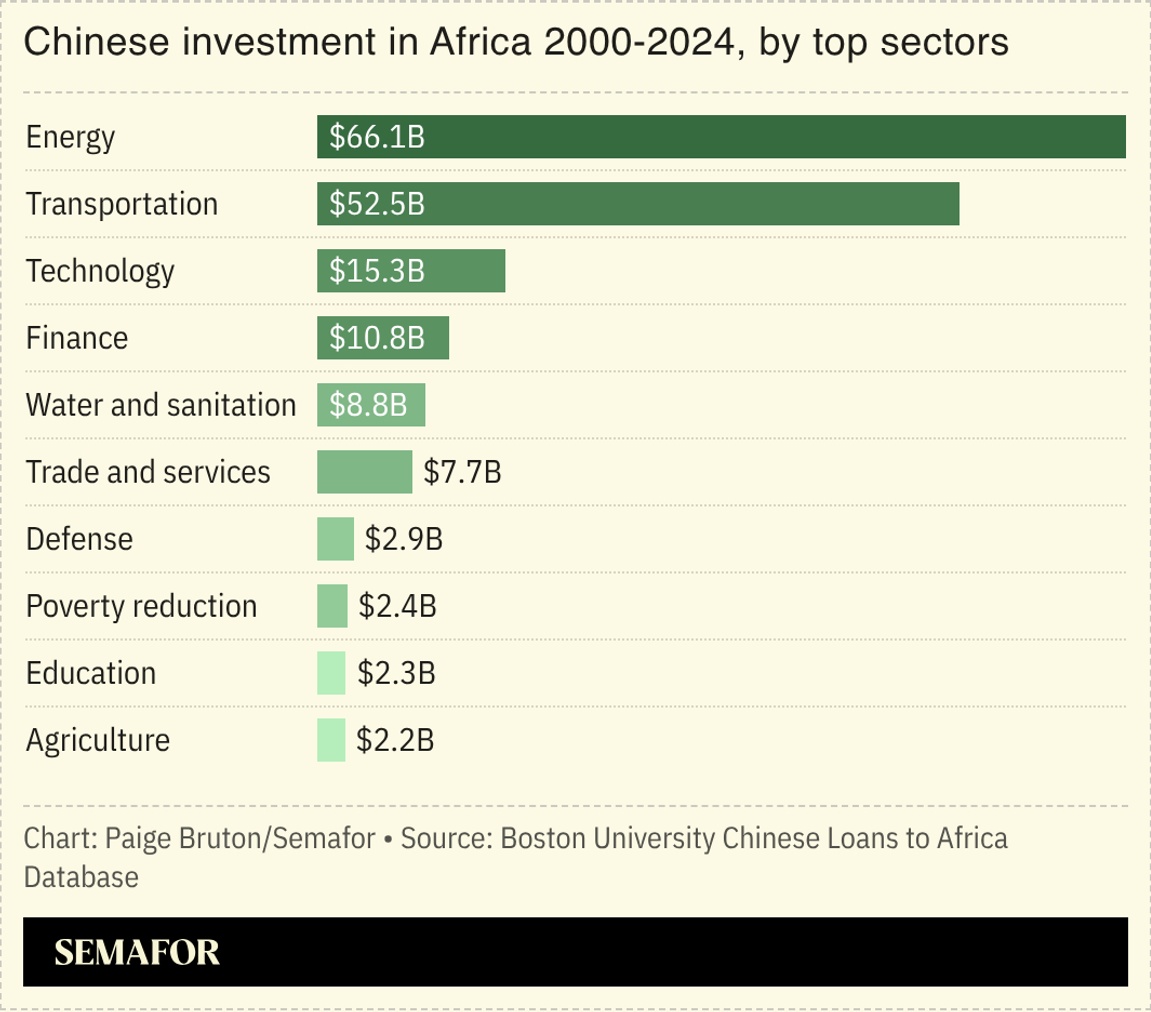 Chinese infrastructure and energy investment in Africa nearly tripled in the first half of 2026 to $33.5 billion — the highest half-year total on record and by far the strongest performance of any region under Beijing’s Belt and Road Initiative, a new report found. The surge was driven by major energy and metals projects, but also reflects manufacturers using Africa’s preferential access to US and EU markets to navigate growing trade barriers elsewhere. Ethiopia recorded the largest increase of any country, led by a $14.2 billion Ming Yang Smart Energy green power and ammonia project. Egypt attracted $12.2 billion, including a $10 billion steel mill, while Zambia announced plans for a 660 MW coal plant, pending regulatory approval. Most other BRI regions saw investment fall, even as construction activity increased. Still, according to the analysis from the Shanghai-based Green Finance & Development Center and the University of Queensland in Australia, volatility stemming from the Strait of Hormuz crisis is likely to accelerate Chinese investment in green energy and manufacturing, rather than slow overall overseas spending. — Yinka Adegoke |
|
PE invests in Kuwait pipeline |
 Mohammed Benmansour/Reuters Mohammed Benmansour/ReutersKuwait agreed to a long-term lease of its oil pipeline network in a $16 billion deal with Blackstone, Brookfield, and KKR. The investors will acquire a 49% stake in a joint venture with Kuwait Oil Company, which will have a 20.5-year lease on the pipelines and lease them back to the state oil company, mirroring a structure used by Abu Dhabi and Saudi Arabia to raise money from their oil infrastructure. It is the largest foreign investment in Kuwait’s history and confirms that some of the world’s biggest dealmakers are still happy to deploy capital in the region, despite Iranian missile and drone attacks. And it’s the latest indication that as access to the Strait of Hormuz remains challenging, oil transportation infrastructure elsewhere in the region will be increasingly prized. |
|
 New EnergyFossil Fuels- Venezuela’s oil production rose by 150,000 barrels per day in the second quarter of 2026. Though the government announced new regulations this month to open up the industry to private sector investment, the recent twin earthquakes in the country could hamper growth, Columbia University’s Center on Global Energy Policy wrote.
- Italy’s Eni and France’s TotalEnergies announced they plan to develop a gas field in Cyprus, as oil companies seek to de-risk from the Gulf following the outbreak of the Iran war.
Finance- Investor demand for private capital funds that explicitly seek progressive climate or diversity outcomes has held firm in recent years, despite political backlash against environmental and DEI-focused agendas, according to new data.
Tech EVs- Morocco has secured $114 million in funding to build Africa’s first EV battery factory.
- BYD launched a mini-car in Japan, priced at just over $12,000, as the Chinese EV-maker pushes to improve sales in a market where the firm has struggled to gain traction.
Food & Agriculture |
|
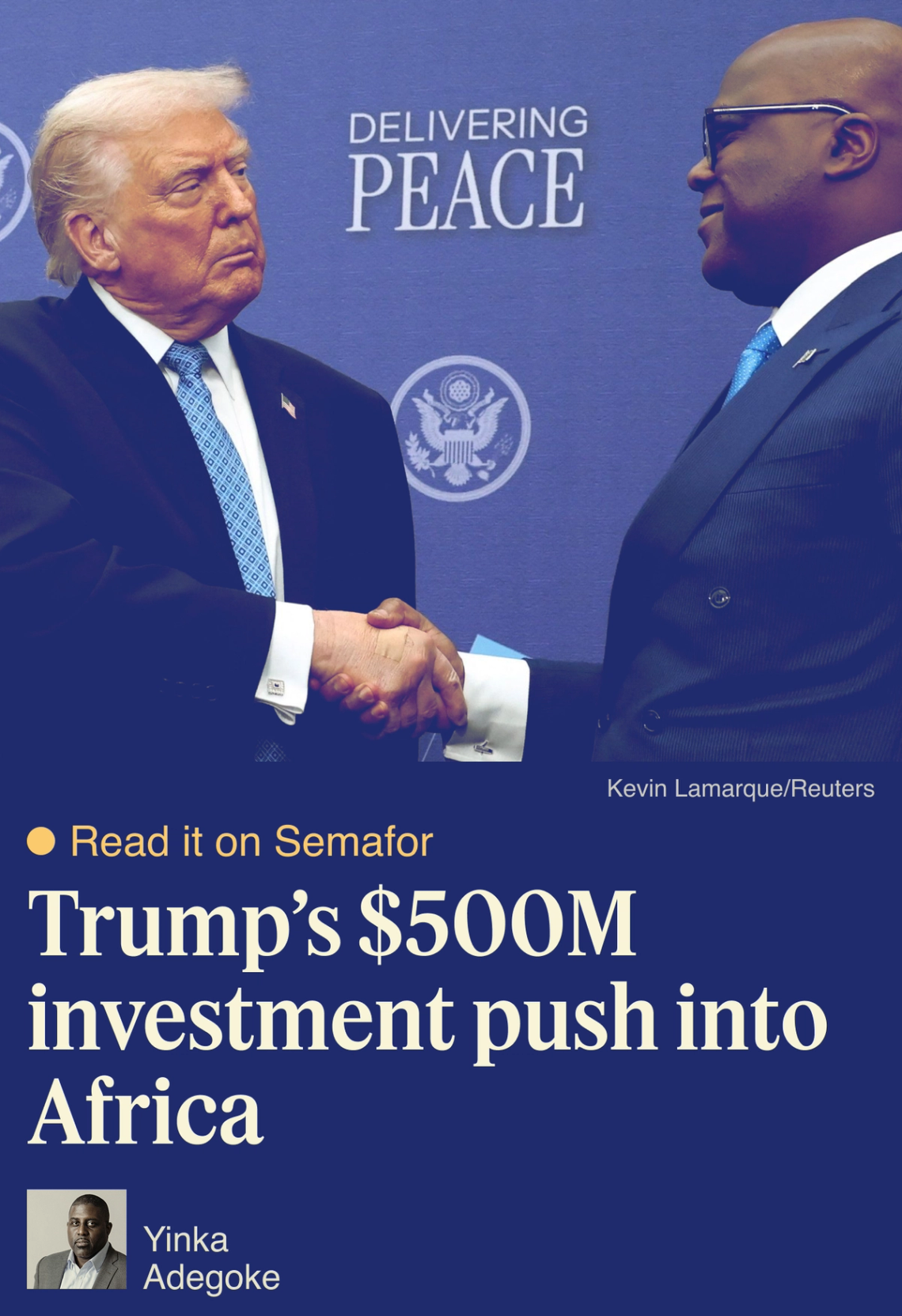 View: A new State Department initiative embodies the US administration’s pledge to prioritize ‘trade over aid,’ using development dollars to create the conditions for private investment. → |
|
|
|


