|
|
|
|
Good morning. Canadian bank stock valuations are historically high. In focus today: Why most investors appear to be riding it out – and the bear case that’s getting harder to ignore. |
|
|
|
|
|
|
|
|
|
|
|
|
|
|
|
|
|
|
|
|
|
|
Investment: Brookfield Asset Management Ltd. is pressing ahead with its expansion in the Middle East, raising money for a regional private equity fund and investing in energy infrastructure despite the threats to trade and security from the Iran war. |
|
|
|
|
Trade: U.S. President Donald Trump defended his handling of the economy during a visit to suburban Detroit, where sweeping tariffs have hurt many businesses as midterm election season heats up. |
|
|
|
|
Economy: Kevin Warsh faces a pivotal choice tomorrow in his second interest rate decision as chair of the Federal Reserve. |
|
|
|
|
|
|
|
|
|
|
|
|
|
|
|
Purely from a climbing perspective, my money's on the bear. Illustration by Melanie Lambrick
|
|
|
|
|
|
|
|
|
|
|
The history and the mystery of rich bank stocks |
|
|
|
|
|
|
|
|
Canadian bank stock valuations are in the stratosphere, at least as far as stuffy financial institutions are generally concerned. But for now, most investors are taking the wild ride in stride. |
|
|
|
|
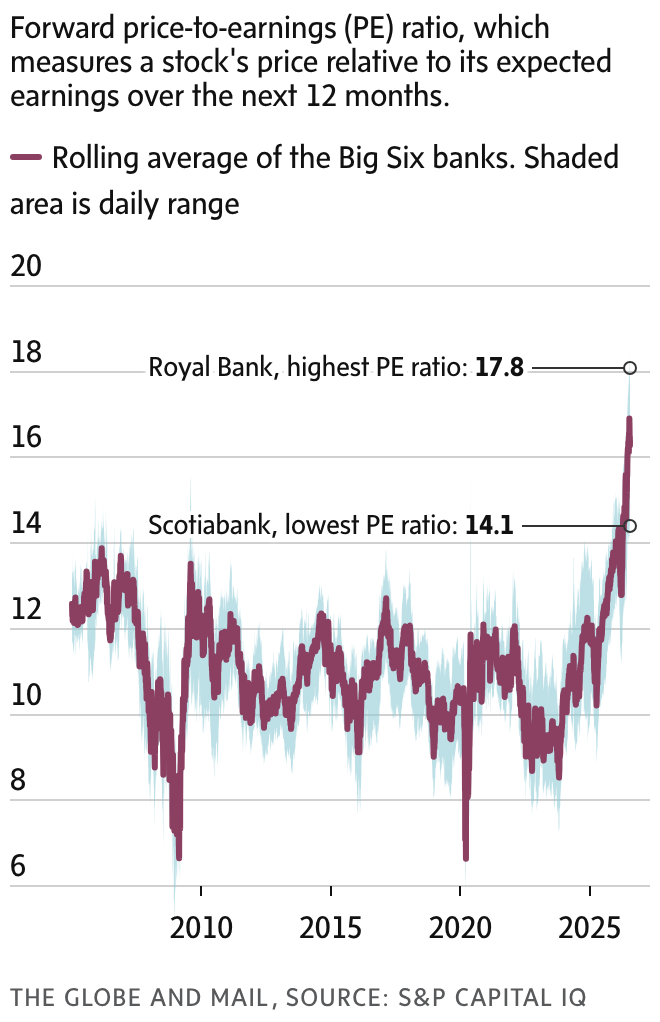
Measured against expected earnings over the next 12 months, the average Big Six bank price-to-earnings ratio sits at about 15, well above the two-decade average of roughly 11. Even Canada’s cheapest institution, Bank of Nova Scotia, is pricey by historical standards. |
|
|
|
|
Canadian bank stock valuations at record highs |
|
|
|
|
|
|
The extended rally has been powered in part by the banks’ fat bottom lines. Despite an onslaught of competition from fintechs and a sluggish economy slammed by tariff uncertainty, Canada’s banking oligopoly has continued to churn out profits quarter after quarter. |
|
|
|
|
That’s helped Canada’s banks outperform U.S. big tech handily. Over the past year, the S&P/TSX banking index has climbed by about 64 per cent, after adjusting for currency – roughly three times faster than that of the Roundhill Magnificent Seven ETF, which holds only its namesake U.S. tech giants. |
|
|
|
|
The run-up has also enriched Canadian investors, who are heavily invested in bank stocks. After all, the Big Six account for nearly one-quarter of the S&P/TSX Composite Index’s value. |
|
|
|
|
|
|
|
|
|
|
Money managers are divided over how far the rally can go. In a recent survey of global fund managers by Scotiabank strategist Hugo Ste-Marie, 42 per cent said they had reduced their exposure to Canadian banks, while 58 per cent were holding for further gains. |
|
|
|
|
Investors are well aware of the pitfalls of betting against Canada’s banks. |
|
|
|
|
This month marks exactly a decade since the peak of the “short Canada” investment strategy, a wave of bearishness over the prospect of a housing crash that spurred investors to place big bets that Canadian bank stocks were primed to tumble. |
|
|
|
|
Instead of dropping, the S&P/TSX banking index closed out 2016 up 26 per cent, leaving short sellers with huge losses. |
|
|
|
|
Now, even though bank valuations have never been pricier, short interest for the Big Six is at its lowest level in years. |
|
|
|
|
|
|
|
|
|
|
David Rosenberg, founder of Rosenberg Research, says the banks’ underlying businesses remain strong, but not enough to justify such a sharp increase in valuations. |
|
|
|
|
Loan growth has been weak, and an upswing in capital-markets revenue isn’t something they can count on forever. |
|
|
|
|
Like the AI trade on Wall Street, the banks have been carrying the TSX. Just as U.S. gains have been driven by chip makers, Canada’s have been driven by banks, which earlier this month rose above 25 per cent of the TSX’s market capitalization. That’s an unprecedented level. |
|
|
|
|
And like the AI trade in the S&P 500, the Canadian banks in the TSX have entered bubble territory, Rosenberg argues. If you have been long and lucky, now is the time to book some profits. |
|
|
|
|
» Why bears and bulls? While we’re on the topic, here’s a little trivia for the day: The term “bear” likely comes from a proverb
about selling a bearskin before catching the bear, a reference that became attached to speculators betting on falling prices. History is a bit less helpful on the origins of “bull,” but one popular explanation is that bulls attack upward with their horns – much as investors buy shares expecting prices to rise. |
|
|
|
|
|
|
|
|
|
|
|
|
|
|
|
|
|
|
|
|