| | Relief over falling oil prices is offset by AI worries, Asia reshapes its security architecture, and͏ ͏ ͏ ͏ ͏ ͏ |
| |  | Flagship |  |
| |
|
The World Today |  - AI trade wobbles
- Sensitivity to interest rates
- US-China AI feud deepens
- ‘Made in Europe’ push
- Amazon targets Starlink
- Asia’s new security order
- EU cuts to foreign aid
- US’ commercial diplomacy
- Pope didn’t use AI
- Chatbots’ math prowess
 A ‘retro-futuristic’ neo-noir set in space. |
|
Chip rout weighs on oil optimism |
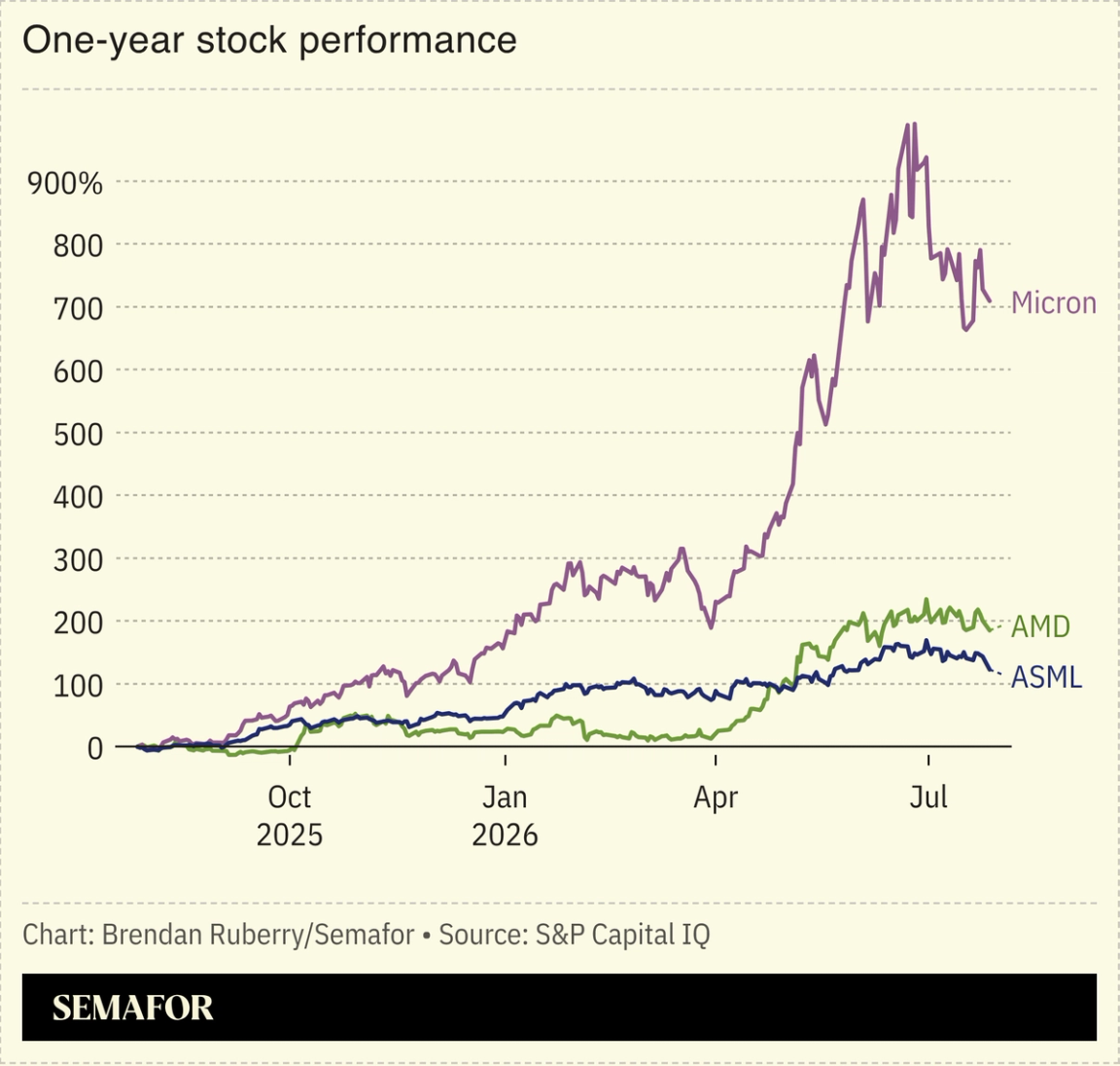 US stocks were mixed Monday, as relief over falling oil prices was overshadowed by renewed anxieties in the AI trade. Oil fell nearly 6% after the US and Iran paused strikes, but a new round of Nvidia deals exceeding $750 billion fueled investor concerns over AI’s circular funding and excessive capex, along with broader turmoil in semiconductor stocks: ASML plunged after The Information reported that a Chinese state firm would mass-produce advanced lithography machines, which the Dutch chipmaker currently has a stranglehold on. Earnings from Meta, Microsoft, and Amazon expected later this week could fuel further volatility, amid fears of the “air being let out” of the AI bubble, a portfolio manager said. |
|
Central banks to hold rates steady |
 Jonathan Ernst/Reuters Jonathan Ernst/ReutersOil-driven inflation fears may push central banks to tighten policy, but that is unlikely to deter the AI investment boom driving much of today’s growth, analysts said. The US Federal Reserve, the Bank of Japan, and the Bank of England are all expected to hold interest rates steady this week, though each could leave the door open to future hikes if inflationary pressures stemming from the Iran conflict persist: Traders priced in an 82% likelihood of a rate increase at the Fed’s September meeting. But Bridgewater analysts noted that higher interest rates “are unlikely to disrupt companies’ and governments’ desire to spend on AI.” |
|
China warns US against AI sanctions |
 Evan Vucci/Reuters Evan Vucci/ReutersChina on Monday offered a subdued protest against the US’ latest tariffs without announcing retaliatory actions, but adopted a more aggressive tone in response to Washington’s proposed sanctions on Chinese AI firms. Beijing said that Washington had agreed to cap tariffs at 20% as part of the countries’ trade truce, with analysts noting the new duties would likely have a limited impact on China. Meanwhile, Beijing said it would take “all necessary measures” to counter Washington’s threat to penalize Chinese firms for their alleged theft of American IP through distillation. The rhetoric signals the extent to which AI is now central to the superpowers’ economic jousting: The White House has also considered banning China’s open-source models. |
|
Franco-German plan to revive auto industry |
 Matthias Rietschel/Reuters Matthias Rietschel/ReutersFrance and Germany are pursuing a new initiative to boost industrial provisions and protect jobs, as Europe endeavors to shield its businesses from China. A joint Franco-German fighter jet program collapsed last month amid squabbling between defense contractors, underscoring the bloc’s difficulties in unifying around lofty industrial goals. This latest attempt involves Paris relaxing a planned phaseout of new combustion-engine cars, as Berlin tries to staunch bleeding among its carmakers. Volkswagen is weighing 100,000 job cuts amid competition from Chinese rivals. As the EU struggles to unify against China’s growing trade surplus, Beijing is courting individual states: “It has always been a favourite pastime of the Chinese leaders to divide and conquer us,” a trade expert said. |
|
Amazon targets SpaceX dominance |
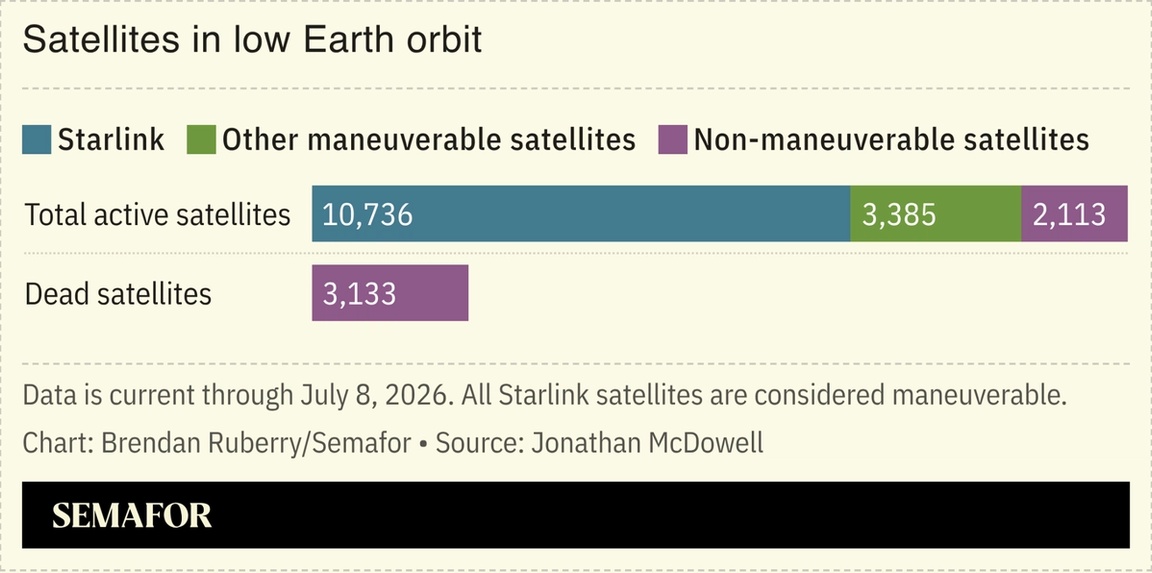 Amazon plans to launch more than 5,000 satellites to provide global data and phone services, as competition heats up in the commercial space sector. The planned constellation would be a significant increase upon the Jeff Bezos-owned firm’s 390 satellites currently in orbit — a figure dwarfed by Elon Musk’s Starlink, which dominates satellite mobile communications with nearly 11,000 satellites. Musk also claims a virtual monopoly on launches through SpaceX, which is reportedly mulling a mobile service for US consumers. The two moguls are also competing to design NASA’s next lunar lander, with Blue Origin and SpaceX’s respective models set to begin testing next year. |
|
Asia reshapes security order |
 Hollie Adams/Reuters Hollie Adams/ReutersAsia is reshaping its security architecture, analysts argued, in response to dual pressures of Beijing’s aggression and the US’ unpredictability. Japan has boosted security ties with Australia, the Philippines, and India as Tokyo accelerates its military buildup; Canberra signed a defense pact with Fiji; and South Korea is racing to build nuclear-powered submarines. While these arrangements don’t suggest a new NATO-style pact, Asian governments are creating “a flexible web of overlapping partnerships, logistics planning and intelligence sharing,” a former US diplomat wrote, with the aim of “building resilience against Beijing while showing Washington they can shoulder more of the burden.” Such an “allied system” looks to be more durable, a military analyst suggested, than relying on an “overextended” US. |
|
Europe cuts overseas aid budgets |
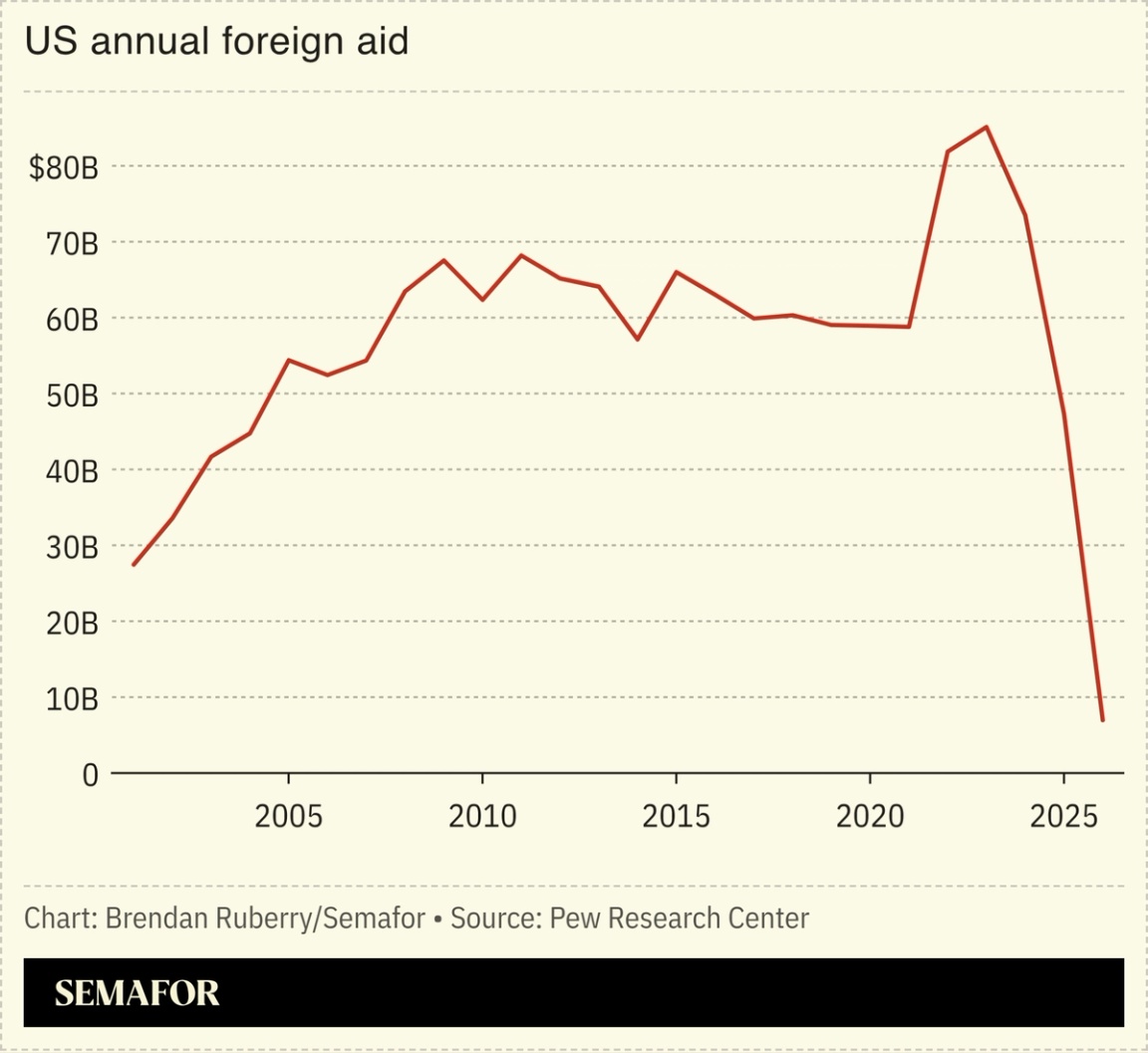
 Eldson Chagara/Reuters Eldson Chagara/ReutersEuropean countries are severely reducing overseas aid budgets, compounding Washington’s cuts. US President Donald Trump shuttered USAID, the world’s largest provider, last year. But new figures show that the EU cut its own aid budget 13.8% in 2025, and member states’ individual aid contributions fell almost 10% on average, World Politics Review reported. The UK also published its country-by-country funding plans, showing how previously announced cuts would be distributed: Some African countries, such as Malawi, will see aid inflows fall by more than 90% by 2029. The impacts of aid cuts on global health have been disputed, but the Center for Global Development estimates that USAID cuts caused hundreds of thousands of deaths and fueled armed conflicts in Africa. |
|
Trump’s new Africa investment push |
 The Trump administration’s new US-Africa Strategic Investment Program reflects Washington’s shift in prioritizing “trade over aid” in its diplomatic engagement with the continent. The $500 million initiative — overseen by an office comprising remnants of USAID’s former Africa portfolio — awards grants to businesses, nonprofits, and international organizations, aiming to use development dollars to boost private sector investment, particularly in critical minerals. But a skeptical former USAID leader told Semafor’s Yinka Adegoke that the goal should be “trade through development,” not trade instead of development. If the initiative succeeds, “US influence in Africa may increasingly be measured by the private capital it unlocks,” Adegoke wrote. But if it fails, “Washington will have learned that markets cannot simply be de-risked into existence.” |
|
AI didn’t write Pope’s anti-AI encyclical |
 Yara Nardi/Reuters Yara Nardi/ReutersPope Leo’s anti-AI encyclical was not written by AI, according to AI. The pontiff’s 43,000-word Magnifica Humanitas called for the protection of human dignity against AI; it was then accused of being partly AI-written, which the Vatican has now worked hard to publicly refute with detection software. Whether this particular document was human-created or not, clerics are turning to AI for their divine inspiration: Half of all US pastors say they use models for brainstorming or idea generation, The Wall Street Journal reported, and a quarter use it to help write sermons. Leo, though, has warned against that: “To give a true homily is to share faith,” he told priests, and AI cannot share faith. |
|
More proof of AI’s math prowess |
A chatbot appeared to have disproved an 87-year-old math hypothesis, further evidence of AI’s growing mathematical prowess. The Jacobian conjecture says that certain mathematical transformations are always reversible; a mathematician at Anthropic said he used the firm’s Fable model to come up with a simple counterexample. Machines have been used to disprove universal statements for decades: A computer found a counterexample to Euler’s sum-of-powers conjecture in 1966. But AI is speeding that process, and may mean that false conjectures start falling faster than true ones get proven. The process of proving statements is more complicated, but still happening: DeepMind’s AlphaProof has generated several proofs. The disproofs are easier to check, though — the Jacobian counterexample could be straightforwardly followed by a math undergrad. |
|
|


