| | In today’s edition: A tense ceasefire, a $16 billion bet on Kuwait, and Abu Dhabi building as if the͏ ͏ ͏ ͏ ͏ ͏ |
| |  Farnborough Farnborough |  Saadiyat Island Saadiyat Island | Kuwait City |
 | Gulf |  |
| |
|
 - Iran, US halt strikes
- The Gulf’s China problem
- Kuwait’s $16B pipeline deal
- Saudi’s big jet order
- $27B Abu Dhabi district
 An Odyssey star wears both sides of the war. |
|
Calm returns for now, as fighting pauses |
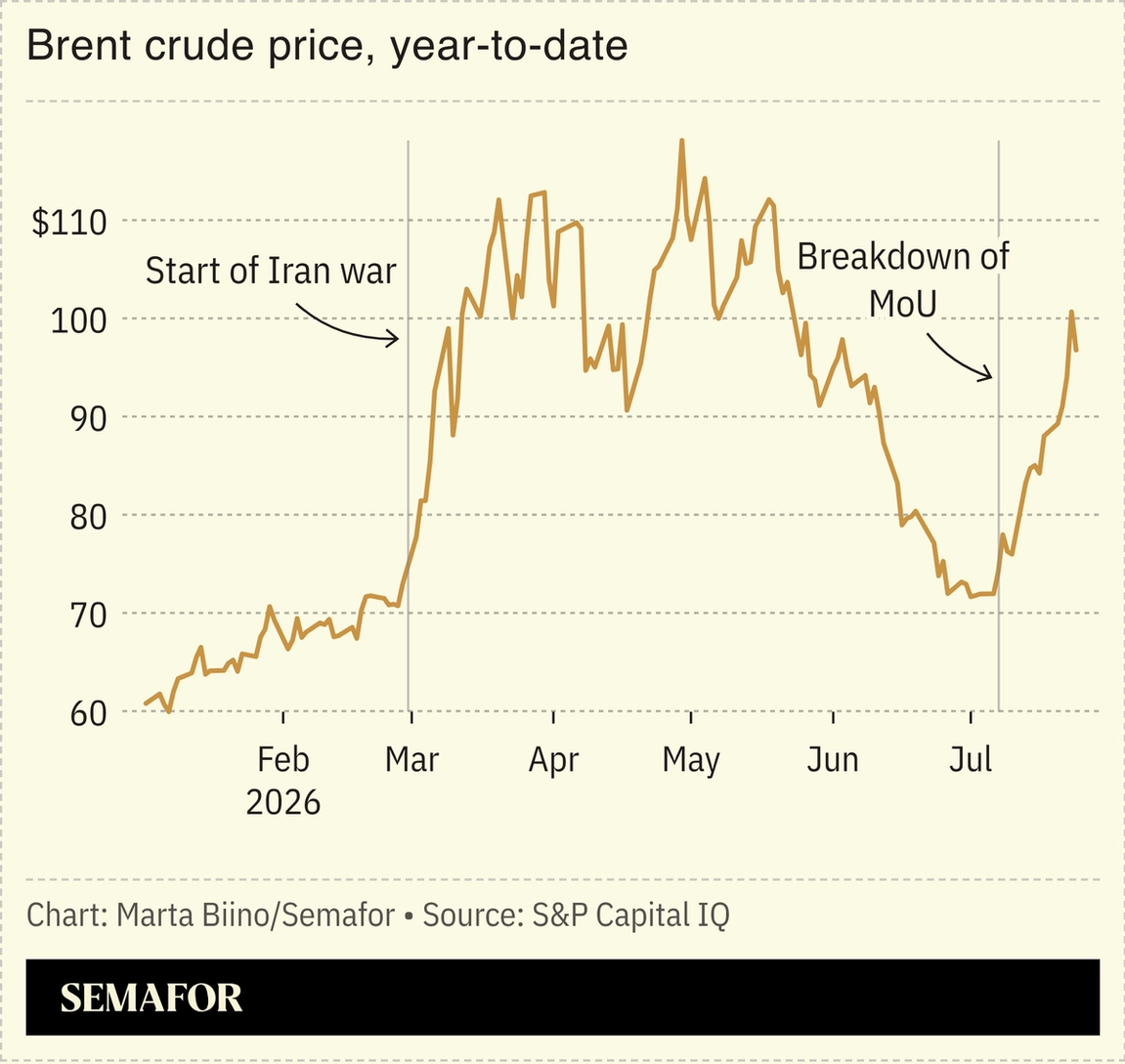 The conflict between the US and Iran settled back to an uneasy ceasefire, as both sides allowed space for diplomacy — and perhaps rearming. The US suspended its bombing of Iran on Friday, prompting Tehran to pause its own strikes. Washington did not give a reason for the halt, but the depletion of its weapon stockpiles may have been a factor. Omani and Iranian officials held discussions on the Strait of Hormuz, and the UK may host a summit on the issue. Oil prices fell below $90 a barrel in response to the positive developments, but this may just be calm before another storm: Iran has acknowledged using previous pauses to restock on weapons. Meanwhile, Saudi Arabia and the Houthis traded strikes over the weekend. The Yemeni group said it attacked Aramco facilities on the Red Sea coast from where the kingdom now exports most of its oil. |
|
Gulf countries reassess China ties |
 cnsphoto via Reuters cnsphoto via ReutersThe Iran war is forcing Gulf countries to reassess their relationships with China. Beijing’s unwillingness to use its influence over Tehran to end the conflict has undermined the idea that it could become a useful security partner for Gulf states or a counterweight to a US that many see as increasingly unreliable, two Gulf-focused academics and a historian of modern China wrote in Foreign Affairs. Beijing has had some diplomatic wins, most notably orchestrating a Saudi-Iran rapprochement in 2023. But its appetite for regional security issues is limited, leaving the US as the Gulf’s only viable security partner. Some are unenthused: Oman’s foreign minister has called for a new regional security architecture to replace the US-led strategy of trying to contain Iran. — Dominic Dudley |
|
Blackstone, KKR invest in Kuwait pipelines |
 Mohammed Benmansour/Reuters Mohammed Benmansour/ReutersKuwait agreed to a long-term lease of its oil pipeline network in a $16 billion deal with Blackstone, Brookfield, and KKR. The investors will acquire a 49% stake in a joint venture with Kuwait Oil Company, which will have a 20.5-year lease on the pipelines and lease them back to the state oil company, mirroring a structure used by Abu Dhabi and Saudi Arabia to raise money from their oil infrastructure. It is the largest foreign investment in Kuwait’s history and confirms that some of the world’s biggest dealmakers are still happy to deploy capital in the region, despite Iranian missile and drone attacks. Blackstone is also opening an office in Kuwait. Kuwait, which raised a $6 billion bond recently, is trying to attract more Wall Street firms and foreign investors as it works to develop its domestic economy, deploying a similar strategy to that rolled out elsewhere in the Gulf. — Matthew Martin |
|
Saudi airlines in expansion mode |
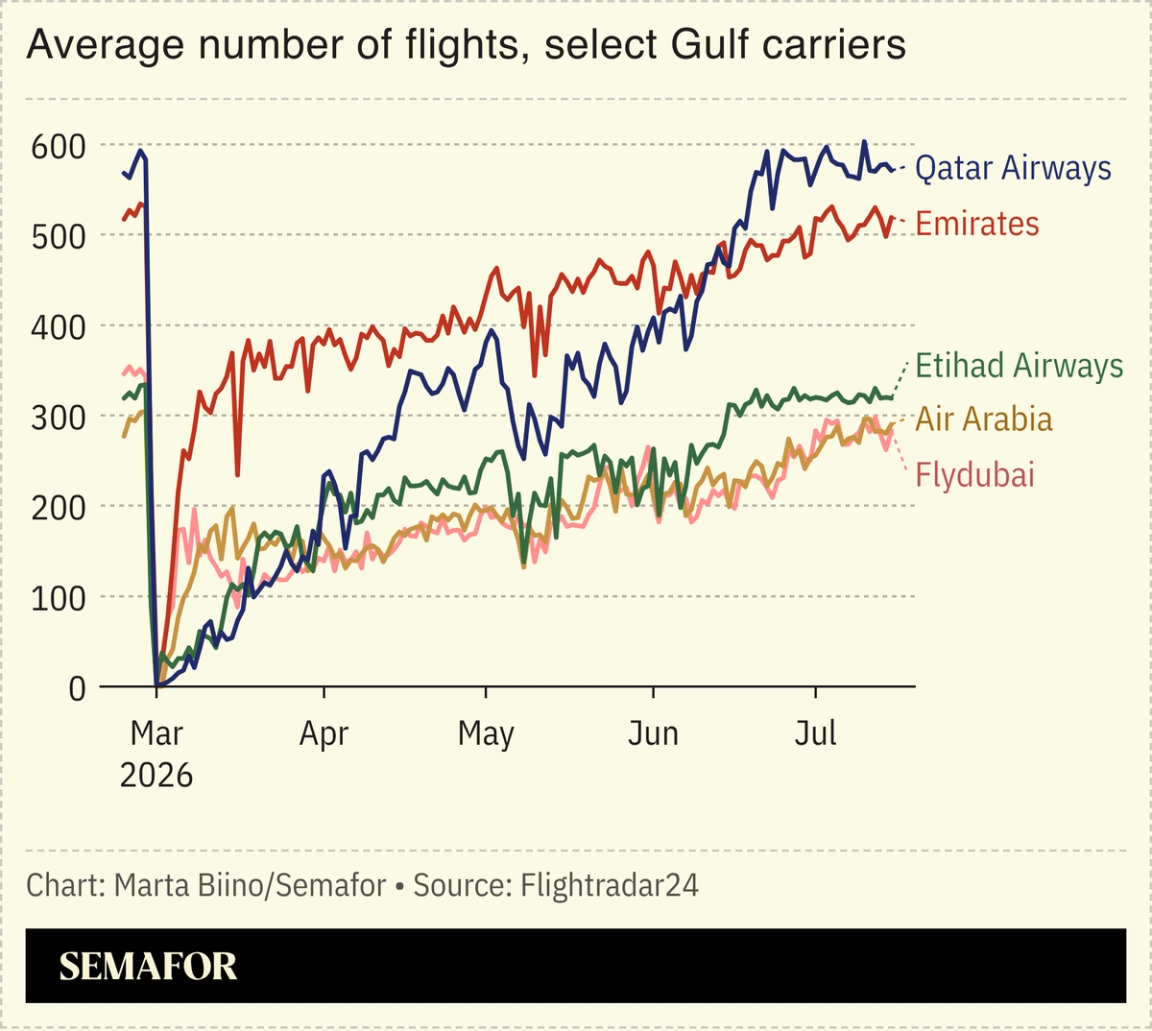 Saudi airlines were the only Gulf carriers with a big shopping list this year at Farnborough, one of the industry’s biggest airshows. Riyadh Air signed a deal for 34 Airbus and Boeing widebody jets, and budget carrier Flynas committed to 25 Airbus aircraft, while the UAE and Qatar, home to the region’s three biggest carriers, made no new orders. (The UAE is expanding all the same: Its aircraft registry passed 1,000 planes for the first time this week, 554 of them flown by its own carriers.) Foreign airlines remain hesitant about the Gulf, with Air France-KLM repeatedly postponing the resumption of regular flights, for example. But the region’s carriers are spending to defend their hub status: Emirates president Tim Clark told Reuters the airline was flying at 90% capacity and has no plans to defer orders. |
|
Abu Dhabi’s Aldar starts $27B project |
 The Louvre Abu Dhabi on Saadiyat Island. John Wreford/Reuters. The Louvre Abu Dhabi on Saadiyat Island. John Wreford/Reuters.Abu Dhabi is building a 100 billion dirham ($27 billion) waterfront expansion on Saadiyat Island, the biggest single addition to the district yet. The emirate has spent two decades turning the area into a cultural hub, home to offshoots of the Louvre and Guggenheim museums. Aldar, the developer behind Yas Island’s Formula One circuit, recently unveiled a new development on the island with homes for 58,000 people, a 360-berth marina, a 6,000-seat theater, and an underground rail station. Saadiyat apartment prices have risen 21% in the past year. Abu Dhabi is one of the few Gulf property markets that has not cooled during the war. Saudi home sales have halved, Dubai’s growth has moderated, and Ras Al Khaimah’s property boom has stalled — but the total value of property traded in the UAE capital has more than doubled in the first half of the year to 117 billion dirhams ($32 billion). — Manal Albarakati |
|
 Budget- Oman could balance its budget this year and still cut its debt, thanks to higher oil prices caused by the Iran war, according to officials. — AGBI
Government- The UAE’s Ministry of Human Resources and Emiratisation will let residents pay government fees and fines through buy now, pay later service Tabby, spreading the cost over four to 12 months up to a limit of 20,000 dirhams ($5,400) per transaction.
Rail- Etihad Rail will open its Madinat Zayed and Liwa passenger stations in Abu Dhabi’s Al Dhafra region on Nov. 30, a month ahead of schedule. The network began carrying passengers between Fujairah and Abu Dhabi in June.
Sports- The Bahrain F1 race is back on — in Malaysia. Officially known as the Formula 1 Gulf Air Bahrain Grand Prix in Malaysia, the race was canceled in Bahrain in March because of the war. Restoring it to the calendar was important for the sport: Bahrain and Saudi Arabia host two of the highest-paying races, with fees exceeding $50 million per year. — The New York Times
Trade- Canada and the UAE finalized a Comprehensive Economic Partnership Agreement aimed at reducing barriers to trade, services, and investment, following the UAE’s $50 billion investment commitment last year. Bilateral trade was $2.5 billion in 2025. It is the UAE’s 38th trade deal since 2021. — The National
|
|
 Zendaya at a Mexico event for “Spider-Man: Brand New Day.” @ashistudio/Instagram. Zendaya at a Mexico event for “Spider-Man: Brand New Day.” @ashistudio/Instagram.Zendaya’s recent red carpet appearances have featured fashion from both sides of the Gulf’s war. The Odyssey actress wore 3,000-year-old Iranian gold earrings to the film’s London photocall this month, then a gown by Saudi couturier Ashi Studio to a Spider-Man fan event in Mexico City two weeks later. |
|
|


