| | In tonight’s edition: A California senator aims to slow the spread of undisclosed influencer ads aft͏ ͏ ͏ ͏ ͏ ͏ |
| |  Washington Washington |  Los Angeles Los Angeles | San Francisco |
 | Media |  |
| |
|
 - Schiff’s crusade
- AGs vs. WBD
- Mixed Signals
- Fake charts
- IMAXxing
- Rage bait
|
|
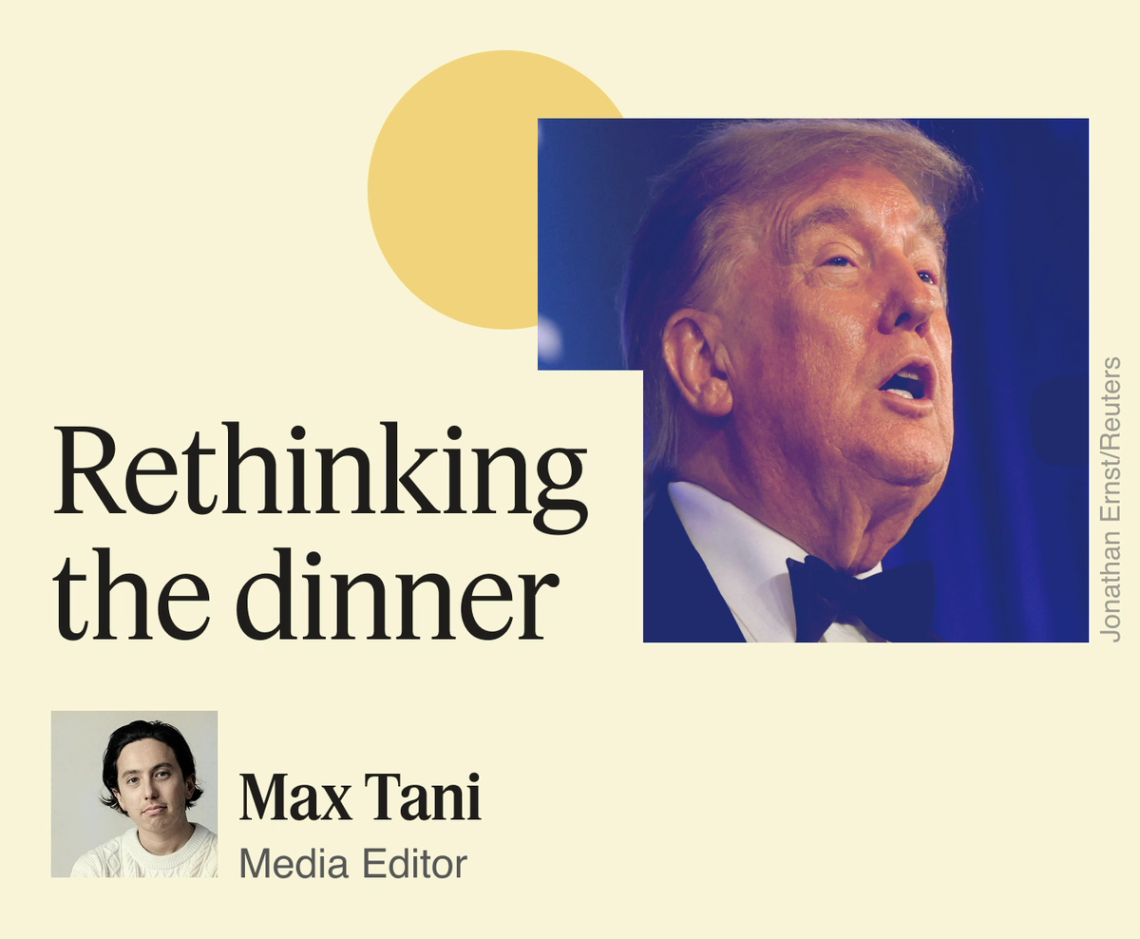 Time to rethink the dinner? That’s the argument New York Times chief White House correspondent Peter Baker made hours after President Donald Trump took the stage for the White House Correspondents’ Dinner do-over on Friday, and launched into an hourlong meandering monologue that doubled as a diatribe against specific journalists, the media generally, and the president’s various political and personal critics. The White House Correspondents’ Association and the press corps have struggled with how to celebrate work that’s often unflattering to the president, as the president loudly complains about and tries to undermine that very work. The WHCA decided to book a mentalist this year; the group had to cancel the comic at last year’s dinner after she’d angered Trump’s team. During Trump’s first term, in 2019, the organization replaced the comedian with a historian (what’s better than press freedom history at 10 pm on a Saturday night?). COVID bailed the WHCA out of booking a follow-up act in 2020. It’s an annual dance that’s gotten increasingly tiresome for many in the White House press corps, some of whom seem ready to heed Baker’s advice. CNN staff in particular are livid about comments the president made about anchor Kaitlan Collins. CNN execs and leadership have attended the dinner and participated in the annual festivities partly as an opportunity to celebrate the network’s hardworking journalists, and partly to avoid the optics of making a political statement by not going. But following Friday’s dinner, some network leaders internally discussed the possibility of scaling back the network’s presence at the dinner next year — or skipping it altogether, if it is going to be a platform for making crude remarks at their employees’ expense. An executive at another TV network appeared to agree with CNN’s frustration when I asked them over the weekend what they thought of this year’s spectacle. Another Washington media boss I spoke to pointed out that the WHCA could have used the do-over as an opportunity to reimagine the event. But instead, on Friday night, the organization congratulated itself on throwing essentially the exact same dinner it had planned for April, and got the result — a critical and insult-heavy speech — that many had feared then, before the violence. The verdict from this exec: “Missed opportunity.” Also today: A California senator aims to slow the spread of undisclosed influencer ads after his state’s wild primary. |
|
Semafor Exclusive Schiff rolls out proposal for AI ad rules |
 Evan Vucci/Reuters Evan Vucci/ReutersSen. Adam Schiff, D-Calif., plans to introduce two bills today that seek to impose new rules on influencers’ political posts online. The Promoting Authenticity with Influencer Disclaimers Act would amend the Federal Election Campaign Act to require labels on some posts from influencers paid for by political committees. If passed, the legislation would mandate that “audiovisual or audio-only content” explicitly state whether it has been paid for by a political committee — mirroring rules already in place in Schiff’s home state. The second bill, the AI Ads Act, would prohibit what Schiff’s office described as “fraudulent misrepresentation of political candidates or committees through content generated by artificial intelligence.” The bill, which Schiff first introduced as a member of the House in 2024, would update existing rules that ban impersonation of candidates to include AI-generated content, and would tighten restrictions around damaging fraudulent content. The measures are Schiff’s reaction to online campaigning in his state’s chaotic jungle primary this year, which saw Californians’ algorithms flooded with paid posts. Tom Steyer, a billionaire, paid influencers significant sums to boost him in the race for governor, while Republican Los Angeles mayoral candidate Spencer Pratt’s campaign churned out AI-generated video ads. |
|
 Daniel Cole/Reuters Daniel Cole/ReutersParamount made its acquisition of Warner Bros. Discovery political. Now, it would like the states to stop making everything so political, thank you very much. Despite notching a notable regulatory win last week in Europe, where antitrust officials waved through the company’s acquisition of WBD with minimal concessions, Paramount has been forced to slow itself down in the face of a 12-state consortium hell-bent on stopping the deal. Paramount executives have voiced their frustration with the review process, saying that the stop-the-merger consortium is motivated not by antitrust law but by partisanship. There’s some truth to that — it’s not a surprise that the AGs suing to block the deal all hail from blue states — but it’s also an obviously hypocritical sentiment from Paramount, which politicized the review process from the jump. The company telegraphed that it would have an easier regulatory path because of its relationship with the administration, which it fêted earlier this year at a private Washington dinner. It was arguably that politicization that galvanized such strong opposition to the deal, and ultimately prompted the states to file suit earlier this month. Paramount now has to wait until at least June 2027 to close its deal, acknowledging that the states, in the short term, would likely prevail were they to seek a preliminary injunction to stop it. The vagaries of merger review mean that Paramount will actually reach a resolution more quickly than if it had chosen to fight that preliminary injunction, but the decision will cost the company $625 million a quarter, starting in October. Paramount has a clear legal strategy here, as The New York Times detailed tonight; it’s willing to take this all the way to the Supreme Court, if need be. But there’s certainly a bit of buyer’s remorse on Melrose Avenue, where some executives have conceded that they may have gone a little too far trying to ingratiate themselves with the president. (One executive did argue to me that every major CEO has to be nice to the president to get things done; that’s certainly true, but it’s also a matter of degrees. Editorial concessions are a bit different from a golden plaque. And perhaps there’s something a little reassuring here in the old sentiment that hypocrisy is the tribute vice pays to virtue.) — Rohan Goswami |
|
Murthy on ‘Mixed Signals’ |
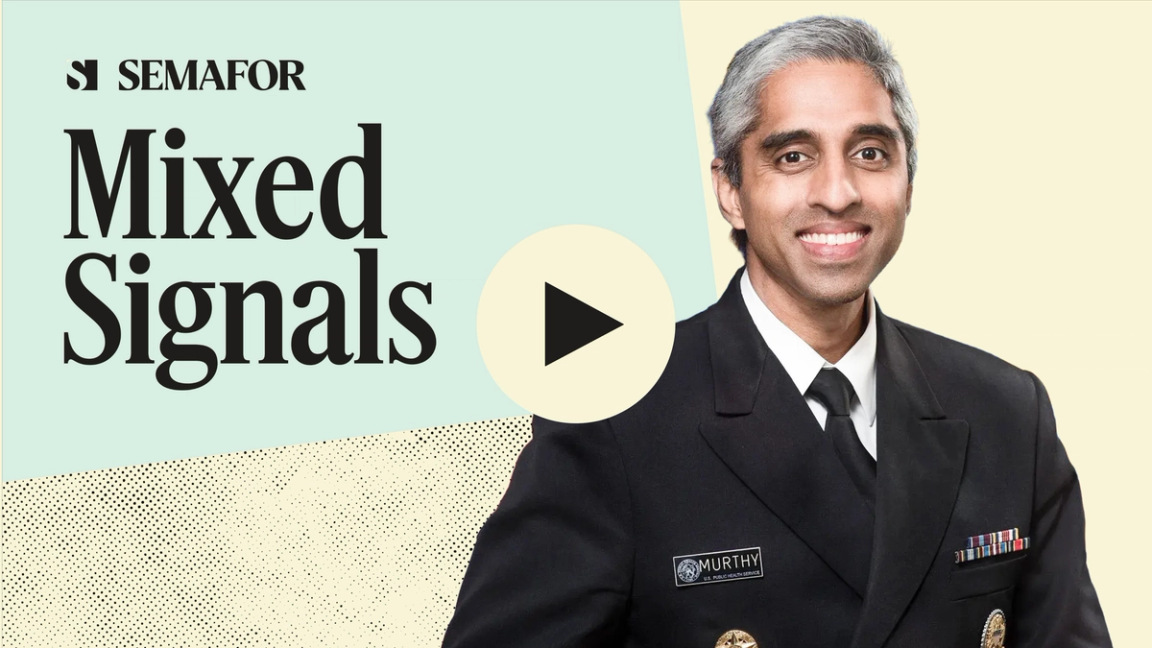 Former US Surgeon General Vivek Murthy joins Mixed Signals to make the case that America’s loneliness crisis is a public health emergency — and that social media is a bigger driver of it than almost anything else we’re paying attention to. Max and Ben ask Murthy why he chose to focus on isolation rather than cancer or heart disease after his tenure as surgeon general, whether the science on social media harms is as definitive as he suggests, and what he’d say to people who think the health risks of drinking alcohol are worth the social benefits. |
|
Semafor Exclusive Inside Polymarket’s hype machine |
 Tobin Tang speaking in one of Polymarket’s videos Tobin Tang speaking in one of Polymarket’s videosPolymarket’s reliance on paid influencers to hype prediction market bets as a way for savvy people to make a quick buck has earned it lots of scrutiny. But newly surfaced internal videos reveal just how far the company’s employees were willing to go, Semafor’s Jake Angelo reported last week. One presentation, titled Getting Started with Fakecharts: Setup and Deposits, was shared in a Discord server that Polymarket used to communicate with dozens of social media creators. In the video, Polymarket employee Tobin Tang walks creators through the company’s “fake charts platform,” demonstrating how to use fake money to wager on whether Trump would acquire Greenland before 2027. He enters $1,000 into a betting field, clicks a button labeled “Buy Yes,” and declares, “Boom, trade complete, just like that.” The videos, along with interviews with current and former Polymarket employees, provide a deeper look at how the company trained what The Wall Street Journal described as a “social media army” to stage fake bets. |
|
Big screens, bigger profits |
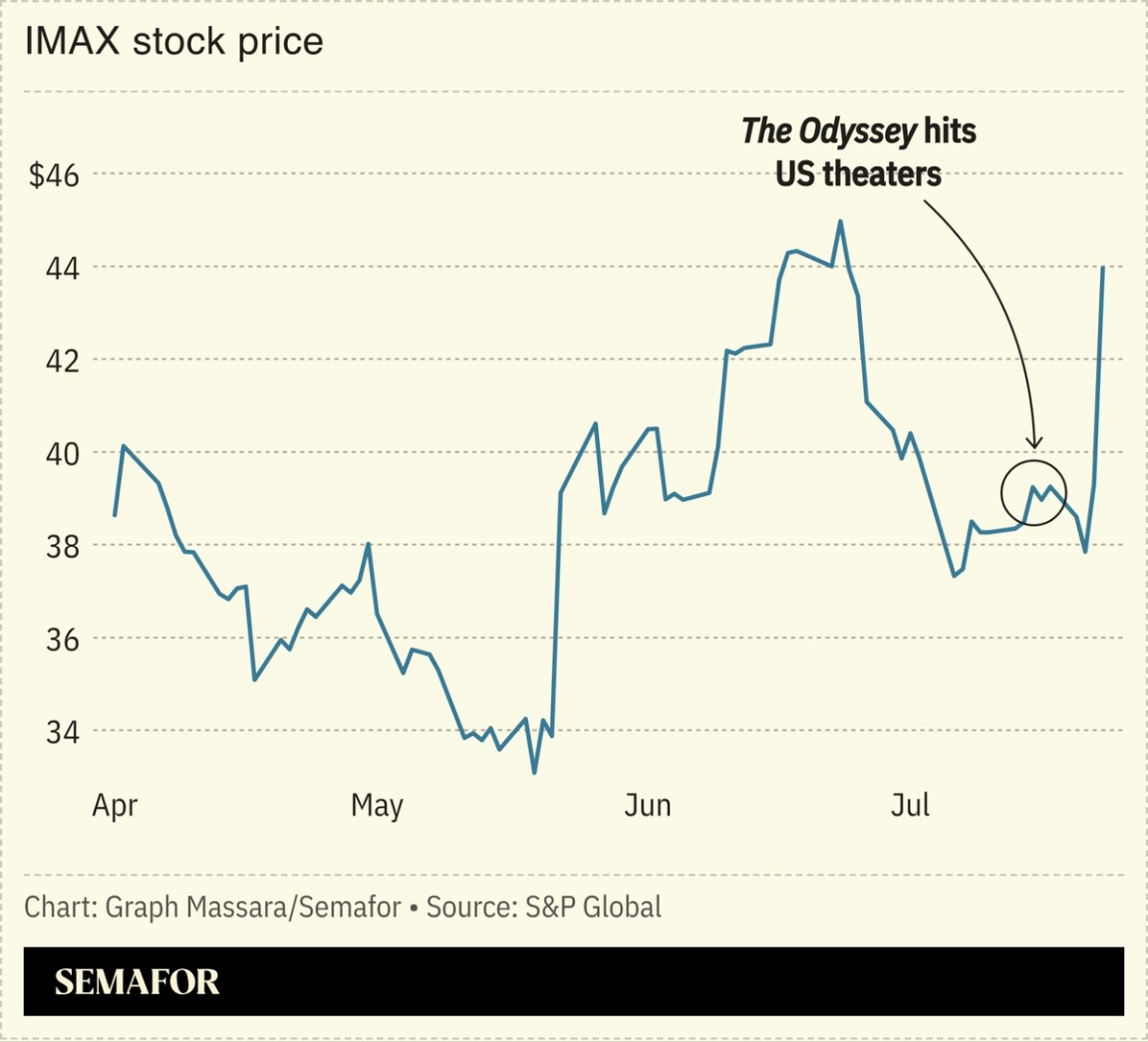 Christopher Nolan wants you to see The Odyssey in 70mm, if you can manage to thwart crowds and scalpers to get a ticket — and that’s been a boon for IMAX and its oversized screens. In an earnings call Thursday, CEO Rich Gelfond said the film’s $52 million global opening weekend, sans South Korea, China, and Japan, was the biggest of its kind in the company’s history, with IMAX screens accounting for less than 1% of Odyssey showings but driving 20% of the film’s debut. A “fan frenzy” has pushed theater occupancy rates to “unheard-of” levels, he said, with Odyssey screenings selling out as many as seven or eight weeks into the film’s run and cinephiles packing the seats as early as 7 am. As young consumers crave IRL experiences, audiences’ overwhelming enthusiasm has even carved out a new market for IMAX merch, Gelfond said: Popcorn buckets in the shape of the company’s famously cumbersome cameras sold out online in minutes. — Graph Massara |
|
TikTok and Instagram’s rage-commerce |
 Instagram InstagramThe newest front in undisclosed social media advertising may be AI-generated influencer ads made by fake influencers. One example, Rachyl Jones reports, is a new dropshipping scam plaguing Instagram and TikTok. Accounts with hundreds of thousands of followers have been posting synthetic videos depicting teens getting bullied for trying to sell Christian apparel alongside links to buy the goods, in an attempt to stoke conservative outrage. It’s not clear who’s behind these specific accounts or if the products actually get shipped (many of the products on the linked websites also appear on other online retailers’ sites). The videos do not contain AI-generated content disclosures, but after Rachyl reached out to TikTok and Meta, some of the accounts were no longer available online. |
|
Vanity Fair: Aidan McLaughlin gets Bill Maher, once a defining critic of the Republican Party, to explain why his “vote’s in play” for 2028. The Ankler: RedBird IMI’s Jeff Zucker, whose firm has been assembling an independent production outfit, makes the case to Manori Ravindran that his US peers don’t get “what a significant player this new company is on the global stage.” WSJ: Reddit and an array of news publishers are rethinking their participation in Google’s AI search, Alexandra Bruell scoops. 404: Influencers are fabricating legal threats from surveillance camera maker Flock, as authentic public anger against the company mounts, Jason Koebler reports. Deadline: The Odyssey had an epic second weekend, raking in $87 million domestically, Anthony D’Alessandro writes. Politico: California Gov. Gavin Newsom appointed podcaster Scott Galloway to the board in charge of the University of California system, Eric He writes (Galloway holds degrees from UCLA and UC Berkeley). |
|
|


