Hello and good morning. Angela Skujins penning your Thursday dispatch, with some hot news.
Speculation is running rampant in Brussels that today, for the first time, tech heavyweight Google will be slapped with a fine for violating the EU’s digital rulebook.
But before we dive in, we just heard explosive comments by the Latvian Prime Minister Andris Kulbergs about the bloc's beleaguered 21st sanctions package against Russia — and those holding it up.
After talks once again failed to garner approval on Wednesday, EU ambassadors will take another run at completing this latest bundle of measures aimed at squeezing the Kremlin’s war chest from 8:30 am today.
The hold out? As my colleague Jorge Liboreiro reports, maritime heavyweight Greece clung to its veto throughout a marathon meeting on Tuesday due to issues regarding a ban on Russian liquefied natural gas (LNG) and its transport.
Latvian leader Andris Kulbergs just said in exclusive comments on Euronews’ flagship morning news programme Europe Today that European politicians should ask themselves two major questions during the debate. Do they want Ukraine to win, or, "Do they want to earn money?"
"There's a choice. It's not both. So the sanctions has to be implemented," he said. Watch.
Back to Big Tech. As my colleague Luca Bertuzzi reports, the Commission's potential fine for Google rumoured to be handed down today follows a two-year investigation into how the company promotes its own services in search results, and how it stops app developers from directing users to deals outside its app store and payment system.
Why today? German financial newspaper Handelsblatt spoke to two anonymous high-ranking EU officials, who pointed to Thursday on the calendar as it follows a meeting chaired by the European Commission President Ursula von der Leyen, where the fine would reportedly be rubber-stamped.
Pay the price. Fines for violating the Digital Markets Act (DMA) can reach up to 10% of a company's total worldwide annual turnover. With Google's parent company, Alphabet, reporting a record annual revenue of $402.8 billion (€353.08 billion) in 2025, the maximum penalty imposed by the European Commission could theoretically run into the tens of billions of dollars.
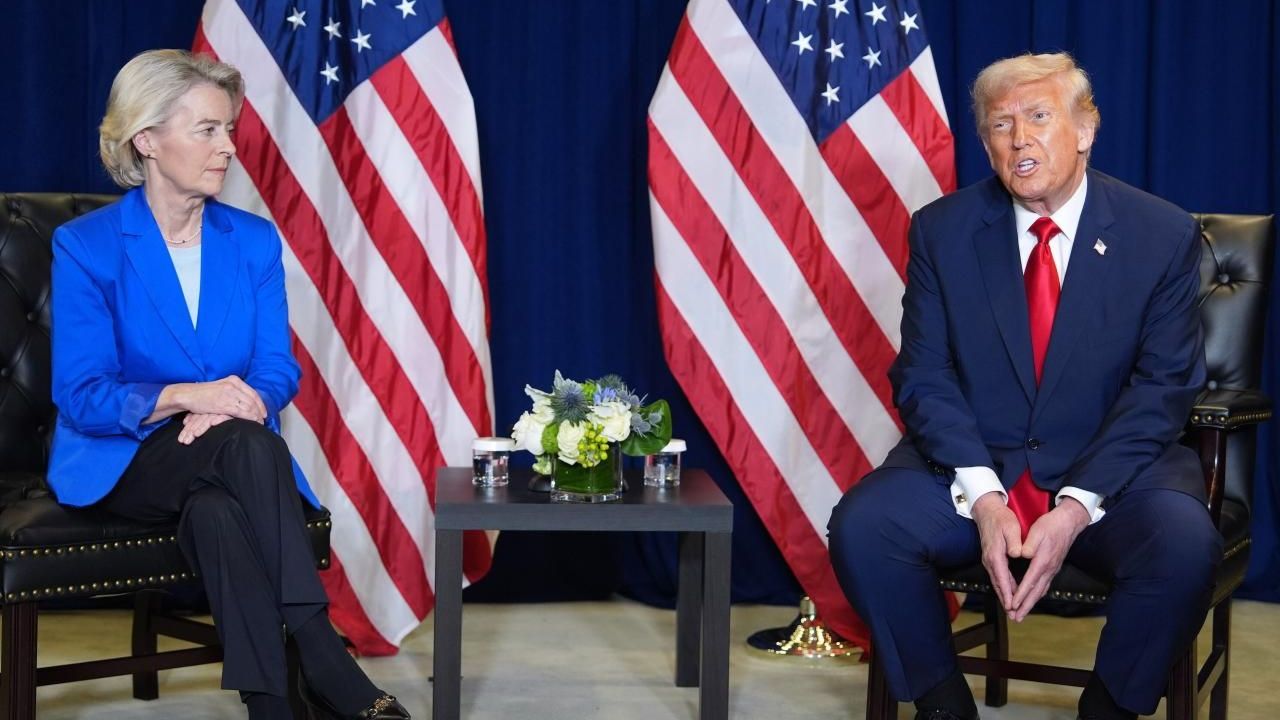
But Google isn’t the only party to potentially suffer. If the DMA fine for the American-based company comes to fruition, the EU risks attracting the ire of US President Donald Trump.
American retaliation? Washington has previously accused Brussels of unfairly targeting American companies through its digital policies. For example, in January, the Republican leader threatened to impose 100% tariffs on any European country that imposed a tax on digital services on US companies.
Right now, Brussels is walking a tightrope of tense transatlantic relations. Outside of the battle over big tech, the US government is preparing fresh import duties on the bloc as the current ones are due to expire this week.
The EU executive is expected to bow to these fresh import levies after the current regime lapses, according to Peggy Corlin, but many are concerned there could be additional retaliation following the DMA dispute.
“Toxic” Putin. Ukrainian President Volodymyr Zelenskyy stated in his nightly address that his country’s frontline gains and mid-range strikes are creating a “toxic” atmosphere around Russian President Vladimir Putin. But does this stench waft from Moscow to Manila?
Russian state-run news agency TASS confirms that Russia’s Foreign Minister Sergey Lavrov is meeting with his American counterpart Marco Rubio on the sidelines of the ASEAN (Association of Southeast Asian Nations) Foreign Ministers meeting in the Philippine capital. The meeting is scheduled to take place during the morning of 23 July.
In Manila, Rubio said the US remains open to playing a role in ending the conflict, “if that opportunity presents itself”. He did admit, however, the efforts have “fallen off a little bit over the last few months”.
Washington's attention has increasingly shifted to the Middle East following the conflict with Iran, particularly with news coming in overnight that the US announced a landmark nuclear deal with Saudi Arabia.
The framework allows the country in the future to produce enriched uranium, a key ingredient for nuclear fuel as well as nuclear bombs.
Fighting for peace. Kallas used her time speaking at the ASEAN forum in Manila to reiterate to partners, as well as observers, to “join the calls” that Russia should stop its full-scale invasion of Ukraine. Her team confirmed to Euronews yesterday that she had no scheduled meeting with Lavrov herself.
Some extra news: a major blow to proponents of migration crackdown. The European Commission on Thursday refused to register a controversial European Citizens’ Initiative spearheaded by far-right activists due to “discrimination grounded on race and ethnic origin”.
The document calls on the Commission to temporarily stop all “non-Western immigration channels” including study and family reunification visas. On top of this, irregular and regular migrants who have not integrated into European society should swiftly be returned to their country of origin, the document states. |