| | In today’s edition: Bahrain is considering nuclear power, Red Sea threats, and Qatar is backing an I͏ ͏ ͏ ͏ ͏ ͏ |
| |  Abu Dhabi Abu Dhabi |  Baghdad Baghdad | Farnborough |
 | Gulf |  |
| |
|
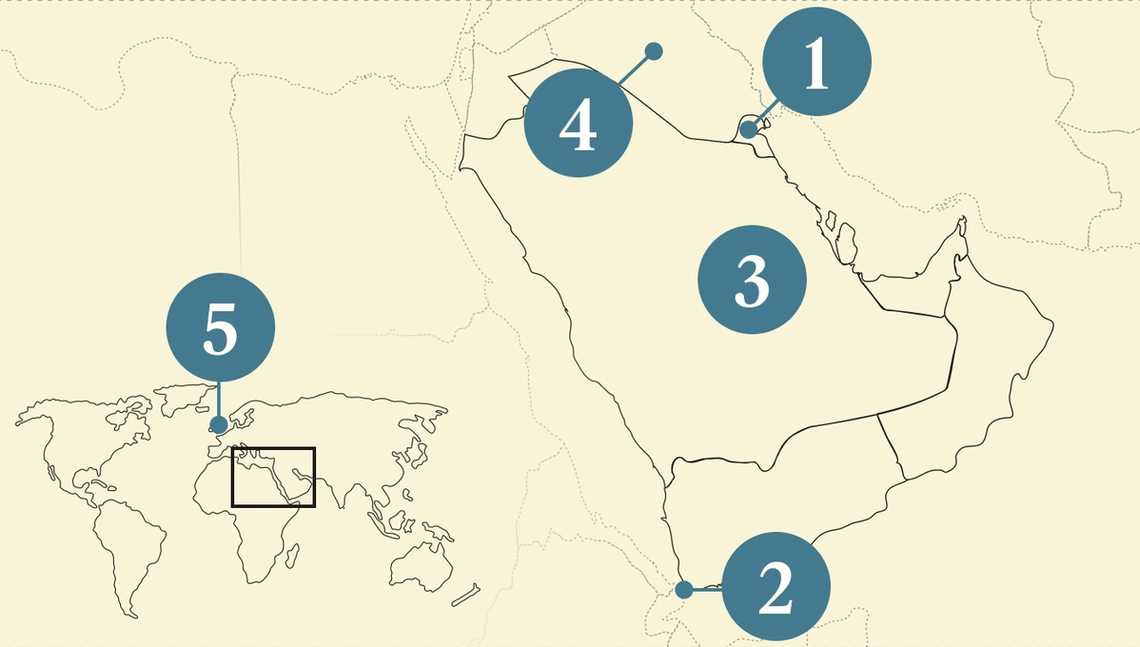 - Escalation, and oil at $90
- The Red Sea chokepoint
- PIF’s mobile tower monopoly
- Qatari firm lands Iraq pipeline
- Arms over planes at air show
 The CIA, China, and the UAE’s quests for AI chips. |
|
Oil tops $90 as strikes continue |
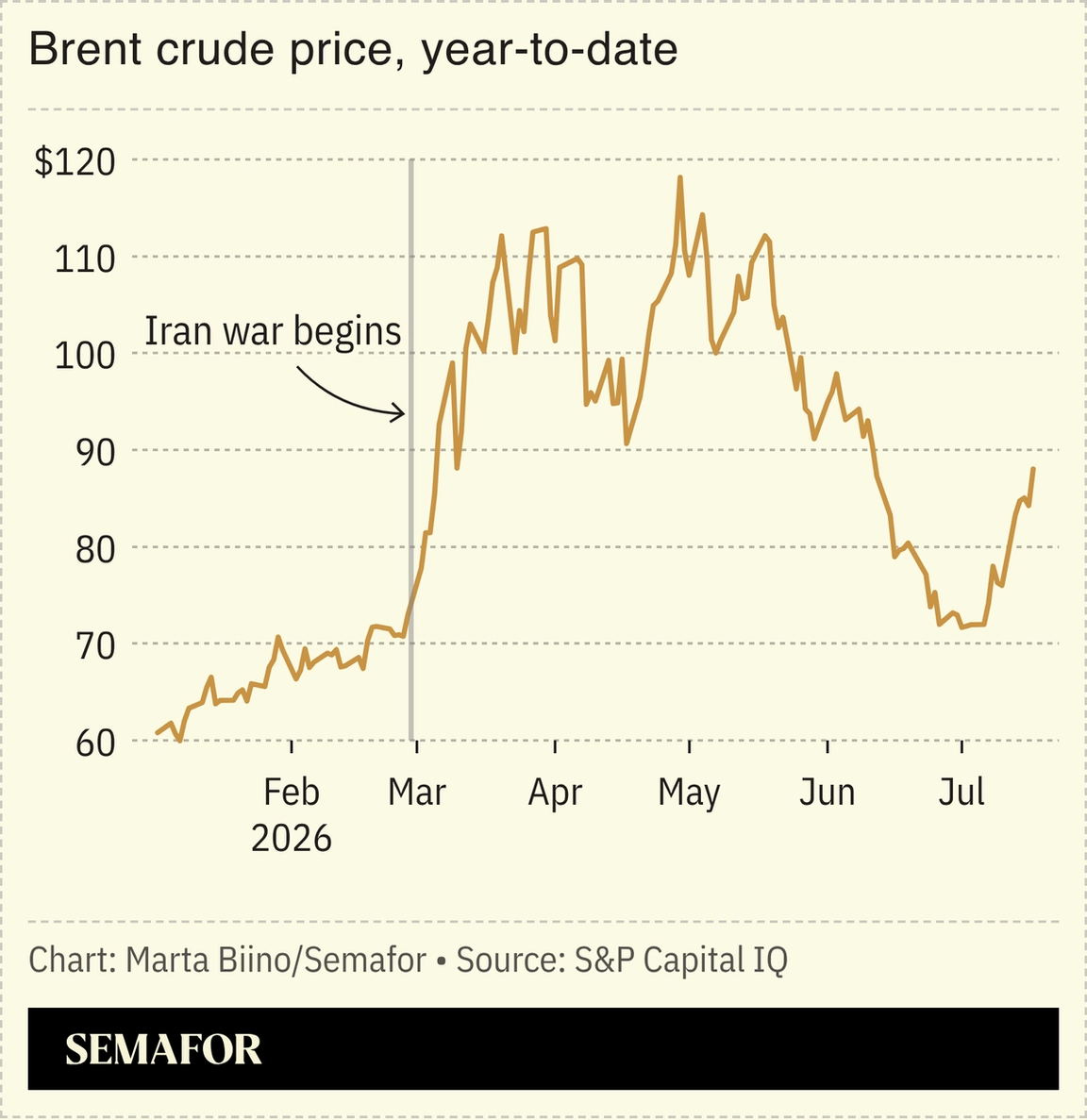 The US and Iran remain locked in a pattern of retaliatory strikes, which have now run for nine consecutive days. Alongside military targets, there are worrying signs that critical civilian infrastructure is now in both sides’ sights: Iran said power and water plants, and an under-construction nuclear power plant, were hit by the US; Kuwait said one of its power and water desalination plants was damaged in Iranian strikes. Qatar has reportedly put forward fresh mediation proposals, but there is little sign of momentum on peace talks, and the potential for further escalation is clear: The US is sending more jets to the region, and an Iranian government minister said Tehran will take “appropriate measures” to defend its security. Meanwhile, the costs are rising. US military personnel were killed in Jordan and Iraq in recent days, while oil rose above $90 a barrel for the first time since June 11. |
|
Red Sea gateway now at war risk |
 Nasa Worldview/Handout via Reuters Nasa Worldview/Handout via ReutersConcerns are growing that the Bab el-Mandeb strait, the southern gateway to the Red Sea, could become the next front in the war between the US and Iran. Tehran has previously instructed the Houthis (its allies, who control northern Yemen) to shut down the trade route if Washington hits the Iranian power network; the US has targeted several Iranian electricity plants in recent days. The Houthi leadership was due to give a statement on Monday, saying in advance that it would set out an “important position.” If the Houthis did start attacks, it would leave the region’s two main trade arteries disrupted at once. Around 9% of global maritime trade flows through Bab el-Mandeb, including about 3.1 million barrels of oil a day before the war; that figure has since grown, with Saudi Arabia now sending 70% of its energy exports through its Red Sea ports. — Ed Clowes |
|
Semafor Exclusive PIF’s telecom tower platform bulks up |
 Mike Blake/Reuters Mike Blake/ReutersTAWAL, the telecom tower company controlled by Saudi Arabia’s sovereign wealth fund, is in talks to acquire more than 10,000 sites from the kingdom’s second-largest mobile operator, according to people familiar with the matter. The multibillion-dollar deal would give TAWAL monopoly power over the kingdom’s mobile tower infrastructure and would pave the way for an IPO in 2027 or 2028, the people said. An IPO would mark another step in PIF’s push to monetize its domestic portfolio. The fund is trying to attract more investors into the companies and real estate developments it has created over the past decade, as it scales back spending on some of its biggest projects. — Matthew Martin |
|
Qatari role in Iraq-Syria pipeline |
 Essam Al-sudani/Reuters Essam Al-sudani/ReutersChevron and a unit of Qatari conglomerate Power International Holding agreed to work on reviving an Iraq-Syria oil pipeline. The link could carry up to 2 million barrels a day from Iraq, bypassing the Strait of Hormuz. The deal adds to the prominent role that Qatari firms are playing in Syria, where Gulf governments and companies are jockeying for position in the country’s reconstruction. Their involvement, with support from the US, is in part motivated by the hope that, by investing in Syria’s infrastructure, the country can become a geopolitical buffer keeping Iranian influence out of the Levant. The pipeline is one of multiple projects in the region to circumvent the strait: Goldman Sachs estimates that 60% of the prewar oil flow through Hormuz could be exported via new routes by the end of 2028. — Mohammed Sergie |
|
 BAE Systems/Sean Hills/Cover Ima via Reuters BAE Systems/Sean Hills/Cover Ima via ReutersWhen Gulf buyers turn up at the Farnborough Airshow this week, weapons will rival jetliners on their shopping lists — a measure of how the Iran war has reordered the region’s priorities. Defense firms account for half the exhibitors at this year’s industry gathering near London, a contrast to prior years when commercial planes were the main focus. One of the aircraft on display this week will be the British-built Eurofighter Typhoon fighter jet, which is used by several Gulf air forces. Some commercial airlines are still looking to do business, despite the war. Riyadh Air, Saudi Arabia’s newest airline, committed to buy 28 Boeing 787s and six Airbus A350s on Monday. |
|
 Energy- Sinopec, PetroChina and other Chinese companies are reportedly in talks with liquefied natural gas exporters to secure long-term contracts that do not depend on shipments through the Strait of Hormuz. China imported about 100,000 tons of LNG from Qatar between April and June, compared with 4.7 million tons during the same period a year earlier. — Bloomberg
Logistics- India has temporarily banned its 300,000 sailors from working on ships travelling through the Strait of Hormuz due to safety concerns, after more than a dozen Indian seafarers were killed during the war. — The National
Markets- The Botswana Stock Exchange will become the first African stock market to join the Abu Dhabi Securities Exchange’s Tabadul hub, linking investors from both markets to trade through local brokerages.
Trade- The UAE is calling for a trade agreement with the UK, asking incoming Prime Minister Andy Burnham to strengthen cooperation with the Gulf state in areas such as AI and financial services. — Politico
|
|
 The Stargate UAE project in October 2025. Courtesy of G42. The Stargate UAE project in October 2025. Courtesy of G42.Much has been said about the UAE’s AI ambitions, notably Microsoft investing in Abu Dhabi AI conglomerate G42 and Washington recently approving access to advanced US microchips. The Wall Street Journal reported new details of the effort, including the US dispatching a veteran CIA official to the UAE to assess G42’s intentions and ties to Chinese firms in 2023. Biden administration officials came away impressed by the company’s operations, Abu Dhabi’s willingness to address US security concerns, and the sophistication of G42 CEO Peng Xiao, who warned American officials about DeepSeek’s rapid progress in June 2024 — seven months before revelations of its advances tanked tech stocks. Not everyone in Washington was convinced, but enough consensus emerged to forge the US-UAE AI partnership. |
|
|


