
|
 |
Welcome to Popular Information, a newsletter dedicated to accountability journalism.
Trump quietly clears the road for Musk’s Cybercab
“It’d be wonderful for the United States to have a national set of rules for autonomous driving”
| |||||||||||||||


This article original appeared in Popular Information’s sister publication, Oligarch Watch. For more accountability journalism focused on the world’s wealthiest people, subscribe HERE.
Four years ago, Elon Musk conceded that Tesla, his automotive company, would be “worth basically zero” if it failed to deliver true autonomous driving technology.
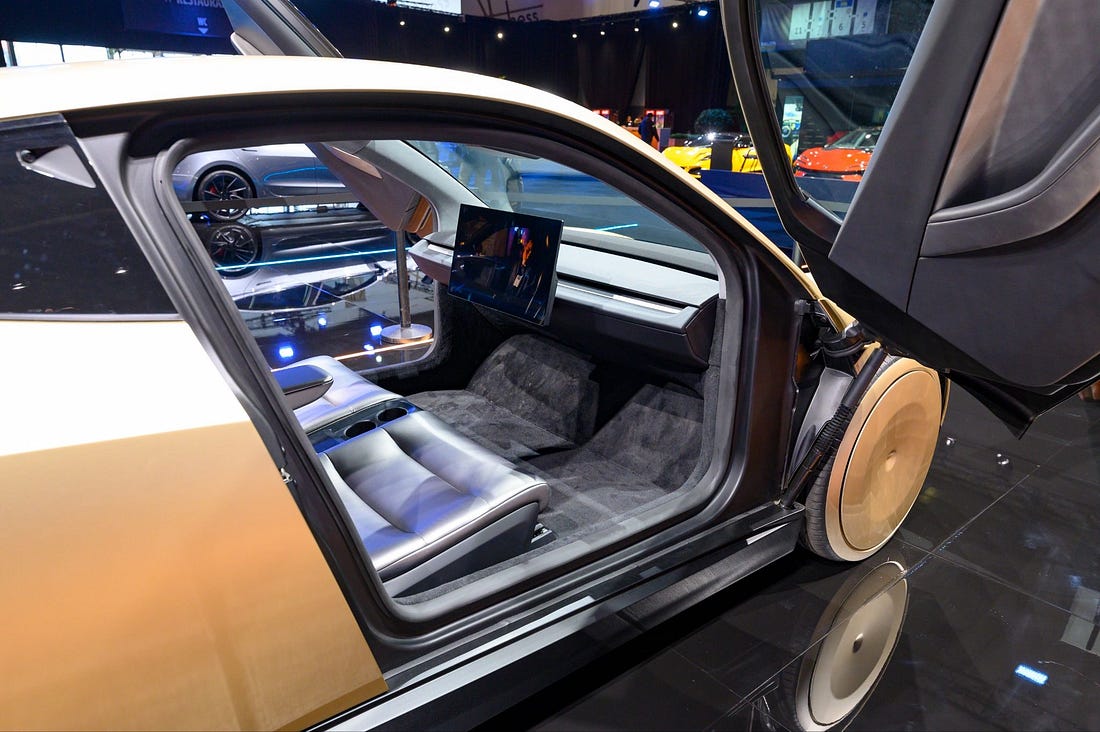
Since then, Musk, Tesla’s chief executive and largest shareholder, has directed the company to pump tens of billions of dollars into speculative autonomous driving research, development, and hardware. Recently, Tesla used its Gigafactory in Texas to produce scores of Cybercabs, a driverless-only model that the company cannot currently sell or deploy on public roads.
However, the Trump administration is now moving to fulfill the regulatory wishlist necessary for Musk’s autonomous driving dream — including deregulatory actions that would clear the way for automakers to drop traditionally required manual controls and safety features. These changes that would accommodate the Cybercab’s lack of a steering wheel, mirrors, and brake and acceleration pedals.
Accompanying the deregulations is a Department of Transportation (DOT) initiative to establish a uniform framework for evaluating the safety of automated driving systems at the federal level.
Musk — who shelled out $290 million to help elect Donald Trump in 2024 and another $85.1 million this cycle, largely backing congressional Republicans — has long lobbied for a similar national framework. According to Musk, the current fragmented system, in which individual states and cities decide whether automated driving systems are safe enough to deploy on public streets, is to blame for the plodding rollout of Tesla’s so-called Robotaxi ride-hailing service.
The DOT’s push to create a federal safety standard for self-driving systems and to loosen vehicle safety requirements to allow for autonomous vehicles like Tesla’s Cybercab were both included in the White House’s “2026 Regulatory Plan and the Unified Agenda of Federal Regulatory and Deregulatory Actions.” The agenda, a massive document quietly released last week, proposed eliminating or weakening hundreds of federal regulations.
I’ll be blunt: These are very challenging times for independent journalism.
First, social media companies like Facebook and X, which had long been a source of exposure and growth for independent outlets, sharply limited outbound traffic to news sites.
Now, Google frequently directs users to AI-generated slop instead of relevant news articles. This has dramatically reduced the number of readers who discover independent media through search.
These companies do not care about journalism. Or whether their users are well-informed. They care about profits.
To survive and thrive in this hostile environment, Popular Information needs your help. Support independent accountability journalism by upgrading to a paid subscription. You can make a real impact for just $6 per month or $50 per year.
“Tesla will have the largest fleet of autonomous vehicles”
For years, Musk has said the future of Tesla hinges on its ability to create driverless vehicles that it can both sell to consumers and use to dominate the ride-hailing industry.
“Tesla will have the largest fleet of autonomous vehicles as far into the future as I can imagine,” he wrote in a February post on X.
Part of that vision, he has said, includes doing away with steering wheels or pedals, despite the National Highway Traffic Safety Administration (NHTSA), a DOT agency, enforcing a litany of safety standards requiring vehicle manufacturers to include analog controls.
Amid the Trump administration’s deregulatory binge, DOT has proposed carving out numerous special exceptions to the Federal Motor Vehicle Safety Standards (FMVSS) that would apply to Tesla’s steering-wheel-less, pedal-less, and mirrorless Cybercab model.
One new deregulatory proposal from DOT indicates that current FMVSS requirements for vehicle electronic stability controls need to undergo “modernization” to allow approval of automated vehicles “that lack manually operated driving controls.”
Another deregulatory change calls for an “update [to] the light vehicle brake systems standard… to except ADS-equipped vehicles without manually operated driving controls from the requirements for physical brake controls that presume a person is driving the vehicle.”
A third safety overhaul would apply to the Cybercab’s mirrorless design: Because the FMVSS requires that new vehicles be equipped with rearview mirrors and backup cameras, DOT has proposed establishing new functional requirements specific to automated vehicles that would not require vehicles “to be equipped with mirrors and a rearview image display.” Instead, separate requirements would be created for the “detection of… standardized objects that simulate small obstacles such as a child,” according to a deregulatory notice issued by the Office of Management and Budget.
 |
According to Musk’s biographer, Walter Isaacson, the centibillionaire has previously said that Tesla would commit to a car with “No mirrors, no pedals, no steering wheel,” adding, “This is me taking responsibility for this decision. Let me be clear. This vehicle must be designed as a clean robotaxi. We’re going to take that risk. It’s my fau