Thanks for reading The Briefing, our nightly column where we break down the day’s news. If you like what you see, I encourage you to subscribe to our reporting here.
Greetings!
Are the Collison brothers looking to spice up their life? According to Reuters and other news outlets, the Collisons’ payments firm, Stripe, has teamed up with private equity firm Advent to make a $53 billion acquisition offer for PayPal. While the aging payments firm has lost the plot in recent years, this is not exactly a generous offer.
Though it’s pitched well above PayPal’s recent rock-bottom price, it’s below where the stock has traded for most of the past few years. In that sense it feels a bit like Stripe and Advent are engaging in bottom-fishing. It’s hard to imagine PayPal’s board will accept this offer. But it does put PayPal into play, raising the prospect that others might jump in with a higher number. A natural buyer could be Elon Musk’s SpaceX.
Aside from rockets and satellite broadband, the company also owns X, which has long planned an X Money payments service. Musk, need I remind people, is also a former PayPal executive. Given that PayPal generates about $5.5 billion in free cash flow annually, paying $60 billion or so for PayPal might make sense particularly if SpaceX used its stock in the deal. PayPal’s cash flow would help SpaceX pay for its substantial AI investments.
One big question, then, is whether Stripe and Advent are willing to raise their price, which in turn raises the issue of why they want PayPal in the first place. One Wall Street analyst, Andrew Jeffrey from William Blair, argued in a report on Wednesday that the “industrial logic” of a Stripe-PayPal combination “does not seem to be there.” Stripe has said its payment volume expanded 34% last year, to $1.9 trillion.
PayPal, for its part, reported payment volume of $1.79 trillion, up only 7%. Given those relative growth rates, Stripe’s edge in payment volume is sure to widen. Jeffrey estimated that “Stripe will probably process about 40% more volume than PayPal this year.” In other words, PayPal will dilute Stripe’s robust growth.
That said, PayPal’s strength lies in its PayPal and Venmo consumer payment apps—particularly Venmo, which is growing much faster than PayPal’s overall checkout business. Stripe isn’t well established in the consumer market—it is the behind-the-scenes payment processor for businesses. Acquiring PayPal could therefore complement Stripe’s existing business. And Stripe’s management chops should help PayPal better compete with Apple Pay and Google Pay.
If a bidder bumps up the price a bit more, PayPal’s board will have to contemplate what life will be like if it stays independent. The company only recently replaced its CEO with Enriques Lores, a former CEO of HP, who despite several years on PayPal’s board clearly doesn’t have the same day-to-day experience in payments as the Collisons. Lores has outlined a vision to cut costs and rejuvenate PayPal—for example, by accelerating Venmo’s growth. But given the uncertainty of success, the board might find it tough to turn down a higher offer.
SpaceX’s Plunge
This might not be the best day to suggest that SpaceX issue more shares. The rocket and broadband firm’s stock traded below its $135 IPO price for the first time since the company’s public debut a month ago, falling as low as $132.15 before rallying to close at $135.27.
While early buyers might be fretting—particularly anyone who jumped in at the high point of $211, reached two days after the IPO—the current market capitalization of the company of about $1.8 trillion is still a very generous number given that analysts expect SpaceX will generate just $39 billion in revenue this year, according to S&P Global Market Intelligence.
SpaceX stock represents a very, very, very long-term bet on Elon Musk’s ambitions to travel to Mars. Investors willing to own the stock need to put it away in a drawer and not look at it again for 25 years or so.
In Other News
• Nvidia on Wednesday released a new small open-source model for physical AI that operates in the real world, including for robots.
• Apple has received a key approval in China that paves the way for the release of its Apple Intelligence on-device AI service in the country, as the Chinese internet regulator permitted the Apple AI service, along with six other services, under generative AI rules.
• Longtime Amazon Web Services executive Dave Brown is leaving the cloud provider, AWS CEO Matt Garman told staff Wednesday. Brown is going to a “new role outside the company,” Garman said.
Today on The Information’s TITV
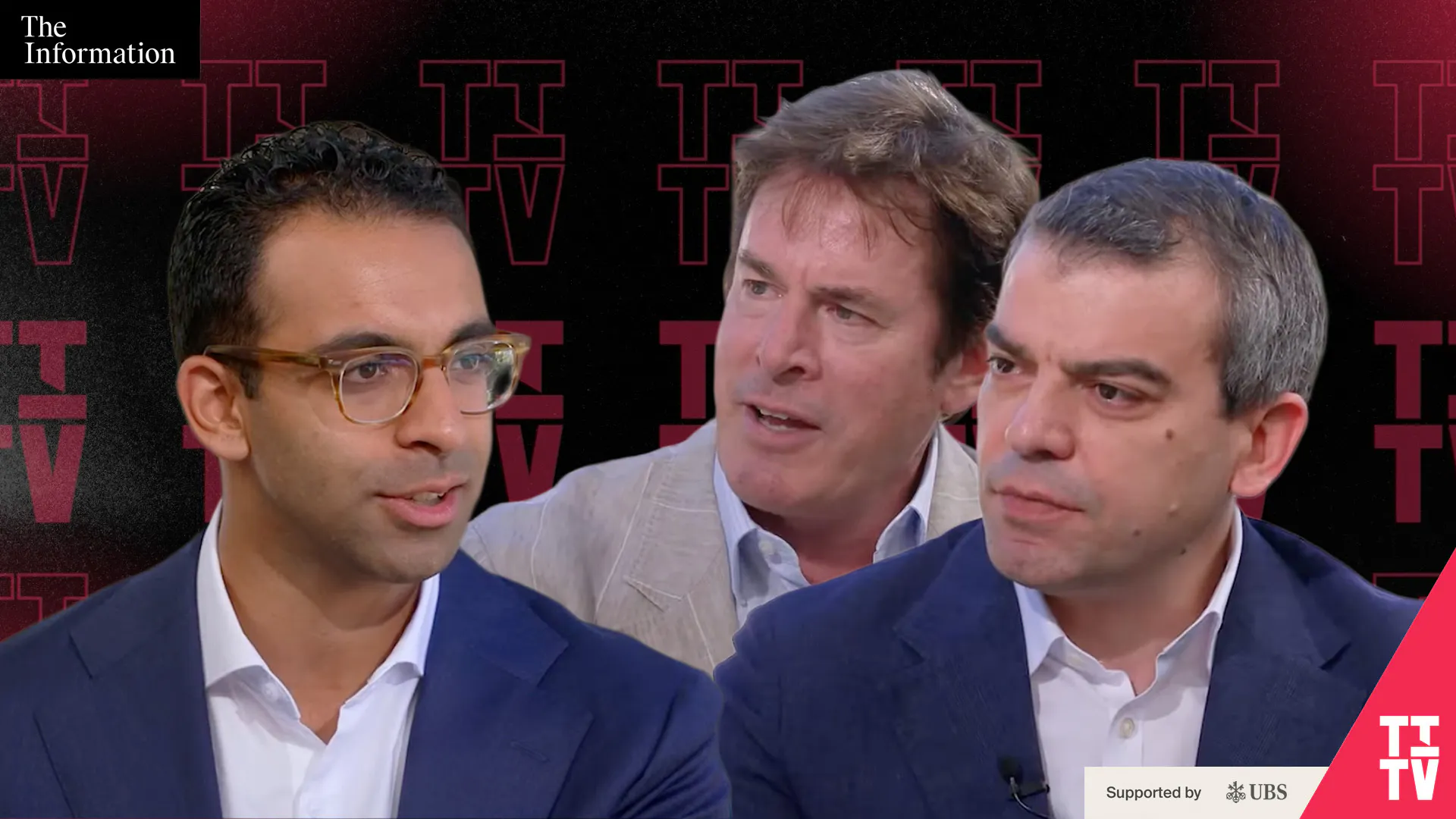
Check out today’s episode of TITV where we cover UBS’ private AI, software and internet conference on the ground, unpacking the state of the SaaSpocalypse and big questions facing AI researchers.
Recommended Newsletter
Start your day with Applied AI, the newsletter from The Information that uncovers how leading businesses are leveraging AI to automate tasks across the board. Subscribe now for free to get it delivered straight to your inbox twice a week.
One year of TITV calls for a toast. Join The Information on July 16 in San Francisco as we celebrate TITV’s first year with a happy hour for the insider community shaping and covering the defining stories in tech. Request an invite to attend.
Request an invitation to join The Information and EY for an exclusive dinner bringing together senior leaders for candid conversation on closing the trust gap in enterprise AI.
Get ahead of the story. Purchase your ticket to AI Agenda Live, where The Information's reporting team convenes the leaders driving the next era of AI. Early Access pricing available now.
Tickets on sale now: The Information returns to Napa Valley October 27–28 to convene senior women across tech, media, and finance. Join us for two days of intimate, candid conversations with the leaders navigating today’s global shifts.