| | In this edition: How Obama fits into Michigan’s primary, Dems vs. the alpha left, and 2028 hopefuls ͏ ͏ ͏ ͏ ͏ ͏ |
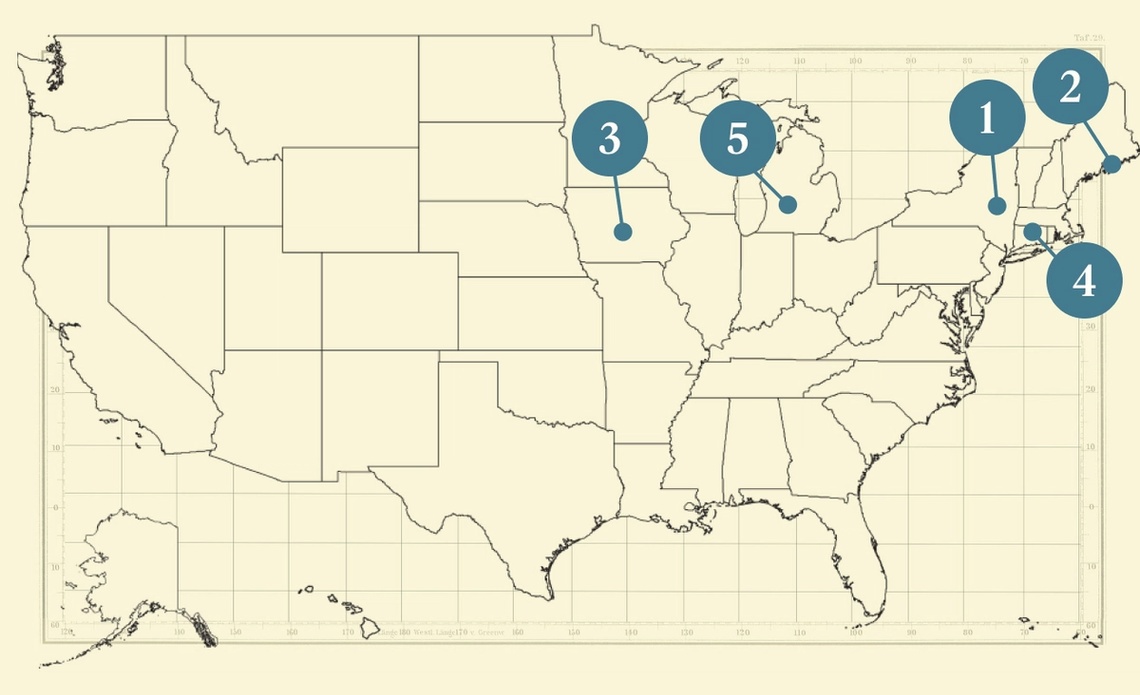
| |  DES MOINES, IA DES MOINES, IA |  DETROIT, MI DETROIT, MI | HARTFORD, CT |
 | Americana |  |
| |
|
 - AI politics shakeup
- Dems vs. the alpha left
- 2028 hopefuls hit the trail
- Connecticut’s gubernatorial ad war
- Michigan momentum shift?
|
|
 Last month, after Abdul El-Sayed and I wrapped up our interview in the Detroit suburbs, I mentioned the ongoing effort by centrist Democrats to link him to Graham Platner. The candidate laughed. El-Sayed rose on his strength during short TV hits, where he would talk about his issues — “Medicare for All,” no more wars — and the interviewer would ask about newsy topics like Platner, who used some of the same consultants as him. El-Sayed liked to joke that he was already running for Senate as a Muslim with the middle name Muhammad, “and now I have to carry that guy?” If centrists have their way: Yes, he does. They want the debacle in Maine, where the left got its candidate and tumbled face-first into disaster, to be front of mind for Democratic primary voters. Centrists warned that a bizarro left-leaning tea party would, like its right-wing antecedent, throw away winnable seats. This feels like their moment. But so far, the moment has revealed how hard it is for the party to fight an insurgency without a clear leader. Ten years after some Bernie Sanders delegates marched out of the Democratic National Convention, the party is still cautious about using its resources to beat the left. And the centrist groups that want to take that on haven’t gotten as far as they hoped. Maine is a prime example here; as disastrous as the fall of Platner’s Senate campaign was, it did nothing for Democratic centrists. Pro-Platner groups like Our Revolution and the Progressive Change Campaign Committee charged in after his departure, amplifying the left’s message that Maine Democrats had given the nomination to their movement. “The people of Maine voted overwhelmingly for a bold, working-class, progressive agenda,” Our Revolution’s Joe Geevarghese said on a Monday night stream with other progressive candidates, including El-Sayed. “That mandate should not be erased behind closed doors.” The truth is, no centrist is even threatening that mandate. The field to replace Platner at a convention next week is set. Two candidates, Troy Jackson and Shenna Bellows, were on Platner’s ranked-choice ballot for governor and are seen as part of his movement. Another candidate, Nirav Shah, agrees with the most contested points of the Platner agenda — that America should move to government-run healthcare and that Israel carried out a genocide in Gaza. |
|
Hochul joins a data center fight staked out by the left |
 Eduardo Munoz/Reuters Eduardo Munoz/ReutersWhen New York Gov. Kathy Hochul announced a one-year pause on data center construction this week, she joined a fight that had been playing out in Democratic primaries for months. Progressive candidates, led by the environmental movement and Sen. Sanders, I-Vt., have spent months calling for data center moratoriums and strict new regulations. Moderate Democrats, wary of super PAC spending and of the more nuanced AI stance taken by unions, hadn’t tended to join them, until Hochul. “Progressives have made the influence of big money a major divide in our politics this cycle,” said Faiz Shakir, an adviser to Sanders, who in March proposed a nationwide data center moratorium alongside New York Rep. Alexandria Ocasio-Cortez. “The centrist push has been so clearly ‘public-private partnerships,’ while we have been ‘fight oligarchy.’” The power of running against data center construction was visible last year in Virginia elections, where local candidates in both parties ran against AI company tax breaks and energy costs. Polling on the issue has moved hard against the industry since then. In one Michigan race, a co-founder of the Sunrise Movement made his first campaign ad about data centers — and a Sunrise activist, on video, confronted one of his primary opponents to ask why she wouldn’t join him in calling for a moratorium. Read my whole story here. → |
|
|
Semafor Exclusive Democrats wage a new campaign culture war with the alpha left |
 Amanda Sabga/Jonathan Ernst/Reuters Amanda Sabga/Jonathan Ernst/ReutersDemocrats are navigating a new culture war over exactly what kind of behavior — from candidates and staff — the party should tolerate. The meltdown of Platner’s Maine Senate bid over sexual assault allegations reopened old divisions between the party establishment and a crop of swaggering young men on the left, many of whom entered politics with Bernie Sanders’ presidential runs. As one prominent Platner defender denounces “Dem HR lady politics,” mainstream Democrats lament that the “Bernie bro” image of 2016 has essentially persisted. “There are so many instances where a woman candidate or a person of color candidate is asked, time and time again, whether or not they are qualified, and they are given so many tests. And then you have someone [who makes] you feel good because they’re wearing plaid, and so that you should just give them the benefit of the doubt?” asked Rep. Sydney Kamlager-Dove, D-Calif. The crackup is prompting some progressives to warn their colleagues on the left to be more choosy with their endorsements from now on. With other Democrats choosing horses in Maine’s race to replace Platner on the ballot, Rep. Mark Pocan, D-Wis., said he was thinking “just sit the f*** down. Maybe let the process be a little bit. Let’s find out who’s getting in.” “I think member restraint is necessary,” Pocan said, not naming any of Platner’s endorsers specifically. “You don’t have to be the first person to endorse someone, to say you were.” Check out the full story, with exclusive details from Pennsylvania and Maine, from Semafor’s Nicholas Wu, Brendan Ruberry, and Lauren Morganbesser. → |
|
|
Moore, Buttigieg hit the trail in swing states |
 Annabelle Gordon/Jeenah Moon/Reuters Annabelle Gordon/Jeenah Moon/ReutersTwo Democrats with eyes on 2028 campaigned in competitive states this week, with Maryland Gov. Wes Moore swinging through Nevada and South Carolina while Pete Buttigieg stumped in Iowa and Nebraska. At Iowa Democrats’ annual fundraising dinner, Buttigieg honed a message he’s been delivering all year: Americans want change that can only come if the Constitution is amended to tackle the rise of corporate-funded super PACs. “If something can’t go on forever, then it won’t. If something can’t go on forever, then it will stop,” Buttigieg said in Des Moines. This is a continuation of a theme from his 2020 presidential bid, when Buttigieg was willing to entertain expanding the Supreme Court and amending the Constitution to reverse the effects of the Citizens United decision that paved the way for more corporate cash to flood into campaigns. |
|
Lamont’s challenger tries to turn his wealth against him |
 Josh Elliott/YouTube Josh Elliott/YouTubeTwenty years ago, Ned Lamont challenged Connecticut Sen. Joe Lieberman for the Democratic nomination, and beat him. Lieberman promptly left the party, winning reelection as an independent and inspiring a new “sore loser” law to prevent that from happening. Lamont is now running for a third term as Connecticut’s governor, and the wealthy former telecom executive’s copious self-funding inspired Democrats to increase the state’s primary matching funds. Josh Elliott, Lamont’s progressive primary challenger this year, is using those funds to charge that the governor won’t make “billionaires pay their fair share.” Lamont’s ads to counter that argument in the primary, like “Drive Down,” assure voters that he’s already tackling the cost of living by addressing power bills: “These initiatives will hold utilities accountable.” |
|
Michigan becomes a less clear head-to-head contest |
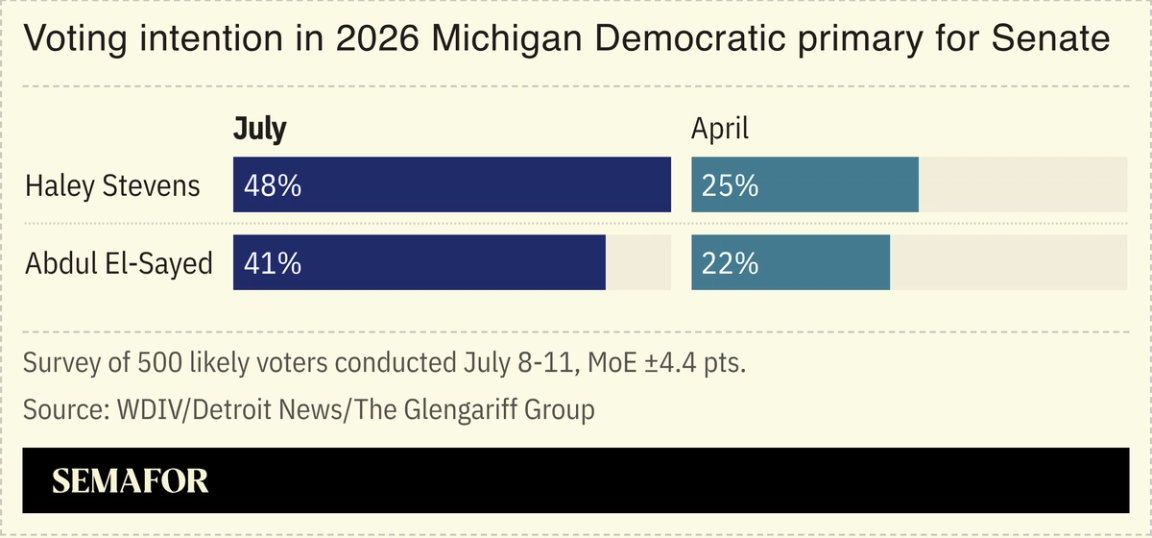 The decline of independent, reliable state-by-state polling is an underrated factor in this year’s elections. That’s because campaigns and third-party groups have filled the gap. As Mallory McMorrow quit the Democratic Michigan Senate primary, polling from progressive groups showed El-Sayed running marginally better than her or Stevens against expected GOP nominee Mike Rogers — and winning most of McMorrow’s voters if she quit. The Glengariff Group’s polling, previously conducted for the Detroit Chamber of Commerce, always showed a closer race than El-Sayed wants. It now finds El-Sayed winning the Sanders coalition from the 2020 primary (which, it should be noted, Sanders lost): younger voters, college-educated voters, and white voters. Stevens leads by lapping El-Sayed with Black voters and doing better with working-class whites. |
|
 Semafor Gulf is now expanding to five days of coverage per week, reflecting the growing need for deeper reporting on the region. More than ever, developments in the Gulf are reverberating around the world, affecting events, energy markets, and entire economies. We are growing our network of reporters and editors across the region and the world and, starting this week, are expanding our coverage of the Gulf into a daily briefing. Subscribers will get even more of the sophisticated, scoopy journalism they’ve come to expect, every weekday. |
|
 Fred Prouser/Reuters Fred Prouser/ReutersAs the not-particularly-young father of a very young kid, I’m taking some time off from parties. That includes the 90s-themed bashes that Politico’s Megan Messerly survived for her trend story about why people born after that decade miss it so much, especially if they’re more politically conservative. Why are all these people on the right so excited to see Nelly? I fully understand it now. |
|
 Elizabeth Frantz/Reuters Elizabeth Frantz/ReutersEven for readers of this briefing, the Washington encomia for Lindsey Graham might have been a surprise. For a long time, he was viewed as the junior partner of John McCain and Lieberman. His 2016 bid for president left behind quotes — praise for Joe Biden, damnation for Donald Trump — that he’d have to live down. Liberals, who appreciated anti-Trump Republicans in 2016, turned hard on conservatives like Graham who later flipped to support the president. But two longish reads this week can catch you up on Graham’s personality and importance: one from Politico’s Jonathan Martin, who knew Graham as a reporter, and another from Richard Fontaine in The Atlantic, who traveled with t |
|
|


