
|



Matic: The Robot Vacuum Making Intelligent Automation Possible at Home (Sponsored)
 |
Matic is the first visually intelligent robot vacuum that sees your home like you do, so it can clean how you want it to.
Matic’s hero features:
Runs entirely on cameras to deftly navigate obstacles
Recognizes floor types to auto-switch between vacuuming and mopping
Big wheels and a height-adjustable cleaning head handle thick rugs
Quieter than conversations at 55 dB
Handles pet hair without clogging or tangling
A single bag collects dry and wet waste—diaper-salts gel dirty water, antimicrobial powder prevents mold
A fresh HEPA filter in every bag for cleaner air, no washing or replacing
Travel platforms are increasingly using AI for customer support. This means an increase in automated answers with less human intervention.
However, the cases handled automatically are largely lookups and routine changes that map cleanly onto a structured workflow. The cases that remain are typically disputes, such as a host and a guest having different views about a cancellation. In such cases, the travel platform is positioned between them and is accountable for the funds. The platform needs to figure out how to deal with these cases. It is not just a business problem, but also an engineering problem.
There is an important question at the center of this problem. At what moment should the system stop and route a case to a human agent?
A platform fielding hundreds of millions of contacts a year faces that decision millions of times a day, across cancellations, refunds, and after-hours lockouts. A confident but wrong answer can ruin a traveler’s trip and the money at stake.
Airbnb, Booking[dot]com, and Expedia have each tried to solve this problem in different ways. Airbnb prioritized autonomous resolution, building models that settle cancellations and refunds before an agent enters the conversation. Booking concentrated on the handoff, routing complex cases to a representative briefed in advance while equipping hosts to answer guests directly. Expedia emphasized deflection at scale, investing in summaries that carry context across more than thirty languages so an escalated case arrives intact.
In this article, we will look more closely at the different solutions by following the support pipeline from first principles, show why a tail of cases resists automation regardless of model quality, and use these three approaches to understand how these can be handled.
Disclaimer: This post is based on publicly shared details from various sources. References at the end. Please comment if you notice any inaccuracies.
 |
The Pipeline
Start with the simplest version of automated support: a bot that matches a traveler’s message to a list of frequently asked questions and returns the closest article.
It works for questions like “What is your cancellation policy?”
However, it fails the moment a traveler writes something like “My host agreed to refund me, so what happens if I cancel now?” That sentence carries an intent, a history, and a financial consequence, and a simple keyword match treats it as a search query.
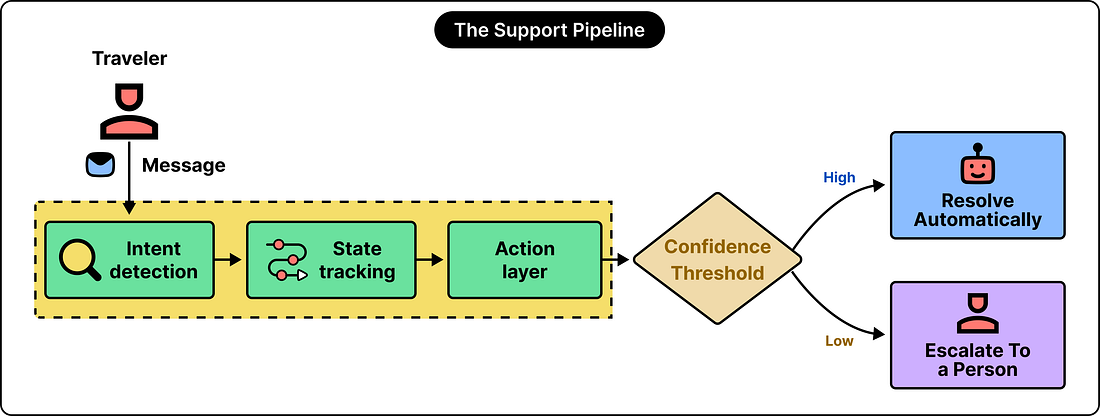
The first real component is intent detection. In plain terms, the system classifies the message and identifies what the traveler wants: a rebooking, a refund, or a question about an existing reservation.
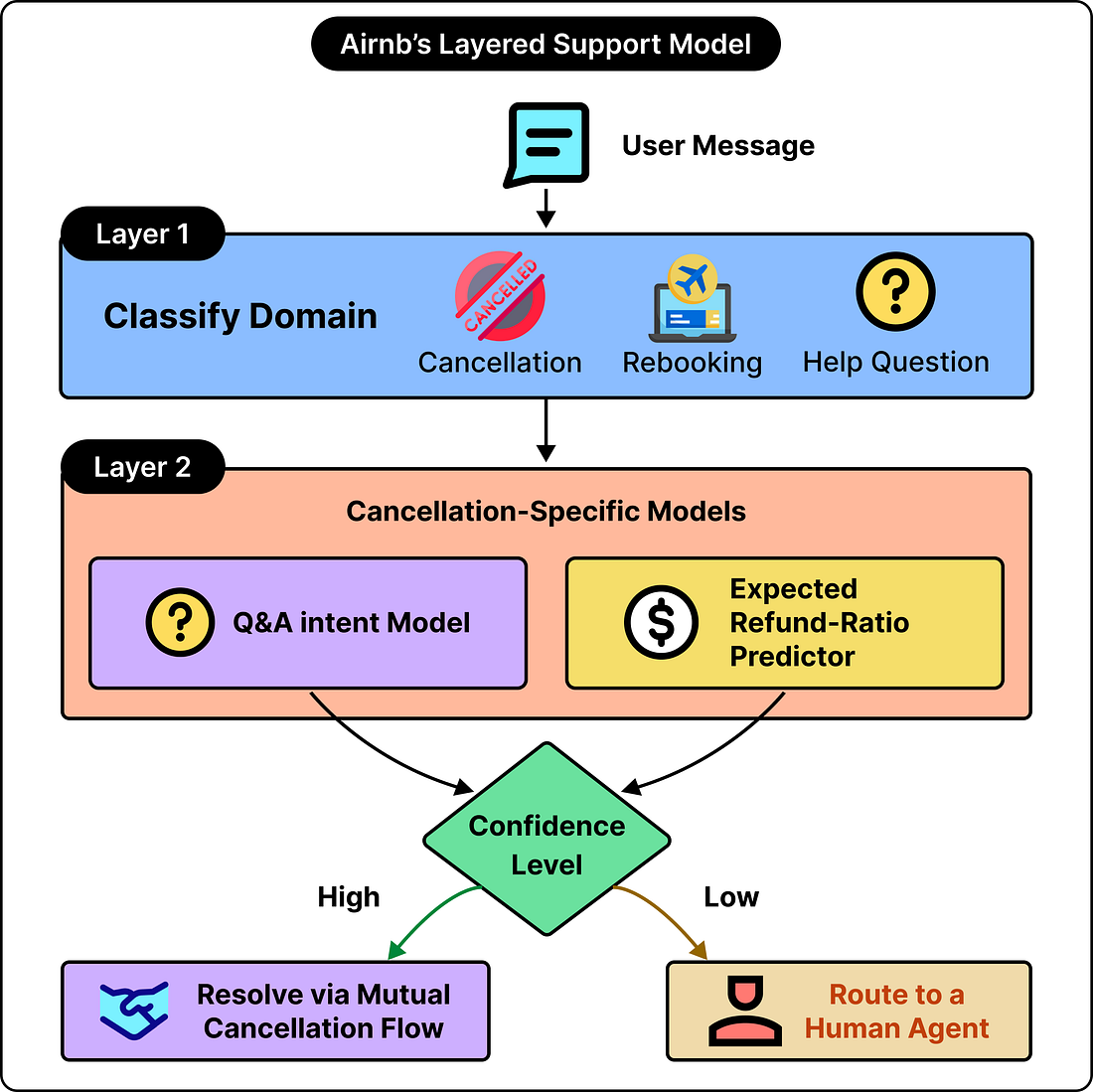
Airbnb frames this as a layered problem:
A top-level model performs domain classification, sorting the message into a broad category such as cancellation or a help-article question.
Once the category is settled, a second layer of domain-specific models takes over to work out the details.
For a cancellation, those second-layer models answer focused questions. Did the host or the guest initiate it? Have both sides agreed on a refund amount?
Alongside this, a separate model predicts the expected refund ratio (such as the share of the payment a human agent would typically return given the circumstances of the trip). That predictor is trained on years of past agent decisions, which lets the system produce decisions in line with how experienced staff have handled similar cases.
 |
However, a message understood is still inert until two further capabilities exist:
The system tracks state, meaning it carries the context of earlier messages in the thread, so a follow-up reply makes sense against what came before.
And it has an action layer, the part wired into live systems that can issue the refund, move the reservation, or open the mutual cancellation flow.
Reading intent is the easier half. Taking a cor