| | In today’s edition: Renewed fighting is delaying the Gulf’s recovery and Saudi soccer fans are being͏ ͏ ͏ ͏ ͏ ͏ |
| |  | Gulf |  |
| |
|
 - US and Iran back at war
- Gulf recovery hopes dim
- Saudi World Cup piracy
- Advertisers dip into gaming
- Dubai diamond trade surges
 Abu Dhabi knows where its oysters are. |
|
Fighting picks up as diplomacy withers |
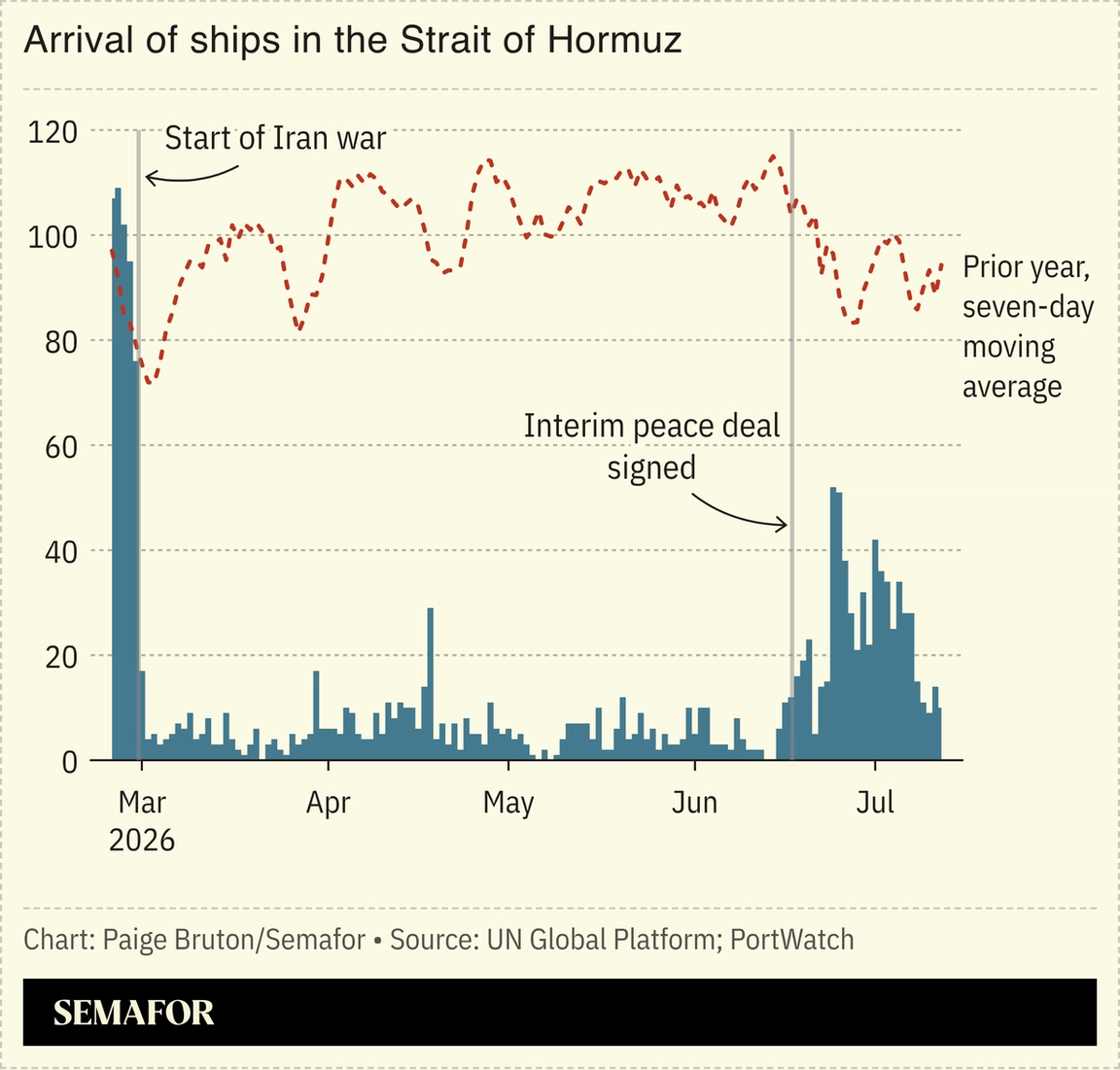 The US and Iran are again on a war footing, albeit not at the intensity of earlier in the conflict. US forces targeted Iranian missiles, drones, ships, and defense systems on Wednesday, with the aim of degrading Tehran’s ability to threaten ships in the Strait of Hormuz. Iran responded with attacks on Bahrain, Jordan, and Kuwait. The US also reimposed a maritime blockade on Iran, but President Donald Trump walked back from his plan to impose a 20% fee on Hormuz shipping. The president said Gulf countries could invest in the US instead, although there have been no announcements of fresh deals. He also said the strait was open to all non-Iranian traffic, but few vessels are willing to take the risk. Tehran has threatened to close other chokepoints, such as the Bab el-Mandeb strait at the southern entrance to the Red Sea. Military action did not convince either side to back down earlier in the conflict, and there is no sign of that changing, but diplomacy has also failed to deliver a breakthrough. Meanwhile, oil prices are heading up. |
|
Revived conflict dims economic hopes |
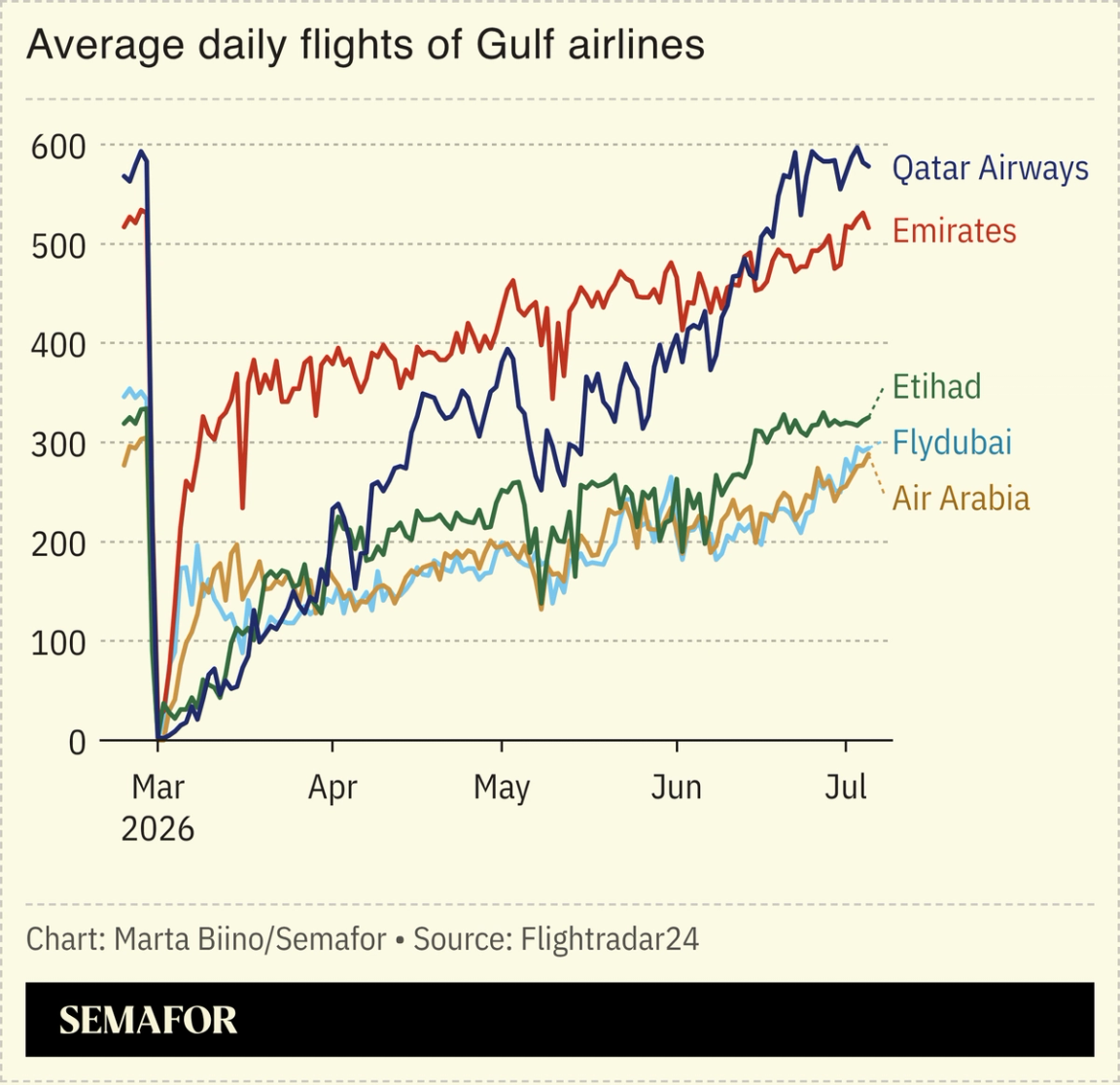 The collapse of the interim peace deal between the US and Iran is delaying any recovery in crucial economic sectors for Gulf countries, including aviation, energy, tourism, and real estate. Regional airlines have mostly recovered to pre-conflict capacity levels, but the EU’s aviation watchdog issued a fresh warning advising airlines to avoid airspace over much of the region. With travelers describing tense waits at airports amid missile alerts on their phones this week, it means international carriers — and many tourists — are unlikely to make a comeback soon. Meanwhile, the US has again closed its embassy in the UAE, and oil and gas exports through the Strait of Hormuz are at a standstill. Analysts had expected a quick rebound if the ceasefire proved durable, but the collapse of the interim deal and a renewed battle for Hormuz could extend the economic pain into next year. — Kelsey Warner |
|
Semafor Exclusive Saudi blocks World Cup matches |
 Siphiwe Sibeko/Reuters Siphiwe Sibeko/ReutersAs soccer fans in Saudi Arabia gear up for the final World Cup matches, many have been unable to legally watch the tournament, after the network that holds the regional broadcasting rights was blocked in the kingdom. BeIN, the Qatari-owned platform that has the rights to air games across 24 countries in the Middle East, hasn’t been available in Saudi Arabia since the tournament began last month. Its streaming service, TOD, is also inaccessible in the kingdom. It is not clear why the coverage has been blocked; the Saudi government and football’s world governing body FIFA did not respond to requests from Semafor for comment. The ban has put soccer fans in the unusual position of relying on unauthorized streaming sites and VPNs to watch the world’s most popular sporting event. Saudi Arabia, which is itself due to host the 2034 World Cup, previously blocked BeIN during an economic boycott of Qatar from 2017 to 2021, when it also launched a rival pirate network called BeoutQ in the kingdom. BeoutQ was eventually closed when the Gulf countries reconciled in 2021. — Matthew Martin |
|
Gulf brands wade into gaming |
 Ahmed Yosri/Reuters Ahmed Yosri/ReutersGaming is moving from the margins of Gulf marketing budgets, as brands look for new ways to engage young consumers. In Saudi Arabia, two-thirds of the population are active gamers, and the state has committed more than $37 billion to games studios and esports through its Public Investment Fund-owned Savvy Games. Such figures make a tempting target for some. Nabil Moutran, whose Dubai firm Division links brands with some of the region’s biggest players, set up Saudi gamer ShongXBong as a brand ambassador for Nissan, integrating its cars into his gameplay on a monthly two-hour stream. In one instance, there was a 488% increase in test-drive applications on the day of the stream, Moutran told Semafor. Still, spending has yet to reach the levels of traditional advertising channels: Marketing teams are under pressure to show measurable returns and many are “very reluctant to look at new, innovative spaces,” Moutran said. — Manal Albarakati |
|
Dubai diamond trade hits record high |
 The value of Dubai’s diamond trade reached a high of $41.7 billion in 2025, according to customs data, breaking the previous record set in 2011. The milestone was driven by record physical volumes of 359.5 million carats — up 42.5% year-on-year — with natural diamonds accounting for nearly 96% of total trade value. In recent years, Dubai has established itself as an essential node for the industry, connecting diamond producers with refining centers and consumer markets globally, and supplanting the traditional home of the trade in Antwerp, Belgium. Since 2020, diamond trade through Dubai has more than doubled in value. |
|
 EnergyLogistics- Saudi Arabia will invest $171 million to expand cargo capacity at Jeddah Islamic Port, its main Red Sea gateway, in partnership with terminal operators DP World and Red Sea Gateway Terminal. The upgrade lands as the Iran war pushes Gulf trade toward routes bypassing the Strait of Hormuz. — Arab News
Traffic- As in previous crises, Dubai is pushing ahead with infrastructure projects. The government approved a 2 billion dirham ($545 million) road project linking some of the city’s high-end suburbs, including Dubai Hills and Al Barari. When completed in 2029, it is expected to cut driving times for about 650,000 residents.
- Traffic is less of a concern for those in autonomous vehicles — and soon, everyone will be able to spot them on Abu Dhabi’s roads: The emirate has mandated blue license plates for driverless cars.
|
|
 A research diver off the UAE coast. Courtesy of Environment Agency-Abu Dhabi. A research diver off the UAE coast. Courtesy of Environment Agency-Abu Dhabi.A three-year effort to map the oyster population in Abu Dhabi’s waters yielded more than expected, according to the emirate’s environmental agency. Using old pearl diver maps, firsthand knowledge, and modern survey data, as well as Hawksbill sea turtle tracking (the endangered turtles are known to congregate around oyster beds), researchers found that oyster beds cover around 7% of Abu Dhabi’s marine environment. The effort resulted in a robust map of a crucial animal in the Gulf’s ecosystem, which the agency has pledged to help safeguard. Researchers found a relationship between oyster beds and gatherings of fish and whales. The mollusk is also a contributor to carbon storage: As they grow, oysters draw dissolved carbon from the seawater to produce calcium carbonate, the mineral that forms their shells. The collapse of the Gulf pearling industry — which began in the late 1920s on the arrival of cheaper Japanese cultured pearls — brought widespread poverty to the region, until the discovery of oil shortly after. The ups and downs of the pearl trade became a parable in some Emirati circles for the need for the country to embrace the potential of technology: Ignore innovation at your peril. — Kelsey Warner |
|
|


