|
|
|
|
|
|
|
|
|
Whether it's telecoms or banks, Canadians tend to stay put with the same providers even if they are unhappy with the service. Andrew Vaughan/The Canadian Press
|
|
|
|
|
We’ve all been there. We grumble about a terrible experience at a bank or telecom, then pay the bill and remain a loyal – if unhappy – customer for another 20 years. |
|
|
|
|
Is that you? It certainly describes my own stagnant approach to these matters: I’ve switched my chequing account only once in my life, and I’ve never changed my telecom provider in my adult life, even as I remain steadfastly indifferent to the brand. |
|
|
|
|
We all have our reasons for staying put. |
|
|
|
|
Sometimes, there are bundled services to consider, where you’re getting a deal on your phone because you also get an internet connection from the same company. Or a bank has your chequing account, trading account, credit card and mortgage. |
|
|
|
|
|
|
|
|
That makes severing one service an ordeal. |
|
|
|
|
|
|
|
|
|
|
For me, laziness is definitely a factor. So is resignation that for all the upbeat marketing hype – convenience! speed! trust! – there might not be a whole lot to gain when we hop from one member of an oligopoly to another. |
|
|
|
|
And let’s not forget the age factor here. It may be a lot easier to change banking and telecom relationships when we are younger and more mobile. |
|
|
|
|
Whatever the reasons, we tend to stay put. I wouldn’t call it loyalty; inertia is a more apt term. |
|
|
|
|
Do you recall the Rogers customer service nightmare in July, 2022, when a botched network upgrade triggered a massive outage across the country that affected millions of Canadians for over 24 hours? |
|
|
|
|
Customers were fuming. Yet, Rogers Communications Inc. added a net 634,000 wireless mobile phone subscribers in 2022, compared with 2021 – and another 962,000 subscribers in 2023. That suggests that we grumbled and then carried on. |
|
|
|
|
If the big banks are hurting as some consumers migrate to smaller lenders with lower fees – and financial enticements – it’s not showing up in their stock prices. The Big Six are up, on average, nearly 66 per cent over the past 12 months. Big banks are booming. |
|
|
|
|
But that’s enough rambling. |
|
|
|
|
As a consumer, how sticky are you? Here’s a quick, painless poll to help us determine if indeed we are a nation of consumers who perhaps talk more than we walk. I’ll report back on the results in a couple of weeks. |
|
|
|
|
Subscribe to the On Money newsletter
Are you reading this newsletter on the web or did someone forward the e-mail version to you? If so, you can sign up for On Money here. |
|
|
|
|
|
|
|
|
|
|
|
|
|
|
|
| ‘Funflation’ hits home: Staying in isn’t the cost-saver it used to be
Think you can save money by streaming movies and playing video games instead of going out to concerts or other live events? Price hikes from the likes of Microsoft and Apple this year are now following you to your couch: “Sticker shock first felt by consumers outside the home is now following them into their living rooms.” | | |
|
How much is one million dollars worth?
The number of U.S. millionaires is skyrocketing, presumably in Canada too. That raises the question of whether having a million dollars in investable assets – houses not included – is still a big deal. Here are a few ways to answer that question (hat tip: Abnormal Returns). | | |
| Think the S&P 500 looks cheap? Read the fine printSizing up the world’s most important stock market index using the price-to-earnings ratio can deliver very different valuations, depending on your definition of earnings (for subscribers to The Wall Street Journal). |
|
|
|
|
|
|
|
|
|
|
|
|
|
|
|
|
|
|
|
|
|
|
|
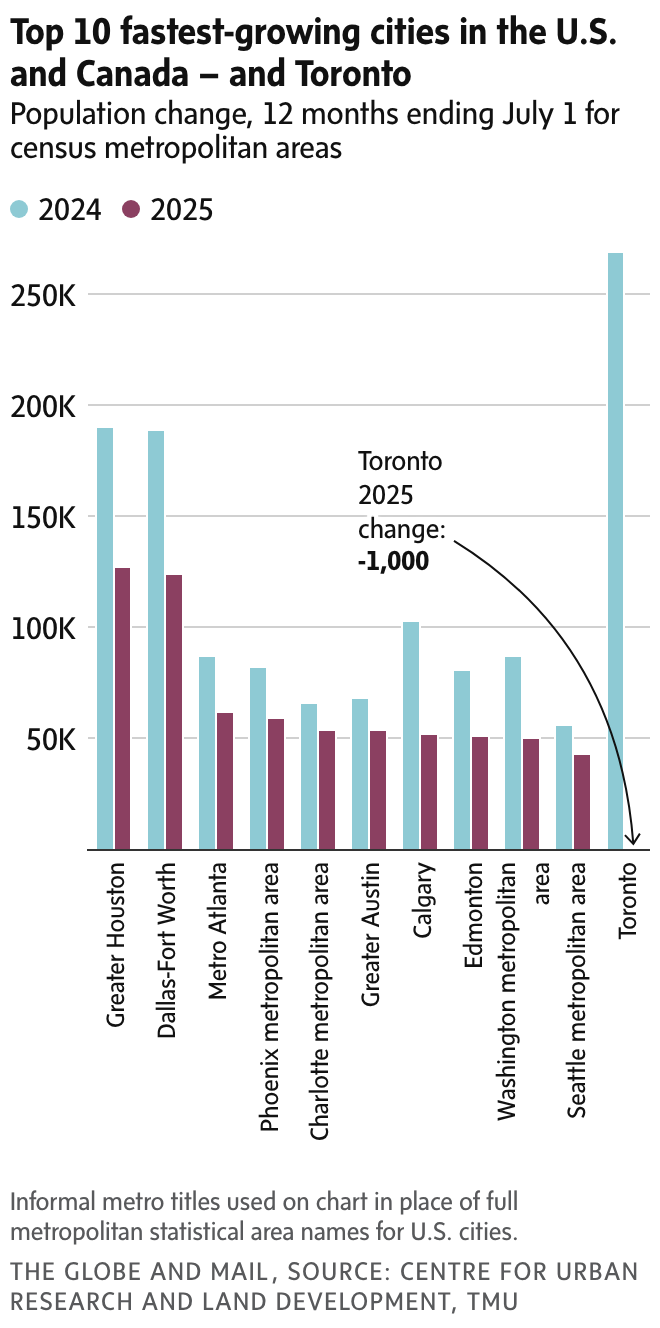
This chart looks at the Top 10 fastest-growing cities in the U.S. and Canada – and Toronto. It finds that Toronto’s population whiplash leaves it at the bottom of the pack. |
|
|
|
|
|
|
|
|
|
|
|
|
|
|
We often look at the performance of actively managed mutual funds, as measured by S&P Global in its SPIVA Scorecards – which demonstrates that most funds struggle to beat their benchmarks. Here’s a look at why this underperformance extends well beyond U.S. equities and into fixed income. |
|
|