
|



AWS Guide to Cloud Architecture Diagrams (Sponsored)
 |
Enhance visibility into your cloud architecture with expert insights from AWS + Datadog. In this ebook, AWS Solutions Architects Jason Mimick and James Wenzel guide you through best practices for creating professional and impactful diagrams.
Ask a model the same question twice, phrased two different ways, and watch how it decides what to give you. It might offer a terse one-liner or a careful walk-through. It might sound fully confident, or it might hedge. Somewhere in training, the model learned which version you would rather have, even though both answers are correct.
That points to a harder question. How do you teach a model to be helpful when helpfulness changes with every request?
For a quick factual query, helpful means brevity. For a debugging problem, it means thoroughness. For a medical worry, it means caution paired with clarity. Each case requires a different direction with underlying trade-offs.
The model learned to handle those trade-offs from people comparing answers thousands of times over. This idea of learning from comparison rather than from a fixed answer key sits beneath every popular model you have used.
In this article, we will look at how that learning actually happens, starting with why instruction-following alone falls short, then walking through the two main methods for teaching preferences (RLHF and DPO).
Pipeline
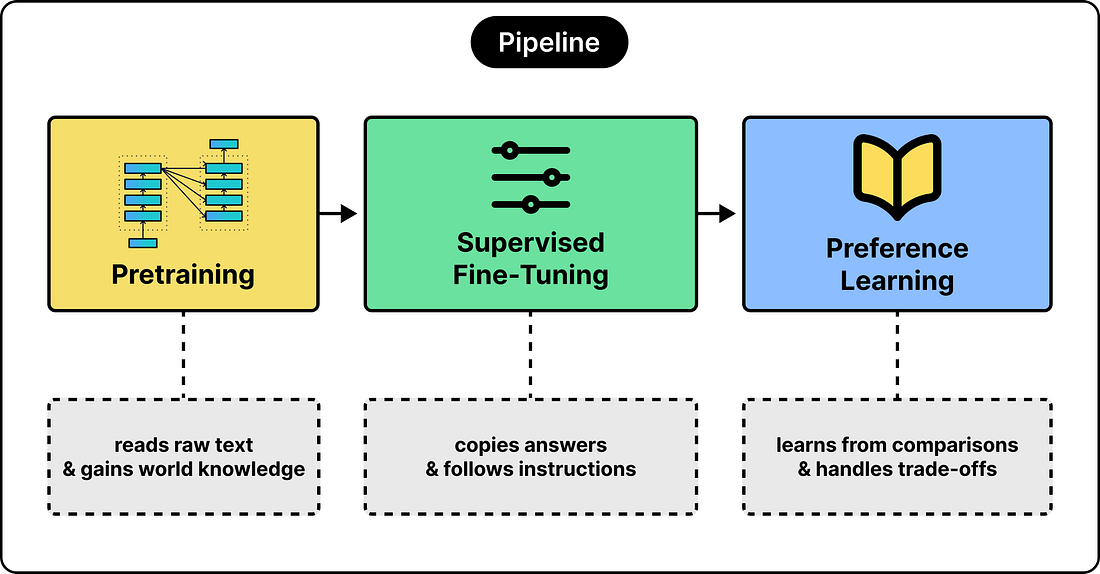
A useful model gets built in three stages, as shown in the diagram below:
 |
Let’s look at each stage in a bit more detail:
The first stage is pretraining. The model reads an enormous amount of text and learns to predict the next word. In other words, it builds a broad sense of how language works and soaks up world knowledge along the way. What it gains is raw capability. What it still lacks is direction, because predicting the next word and answering your question are two different goals.
The second stage is supervised fine-tuning, or SFT. We show the model thousands of example pairs, each an instruction together with a good response, and train it to imitate them. After this stage, the model follows instructions instead of continuing text. For example, if we ask a model to summarize a paragraph, it writes a proper summary. A raw model without SFT would have rambled on.
The third stage teaches preferences, which will be the focus of the rest of this article.
Why does a model that already follows instructions need a third stage at all?
This is because SFT works through imitation. The model sees a correct answer and learns to copy its shape, which holds up well when a question has one good answer, but runs into problems when a question has many possible answers.
Consider a request like “explain how a hash map works”. A short answer and a long answer can both be excellent, and which one helps depends on who is asking. An example dataset can show one of those answers, while the trade-off between them stays invisible. Imitation teaches the model what a good answer looks like, but struggles to teach it how to weigh two good answers against each other.
The payoff is larger than it might appear at first. For example, when OpenAI built InstructGPT in 2022, human raters preferred answers from a 1.3 billion parameter aligned model over answers from the 175 billion parameter GPT-3, a model roughly a hundred times larger. The alignment stage mattered more than a hundredfold jump in size.
Nevertheless, the line between pretraining and SFT is cleaner in the example than in practice. Some recipes blend the two, but the three-stage view is the right place to start.
Next up, we need a signal that captures the trade-off directly. That signal is comparison.
Introducing Attio: the agentic CRM. (Sponsored)
 |
Attio, the agentic CRM, makes it incredibly easy for anyone to run workflows for any GTM play they need.
Describe what you want, and Attio builds it. I just built a workflow that runs every morning, surfaces the deals that need my attention today, like anything with a stage change or a new signal in the last 24 hours.
Hundreds of thousands of automations already run on Attio every day. Ready to try now?