| | In today’s edition: OPEC trims oil demand forecast, Asian buyers look beyond Gulf LNG, and Saudi str͏ ͏ ͏ ͏ ͏ ͏ |
| |  | Gulf |  |
| |
|
 - Back to the blockade
- OPEC cuts forecast
- LNG demand softens
- HUMAIN’s Canada deal
- Saudi economic resilience
 A rare look into the UAE’s arms sector. |
|
Trump claims Hormuz ‘guardian’ role |
 Stringer/File Photo/Reuters Stringer/File Photo/ReutersPresident Donald Trump said the US was the “guardian” of the Strait of Hormuz and proposed charging a 20% fee on cargo passing through the waterway. The one-upmanship with Tehran — which has proposed a more modest fee to allow tankers through — came after Trump formally notified Congress that fighting with Iran had resumed. That started a new 60-day countdown before he will need congressional approval for military operations. While lawyers work out how Hormuz tolls or fees might be levied (something US Secretary of State Marco Rubio previously said would be illegal), traffic through the strait has plummeted after ships came under fire. On Monday, Iran struck two UAE tankers with cruise missiles, killing one sailor and helping to push Brent crude above $85 a barrel, its highest level in a month. The conflict is spreading to the region’s other maritime chokepoint. Saudi Arabia struck Houthi targets in Yemen, acting on intelligence Riyadh had about weapons transfers from Iran, Axios reported. The Houthis responded with missile attacks on the kingdom, raising the risk of renewed conflict around the Red Sea. |
|
OPEC trims oil demand forecast |
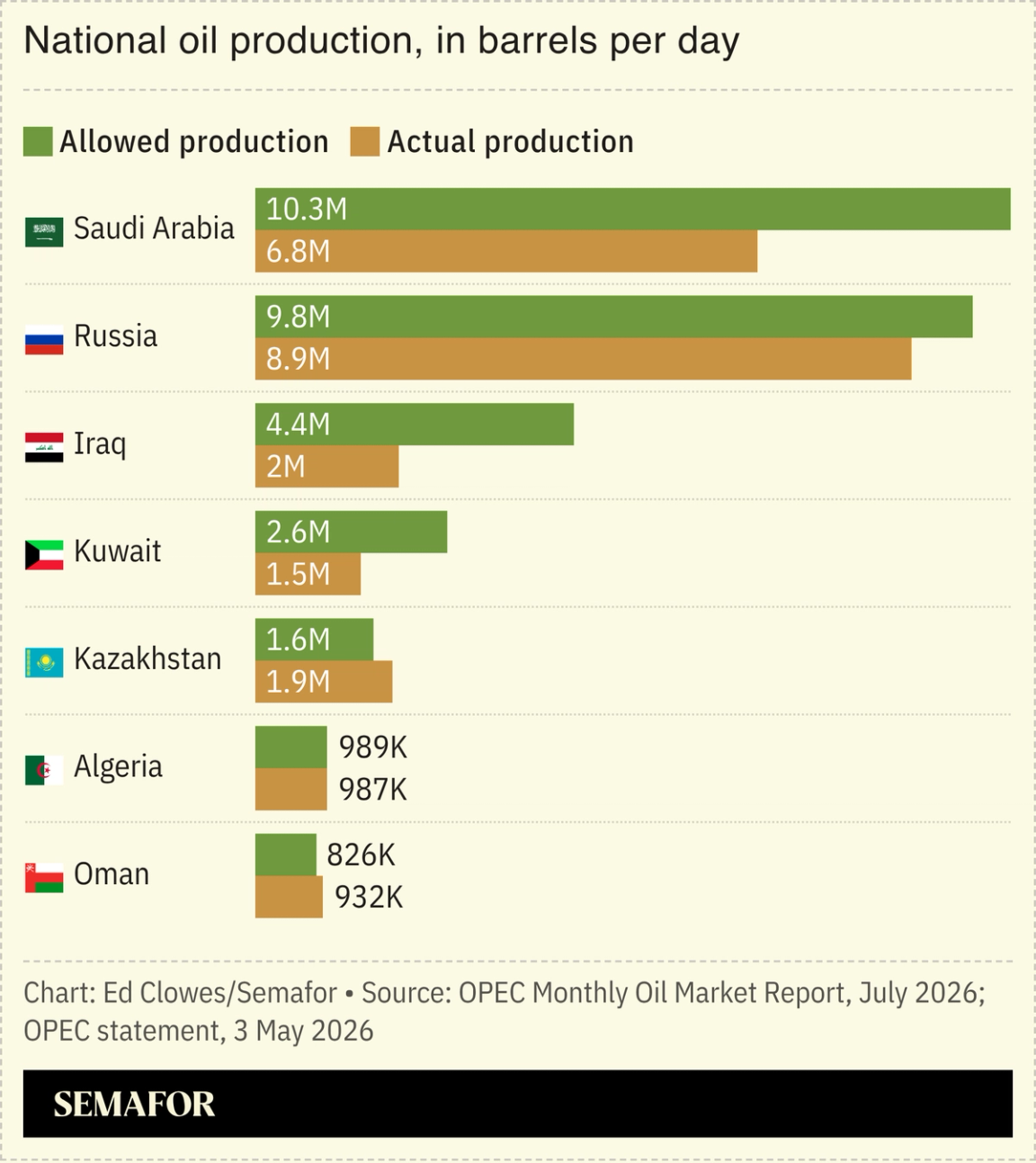 OPEC cut its growth forecast for world oil demand this year by 20% — its third straight downward revision. The producer group still sees the Iran war denting consumption less than the International Energy Agency does, and raised its 2027 growth forecast by 12% to 1.94 million barrels per day on expectations of a stronger second half. The Strait of Hormuz has been closed for much of the period since March, stripping millions of barrels from Middle East supply and making the OPEC+ quota increases agreed in April unachievable. Output is recovering — the group pumped 36.28 million barrels per day in June, roughly 3 million more than in May, as Gulf producers restarted halted fields. The UAE, which quit OPEC in May but will report production figures to the group for the rest of the year, is free of quotas and opened the spigots last month, boosting crude output by 80%. — Ed Clowes |
|
Asian buyers cool on Gulf LNG |
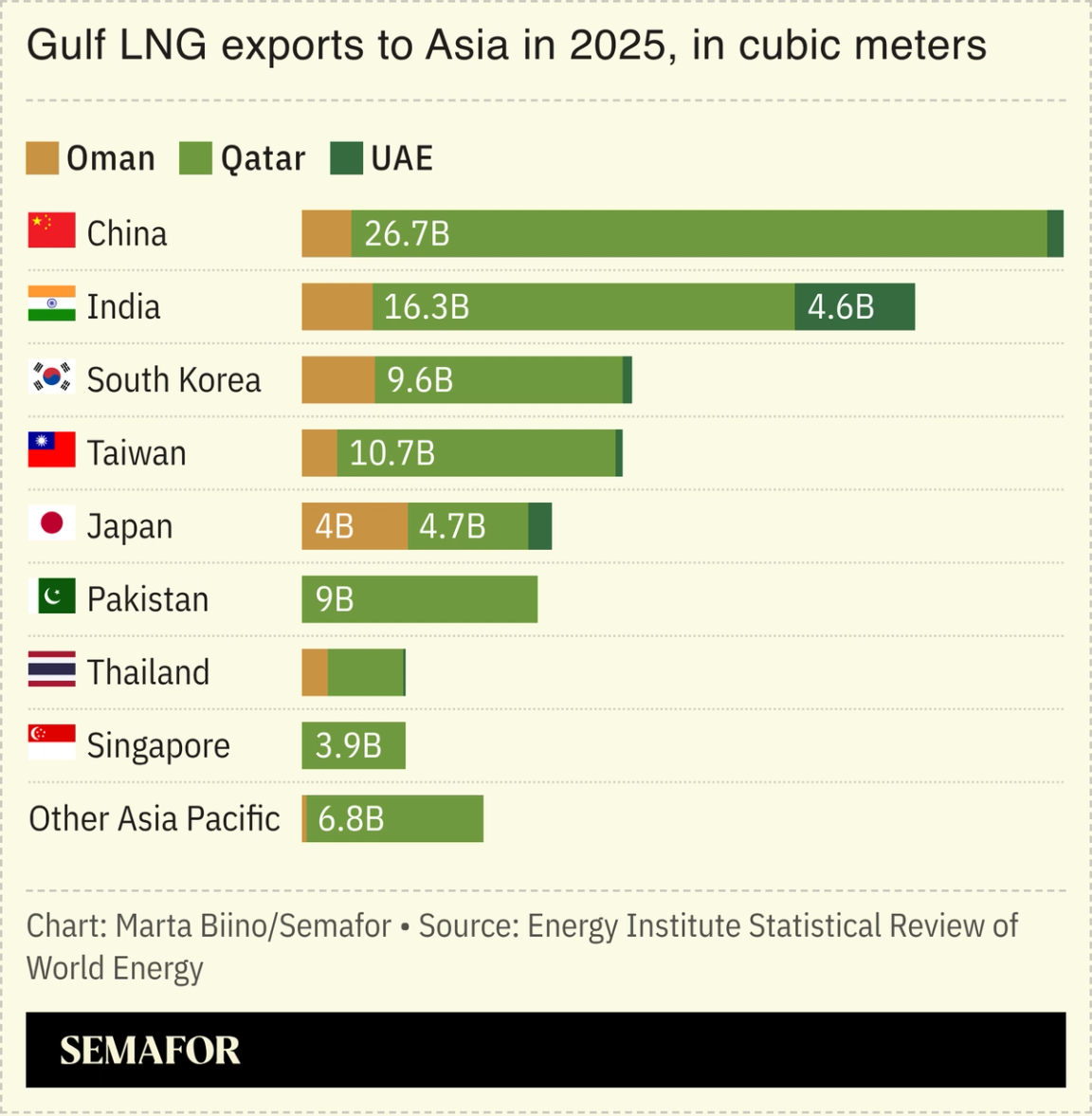 LNG demand in Asia — the most important market for Gulf producers — is on track to fall for the second year in a row, according to Wood Mackenzie. Around 83% of the Gulf’s LNG exports head to Asia, but the Iran war is changing the market dynamics, prompting importers to cut demand, switch to other suppliers, or turn to other fuels such as coal and nuclear. Overall LNG demand in Asia is expected to be 8% lower this year than its 2024 peak. A recovery in demand depends in part on how long supplies remain disrupted, but some Gulf producers are betting on a rebound. Abu Dhabi’s ADNOC Logistics and Services last week placed a $900 million order for four LNG carriers from a Chinese shipyard, with its CEO citing the “strong fundamentals” of the LNG market. |
|
Canada onboard with HUMAIN |
 Saudi Press Agency/Handout via Reuters Saudi Press Agency/Handout via ReutersSaudi Arabia’s artificial intelligence champion HUMAIN will supply computing power to Cohere, an Nvidia-backed large language model developer and one of Canada’s biggest startups. Announced during Canadian Prime Minister Mark Carney’s visit to the kingdom last week, the deal follows a thawing of bilateral relations after a years-long diplomatic rift over Saudi Arabia’s human rights record. It also marks Cohere’s first major deployment outside North America. HUMAIN will dedicate at least 50 megawatts of compute to Cohere’s new models starting in late 2027, part of Saudi Arabia’s ambition to be a global hub for AI infrastructure. The pair will also work together on Arabic-language AI models. Cohere, which competes with Anthropic and OpenAI in enterprise sales, has made government contracts a focus. Such expertise is in demand in the Gulf: Last week, the UAE tapped Microsoft to automate government services in partnership with its own G42. — Kelsey Warner |
|
Saudi holds up against wartime pressures |
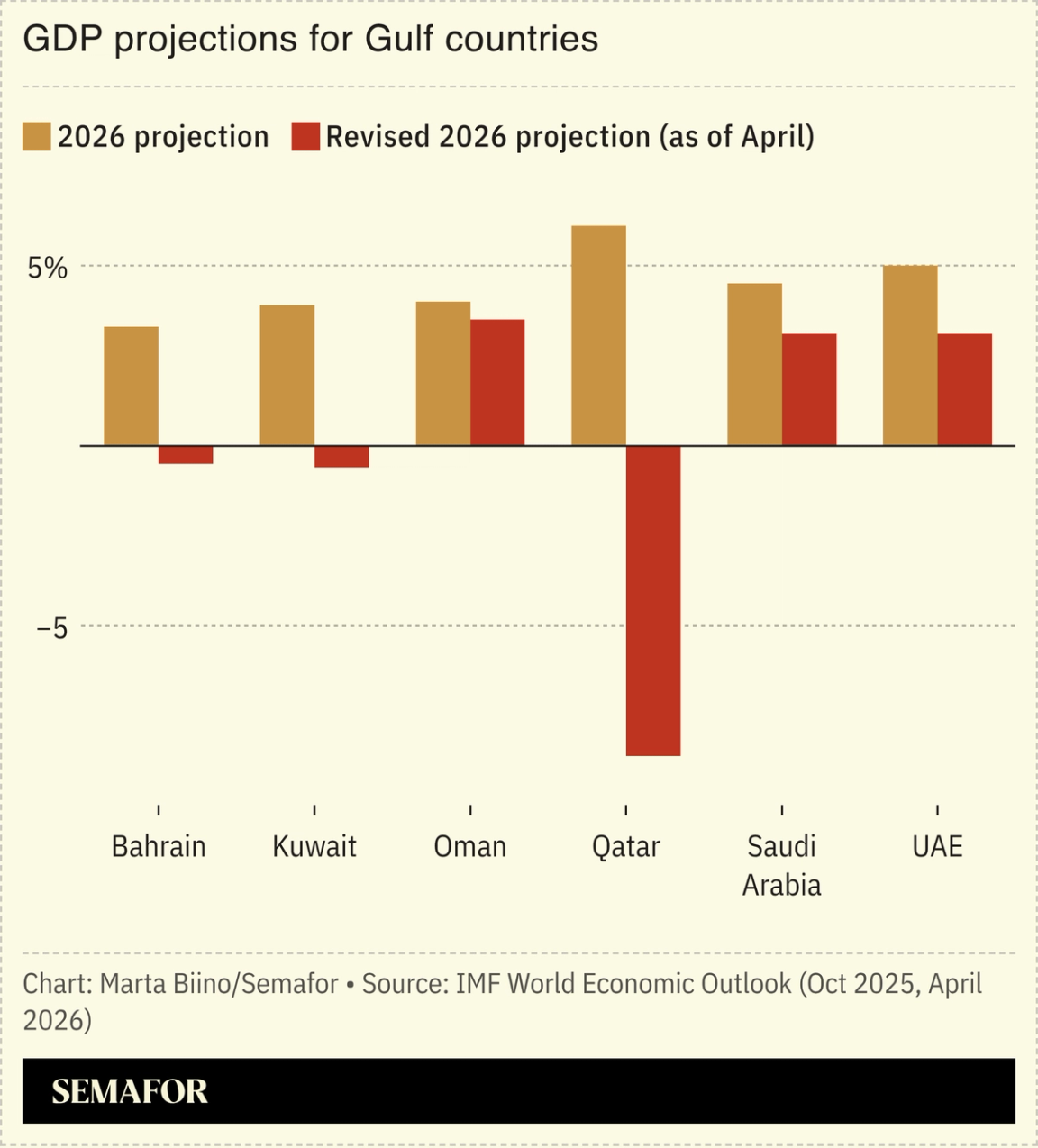 Saudi Arabia’s economy has held up to the stresses of the Iran war well thanks to a decades-old oil pipeline to the Red Sea and prudent fiscal policy, Tim Callen, former IMF mission chief to the kingdom, writes for Washington-based think tank Arab Gulf States Institute. Aramco’s East-West pipeline and its investments in storage facilities around the world enabled it to take advantage of higher crude prices. The kingdom reported its first current account surplus in nearly two years in the first quarter of 2026, helped by higher oil revenues and a lower import bill as fewer goods reached the kingdom. The economy also benefited from being used as a transit hub, as well as a safe exit route in the early months of the war. Large foreign inflows at the start of the year, low debt levels, and a government spending surge helped cushion the economy. Saudi policymakers are expected to pursue economic resilience, building new pipelines and better air, rail, sea, and road infrastructure, Callen wrote. |
|
 Big law firms have run the same playbook for 50 years: hire armies of young lawyers, bill their hours at steep rates, and funnel the money up to the partners. AI is about to upend that model. On this week’s episode of Compound Interest, presented by Amazon Business, Cooley partner and CEO Rachel Proffitt joins Liz and Rohan to discuss how AI could disrupt Big Law’s sacred cow — the billable hour — by taking over the grunt work that most associates cut their teeth on. Plus, what the rainmakers of the future look like, the rise of AI-native law firms, and the paranoia sweeping the industry.
|
|
 Crypto- Abu Dhabi-based ADI Foundation — a unit of Sheikh Tahnoon bin Zayed’s International Holding Company — said its blockchain platform ADI Chain raised $50 million from an undisclosed investor. The firm builds regulated blockchain infrastructure for governments and financial institutions, with plans to expand across the Middle East, Africa, and Asia.
Deals- Abu Dhabi’s Masdar secured $6.1 billion in financing to develop what it said will be the world’s first gigascale renewable energy project, delivering 1GW of clean power 24/7. The project combines a 5.2GW solar plant with a 19GWh battery storage system to provide continuous clean power.
Logistics- DP World is reportedly planning a new port and container terminal in Fujairah on the Gulf of Oman. With its main facility at Jebel Ali cut off by disruptions in the Strait of Hormuz, shifting capacity to the UAE’s east coast would allow the Dubai ports operator to keep goods flowing to the region’s leading trade and financial hub. — Financial Times
Sovereign Wealth- Abu Dhabi Investment Council, a unit of sovereign fund Mubadala, has put $1 billion into hedge fund Deem Global. The investment went into the fund’s macro strategy, which bets on broad economic trends.
- I Squared Capital signed a memorandum of understanding to invest $2 billion in digital infrastructure and district cooling in Saudi Arabia, in an agreement with the Public Investment Fund.
|
|
 Visitors view guns on display at an exhibition stand for Tawazun Advanced Defense Systems. Ben Job/Reuters. Visitors view guns on display at an exhibition stand for Tawazun Advanced Defense Systems. Ben Job/Reuters.The UAE’s weapons industry, more important than ever as conflict rolls on between the US and Iran, is typically shrouded in secrecy. CNBC’s Dan Murphy got rare access to the sector, filming facilities operated by EDGE, the country’s largest defense conglomerate. Founded in 2019, EDGE consolidated state-owned companies into a group that employs 20,000 people and makes everything from sniper rifles to anti-missile systems. The CNBC team visited Halcon, one of the group’s munitions arms, where assembly lines turn out Desert Sting, Shadow, and Skyknight missiles. There, EDGE CEO Hamad Al Marar said that, since the war with Iran began, 80% of the UAE’s missile and drone interceptions had used domestically-made technology. “Of course, no one wants war. But war is also a validation,” he said. “War tests your preparation.” |
|
|


