| | Donald Trump proposes charging a Hormuz toll, Europe ramps up its commitments to Ukraine, and World ͏ ͏ ͏ ͏ ͏ ͏ |
| |  | Flagship |  |
| |
|
The World Today | 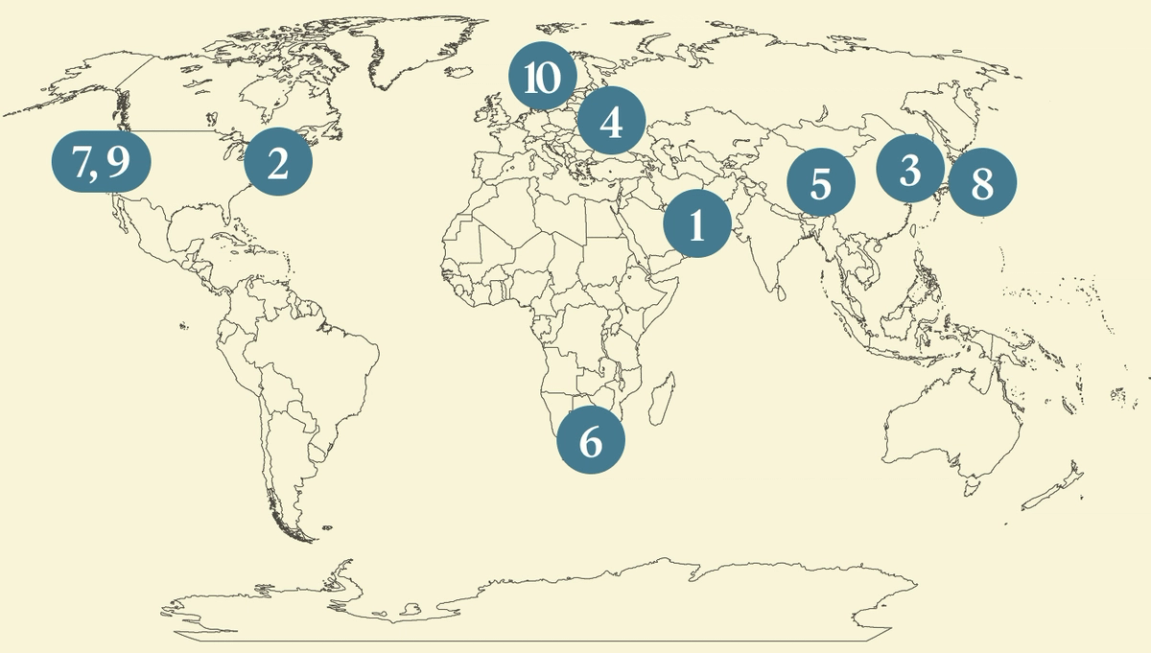 - Trump proposes Hormuz toll
- More inflation warnings
- Asian chipmakers hammered
- Kyiv’s cognitive warfare
- Rare earths fight heats up
- De Beers crisis deepens
- Paramount-Warner deal suit
- Reusable rockets race
- AI fix for aging workforce
- Soccer’s VAR controversy
 A novel set under a climate-controlled dome, a century in the future. |
|
Trump announces new blockade, Hormuz fee |
 Stringer/Reuters Stringer/ReutersPresident Donald Trump said Monday that the US was the “guardian” of the Strait of Hormuz and proposed charging a 20% fee on cargo shipped through the waterway. He also formally notified Congress that fighting with Tehran had resumed, as Washington reimposed its naval blockade on Iran. It’s unclear how the Hormuz payment arrangement would work, the BBC wrote, though Trump implied Gulf nations should reimburse the US. While maritime law prohibits charging ships to cross international waters, the practice has a long history, the Financial Times wrote: The Ottomans charged to traverse to the Black Sea in the 18th century, and starting in 1429, Denmark forced vessels transiting the Øresund waterway to hand over 1-5% of their cargo value. |
|
Prospects of US rate hike rise |
 Pedro Rocha/Reuters Pedro Rocha/ReutersThe US Federal Reserve must consider raising interest rates if inflation reads “hot” this week, a top central bank official said Monday, reflecting the pressure facing the world’s monetary policymakers as the US and Iran resume fighting. “Sternly staring at inflation until it melts before our withering gaze is not an option,” governor Christopher Waller said. Another hike in energy prices keeps the prospect of a rate increase alive, ING Think analysts said. But even if oil prices stay low, US inflation has proven sticky, in part because the AI boom has pushed up prices for electricity, computer software, and gadgets, Barclays wrote: “The irony is hard to miss,” given that “AI has been widely heralded as a disinflationary force.” |
|
Asian chips lead global tech selloff |
 Asia’s chipmakers led a tech selloff that roiled global markets on Monday, adding to concerns about the sustainability of the AI investment boom. “It’s global risk off,” a BNP Paribas analyst said. Samsung fell 10%, and SK Hynix sank 15% in Seoul — a record drop that helped trigger a market-wide trading halt. The selloff coincided with chipmaker TSMC reporting a 36% jump in quarterly sales, signaling that global demand for AI computing remains robust. Chipmakers now comprise large shares of both US and Asian indexes, and that concentration ends “one of two ways,” a markets analyst argued: “Either demand comes down and prices collapse, or supply comes in and prices collapse.” |
|
Europe steps up commitments to Kyiv |
 Stringer/Reuters Stringer/ReutersUkraine and its European allies on Monday announced a coalition to develop an anti-ballistic missile system to protect against Russian attacks. Europe has stepped up its commitments to Kyiv as the US pulls back from its role as the continent’s guardian: France’s president said Europe would defend itself “with blood, if necessary.” Ukraine’s drone attacks have triggered a fuel crisis in Russia and forced Moscow to suspend shipping in a critical waterway, shifting the war’s momentum in Kyiv’s favor. But one of Ukraine’s leading drone proponents is now focusing on the war’s next phase: “the battle for minds,” The New York Times reported. She is spearheading efforts to deploy “cognitive warfare” to undermine public support within Russia for the war. |
|
US, China ramp up mineral investments |
 Steve Marcus/Reuters Steve Marcus/ReutersChina and the US are ramping up dual pushes to use state funds to bolster mineral supply chains. A new Beijing-backed mining investment firm is focused on shoring up overseas supplies of critical metals, Bloomberg reported, as fresh challenges from the US and Europe push China to “increase the number of tools at its disposal.” Washington has taken stakes in several domestic rare earth firms to counter China’s dominance, and the Pentagon on Monday announced a $25 million investment in a startup whose minerals can be used in jets, missiles, and submarines. But it would cost the US $13.7 trillion over the next 25 years to fully end its reliance on China in manufacturing and tech, a new analysis found. |
|
De Beers halts S. Africa mine output |
 Anglo American and De Beers Group/Handout via Reuters Anglo American and De Beers Group/Handout via ReutersDe Beers is halting production at South Africa’s biggest diamond mine, with gemstone prices falling thanks to slowing demand and increased competition from lab-grown stones. The Venetia mine produces 40% of South Africa’s diamonds. De Beers managed to prevent prices sliding in the 1960s after the discovery of major reserves in the Soviet Union, via clever marketing and what The Atlantic in 1982 called “the most successful cartel arrangement in the annals of modern commerce,” but the ever-improving quality of artificial diamonds — and Chinese consumers’ collapsing interest in luxury goods — has defeated it. The cost of the real gems has fallen 50% since 2022, and De Beers’ parent company Anglo American is looking to sell. |
|
US states sue over Paramount deal |
 Daniel Cole/Reuters Daniel Cole/ReutersA dozen US states sued on Monday to block Paramount from buying Warner Bros. Discovery, heightening the stakes surrounding the mega-merger. The coalition argued the $110 billion takeover would quash competition in the industry; the deal would bring some of the country’s largest media properties, including CBS News, CNN, and two of the top five Hollywood studios, under Paramount’s control. The legal showdown comes as Semafor reported Paramount is weighing leaving California, the state that led the lawsuit. The idea may just be a show of brinkmanship, but Paramount wouldn’t be the first major firm to decamp from California in recent years due to tussles with state regulators: Oracle, Chevron, and Tesla have all moved their corporate headquarters to Texas. |
|
 Semafor Gulf is now expanding to five days of coverage per week, reflecting the growing need for deeper reporting on the region. More than ever, developments in the Gulf are reverberating around the world, affecting events, energy markets, and entire economies. We are growing our network of reporters and editors across the region and the world and, starting this week, are expanding our coverage of the Gulf into a daily briefing. Subscribers will get even more of the sophisticated, scoopy journalism they’ve come to expect, every weekday. |
|
Japan’s milestone in reusable rockets |
 SpaceX test launch. Steve Nesius/Reuters SpaceX test launch. Steve Nesius/ReutersJapan’s space agency carried out its first test flight of a reusable rocket. The RV-X craft lifted off, hovered, and moved horizontally before landing during its under one-minute flight, The Associated Press reported. JAXA is trying to catch up with SpaceX’s low-cost technology for putting payloads in space, as are other groups, including Jeff Bezos’ Blue Origin, as well as China — which recently landed a reusable rocket for the first time, but they are more than a decade behind: Falcon 9 first successfully touched down in 2015. SpaceX’s Starship, the world’s most powerful rocket, has been cleared for a 13th test flight, set for this week. For the first time, it will carry a working payload of several third-generation Starlink satellites. |
|
AI could solve workforce crisis |
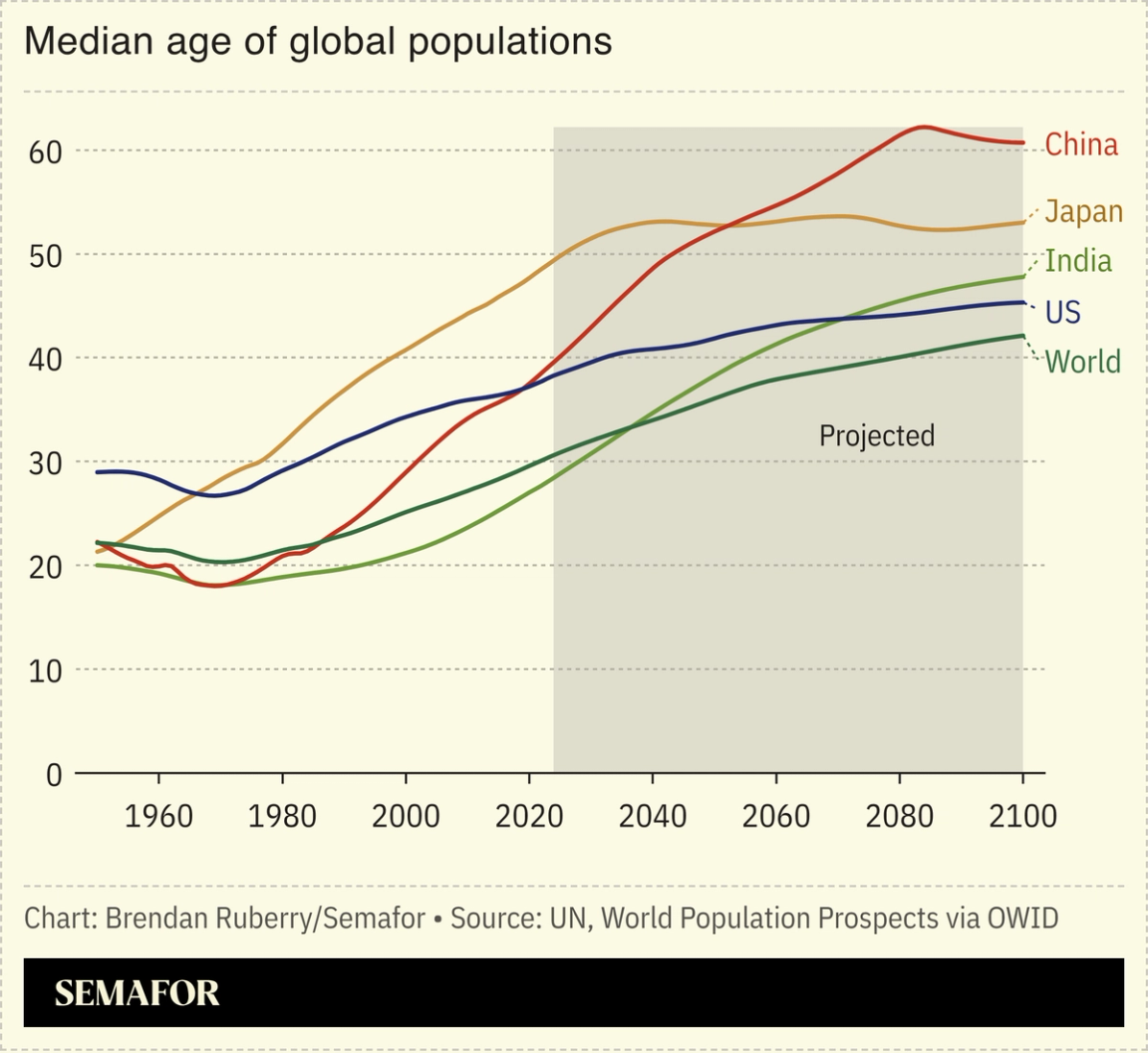 AI could help overcome a fast-approaching demographic deficit in the financial advice industry, and perhaps elsewhere. A third of all US financial advisers are expected to retire in the next decade, taking much of the industry’s expertise with them. An executive at US wealth management firm Edward Jones told Semafor that the company is using AI to analyze around 55 million records of client calls and meetings in order to institutionalize that expertise and pass it on to younger advisers. AI has been suggested as a partial solution to a workforce crisis triggered by aging, shrinking populations worldwide. But some argue that demographic decline could encourage companies to accelerate AI adoption, Bloomberg wrote, potentially “replacing rather than augment[ing] humans.” |
|
|


