
|


 |
I grew up in the 1980s in a small house with only one bathroom shared between four people. The floor was linoleum. There was a carport instead of a garage, and we had one beat-up used Toyota Tercel hatchback. I don’t remember when we got our first color TV, but when I was young we had a black-and-white one that my grandmother gave us. Our furniture was all second-hand and we kept the couches covered up with worn old blankets.
When I was young, I mowed lawns for money. As a high school kid, I signed up to pick cotton by hand (!!) for an agricultural research project at Texas A&M University, for minimum wage¹. I have also worked as a cashier. Twice in my life, I have been a member of a labor union, and I have marched in a strike.
I have never once considered myself part of the working class.
Why not? Because I have never thought of class as being defined by a present snapshot of someone’s lifestyle or material circumstances. Instead, I always thought of class as being about someone’s potential. And I grew up always knowing that my economic potential went far beyond the rather humble circumstances of my early childhood.
For one thing, my family was upwardly mobile. My grandparents could probably be called “working class” in their youth — my grandmother worked in a sweatshop as a teenager, my grandfather wore cardboard in his soles because his family couldn’t afford shoes. But after World War 2, thanks to the GI Bill and rapid economic growth, my ancestors advanced into the middle class, with jobs like optometrist, athletic coach, and registered nurse. My father had a PhD and a tenure-track academic job that promised to pay a lot more after a decade of work. We weren’t rocketing up the income distribution, but we were clearly climbing.
Our humble lifestyle in the early and mid 1980s reflected this future orientation. Our family income was probably around the 35th-38th percentile,² but this was because we were a one-earner family. My mother chose to spend the first seven years of my life as a housewife — which she did in order to make sure my sister and I got a thorough, accelerated education. We lived an abstemious life in part because we saved as much money as we could.
What were we saving for? My college education, and my sister’s. We were smart kids; we knew we would go to good schools, and we did.³ We knew our college educations would allow us to get good jobs that paid more than our parents ever made. And we were right.
As for the union membership, I was part of the grad student instructors’ union at the University of Michigan, and the professors’ union at Stony Brook. When I marched in a strike in 2008 to secure a raise and health benefits, I was already getting paid to complete a PhD that would eventually increase my earning power even more. Even as I scarfed free food from charcuterie boards at departmental events to save money, I was building up my future earning power at a rapid clip.
Class in some countries is about the past; you can be a shabby aristocrat if your grandfather was the Earl of Whatevershire. In American policy discussions, class is often implicitly about the present — where you lie in the income and wealth distributions this year. But on some level, everyone knows that class in America is really about the future.
Milton Friedman had a theory that sort of gets at this idea, in fact. It’s called the Permanent Income Hypothesis. “Permanent income” is the income you can expect to make over the course of your life. If you’re a shabby grad student living off of cup ramen, your current income is low, but your permanent income is high, because you know you’re probably going to make a lot of money in the future.⁴
But class in America isn’t just about the money you will make in the future; it’s about the money you could make if you wanted. I know schoolteachers who live modern middle-class lifestyles despite having graduated from the best schools in the country. They could have gone to work for companies and made decently big bucks, but they preferred a more laid-back lifestyle. Whether their children should count as middle class or upper class is an interesting question, but they themselves are clearly the American equivalent of Europe’s shabby aristocrats, because they forsook the upper-class lifestyle voluntarily.
Meanwhile, there are millions upon millions of Americans for whom working in high-paying salaried jobs was just never an option, and never will be. They will spend their entire careers driving long hours in a truck, or stocking shelves at a store, or installing smoke alarms in people’s houses, simply because this is the best they can do.
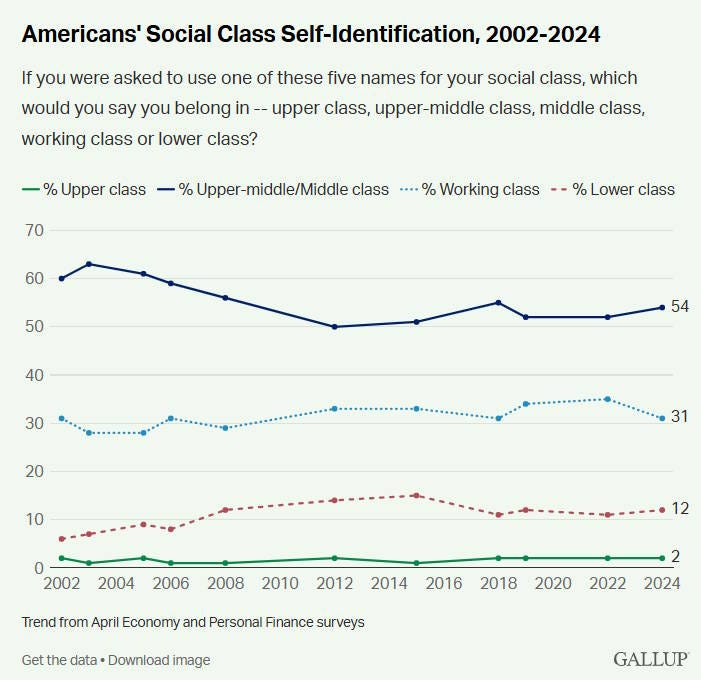
This explains at least part of why most low-income Americans traditionally consider themselves middle class. They expect to be middle-class at some point; they don’t think they’ll be trapped driving a truck or stocking a shelf forever.⁵ And it could also explain why the number of Americans calling themselves “lower class” rose in the 2000s and 2010s, as growth in incomes temporarily stagnated and the potential for rapid downward mobility became clearer after the financial crisis:
 |
I’m being very approximate here, of course, and I’m speaking for the country more than I probably should. In fact, America has less class consciousness than many other societies, and when we do talk about the idea, there’s rarely agreement on what it should mean. I wrote about the contested nature of class in American society two years ago:
