| | In today’s edition: A logjam at the Saudi-UAE border, Dubai pours investment into aircraft leasing, ͏ ͏ ͏ ͏ ͏ ͏ |
| |  | Gulf |  |
| |
|
 - Saudi-UAE trade hurdle
- More US-Iran strikes
- Bahrainis want normality
- UAE leads in regional FDI
- Dubai Aerospace fund
 The Iran war strengthens the case for Saudi economic diversification, and other weekend reads. |
|
Saudi-UAE imports snarled in delays |
 Hamad I Mohammed/Reuters Hamad I Mohammed/ReutersFirms moving goods from the UAE into Saudi Arabia are complaining of border delays lasting several days, in a sign of the simmering tensions between the Gulf’s two largest economies. The issue — which follows recent reports of problems with transferring money between the two countries — has been getting worse in recent weeks, according to people familiar with the matter. Goods are now frequently held up without explanation and some truck drivers are being forced to sleep under their trailers as they wait at the frontier for more than a week. Goods snarled in the delays have included building equipment, furniture, spare parts, and even fresh flowers. While it is difficult to directly link the delays for money transfers and border trade with the worsening diplomatic ties between the countries, it has coincided with a new low in relations. Trade flows across land borders in the Gulf have increased during the Iran war and the closure of the Strait of Hormuz, but Saudi officials deny there have been problems on the UAE border. “Trade exchange remains within the normal range of customs operations, reflecting the continued smooth movement of goods through customs ports,” Saudi Arabia’s Zakat, Tax, and Customs Authority said in a statement. “No complaints have been received.” — Matthew Martin and Kelsey Warner |
|
US and Iran trade more blows |
 US Central Command/Handout via Reuters US Central Command/Handout via ReutersA second day of strikes saw the US hit targets along the Iranian coast, from the oil export hub of Kharg Island in the north to a port control tower in Chabahar in the south. Deeper inland, US missiles hit a bridge and disrupted rail services from Tehran to Mashhad, where the late supreme leader Ali Khamenei is due to be buried today. Iran fired missiles and drones at Bahrain and Kuwait, while warning it could extend its target list to elsewhere in the region. Neither side seems close to a knockout blow. Tehran is focused on trying to control shipping through the Strait of Hormuz, its key point of leverage and an issue which now arguably outweighs Iran’s nuclear program in importance for both sides. The US cannot easily walk away until the situation is stabilized, but any likely deal is unpalatable. Meanwhile, the latest clashes mean oil prices are again on the rise. — Dominic Dudley |
|
Sirens and shattered nerves in Bahrain |
 Bahrain Police Media/Handout via Reuters Bahrain Police Media/Handout via ReutersAir raid sirens sounded intermittently across Bahrain for more than 24 hours during the latest exchanges of fire between the US and Iran, unsettling residents hoping for a return to normal life. The small Gulf state has, along with Kuwait, borne the brunt of the latest fighting, which erupted Tuesday after the fragile Iran-US ceasefire collapsed. “We want the situation to stabilize, we want our normal lives back,” local resident Adel Mohammed told AFP. “I run a business, and continued instability does me no good.” Iran has fired missiles and drones at US fuel storage sites and military installations in Bahrain since hostilities resumed, with loud explosions heard through Wednesday night, an AFP correspondent in the capital Manama reported. “We do not want war to return to the region,” said Sawsan Deif, a Saudi living in Bahrain. “We have already been through a harrowing time.” |
|
UAE attracts record FDI in 2025 |
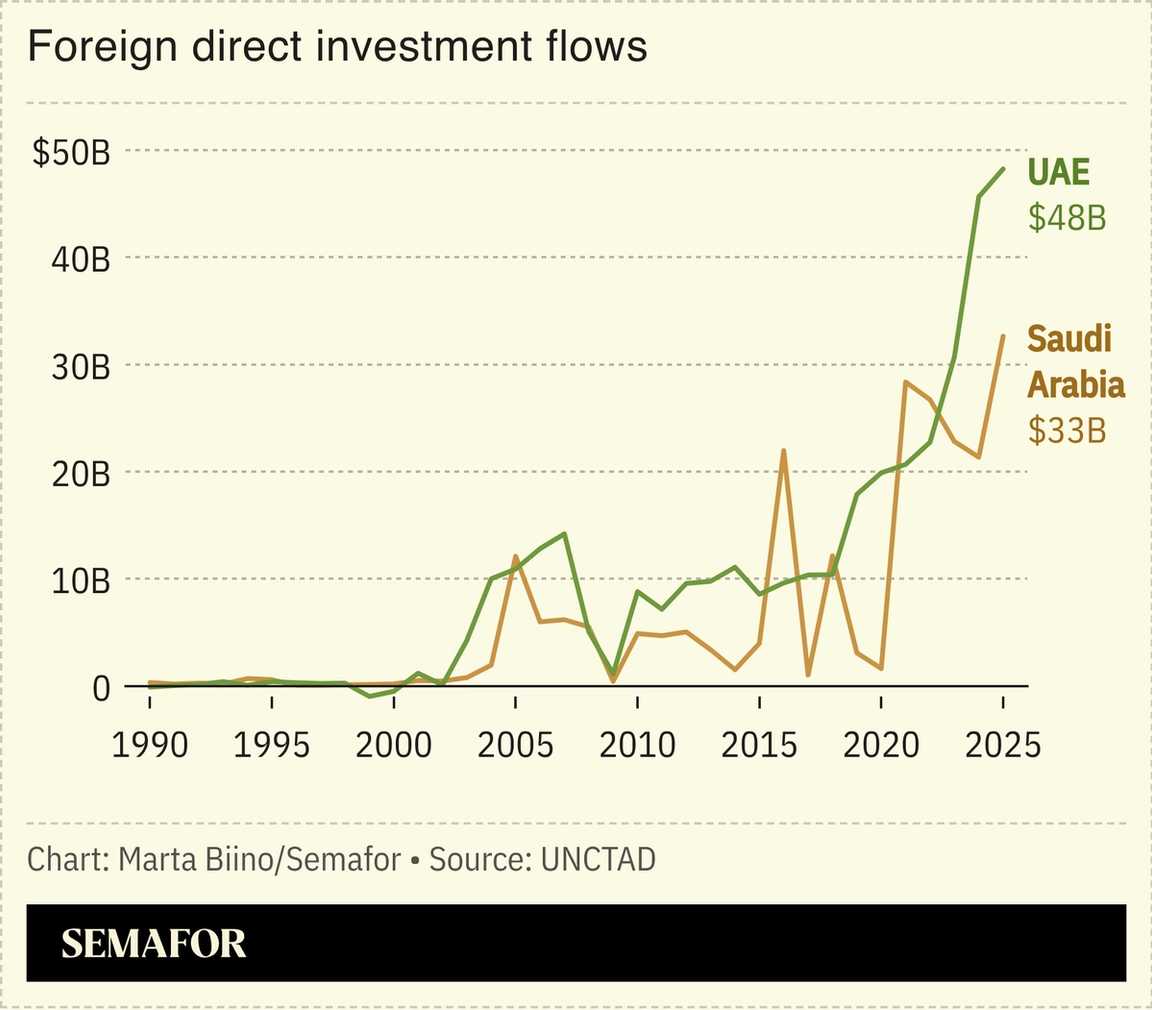 The Gulf stood out in attracting foreign direct investment in 2025, led by record inflows into the UAE. FDI into West Asia — a region tracked by the UN that includes the Gulf — rose 20% year-on-year to nearly $111 billion, compared with 2% growth across developing economies, according to the United Nations Conference on Trade and Development’s annual investment report. The UAE attracted $48 billion, ranking ninth globally, followed by Saudi Arabia. Both drew investment into energy, infrastructure, and technology. FDI into Qatar surged more than sixfold to $3 billion, driven by chemicals and energy investments. Globally, nearly half of greenfield investment went into data centers, energy, and semiconductors — sectors that the Gulf states have been pouring money into at home and abroad. The outlook for 2026 is less rosy: the UN agency warned that conflict could weigh on cross-border investment flows this year. — Mohammed Sergie |
|
Mohamed Hassan Alsuwaidi is the UAE Minister of Investment. 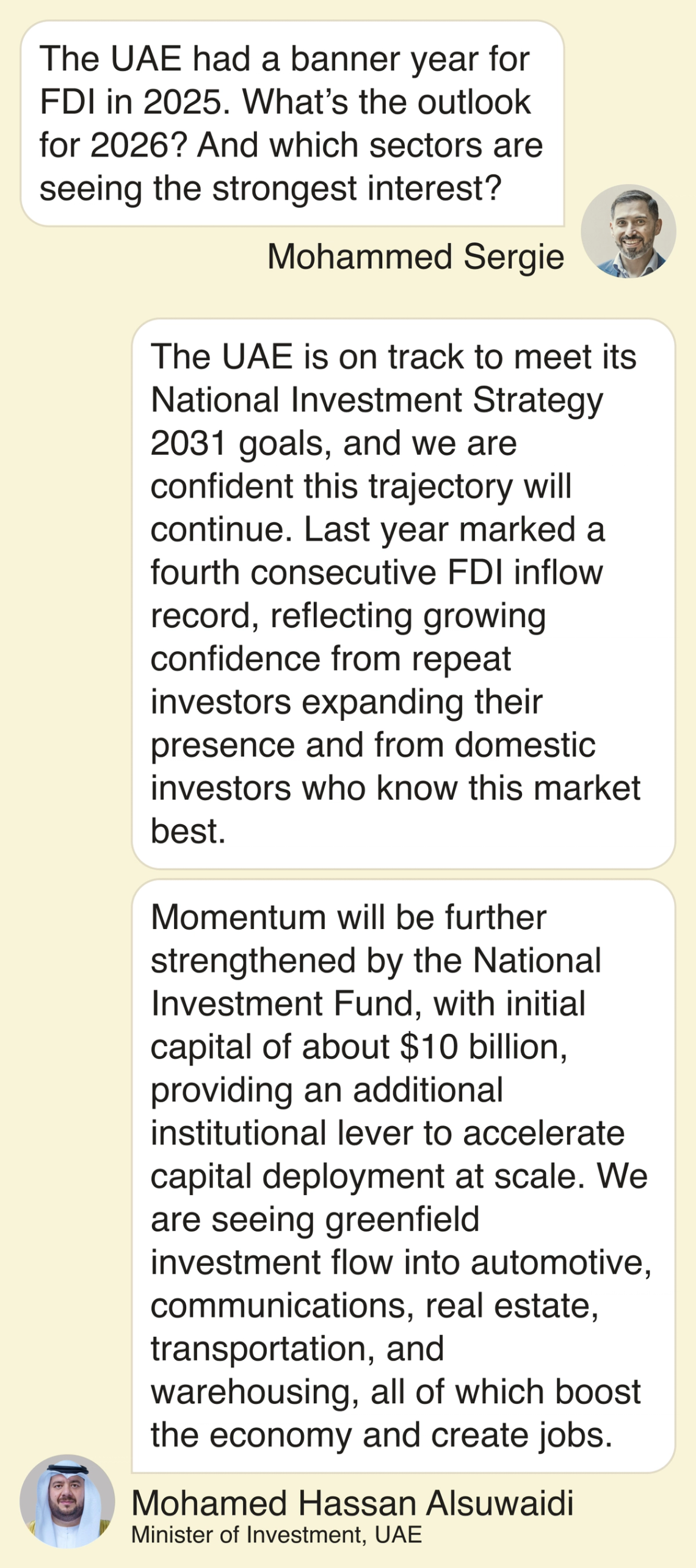 |
|
Dubai aircraft lessor launches new fund |
 Dubai Aerospace Enterprise partnered with a unit of New York-based asset manager Neuberger Berman to launch an aircraft leasing platform targeting about $6 billion of investments. The joint venture, Mustang Aerospace, will acquire and lease aircraft to airlines globally, drawing on DAE’s fleet management expertise and Neuberger’s investor base. DAE — owned by Investment Corporation of Dubai, the emirate’s sovereign wealth fund — is the world’s third-largest aircraft lessor, and has a fleet of about 700 aircraft. With Boeing and Airbus struggling to meet airline demand, aircraft values have surged, allowing leasing companies to command premium prices. |
|
 Conflict- The UAE has helped build a sprawling network of logistics, military bases, financing, and weapons trafficking routes to support the Rapid Support Forces’ war efforts in Sudan, according to an investigation. — Lighthouse Reports
Energy- Saudi Arabia is weighing an expansion of its East-West crude pipeline to the Red Sea, looking to add up to 2 million barrels a day of capacity and assist neighboring countries in bypassing the Strait of Hormuz. The upgrade is expected to take years and cost billions. — Reuters
Economy- The IMF cut its 2026 Saudi GDP growth forecast to 1.7%, down from 3.1% in April, but raised its 2027 call to 5.5% on the assumption the Strait of Hormuz reopens by mid-July.
Trade- Container terminal operator Gulftainer is investing $2 billion to triple capacity at Khor Fakkan, the UAE’s only container port outside the Strait of Hormuz — in a sign of how the country is preparing for the possibility of long-term disruption to the strait. — The National
Jobs- The UAE labor market contracted in June by the most since the height of the Covid-19 pandemic, with recruiters blaming a mix of uncertainty from the war, rising costs, and AI disruption for the slowdown, particularly in aviation, hospitality, logistics, and tourism. Hiring is expected to pick up later this year. — The National
|
|
 - The UAE ran a covert tanker shuttle to keep crude flowing through the Strait of Hormuz during the Iran war — and it leaned on secretive Korean tycoon Ga-Hyun Chung’s fleet to do it, a bet that may have earned him up to $120 million on three ships alone, an investigation by Bloomberg found.
- Abu Dhabi’s sovereign wealth funds have put the city on the map for the titans of global finance, but a little-known family office of the emirate’s ruler, Sheikh Mohamed bin Zayed, in Dubai is also a major investor in everything from Chinese buyouts to healthcare takeovers in the US, according to an in-depth report by a team at Bloomberg.
- Saudi Arabia’s Vision 2030 should be judged less as an economic diversification program than as an exercise in national resilience, an argument the 2026 Iran war strengthened rather than weakened by proving the case for weaning the kingdom off vulnerable oil routes, Michael Ratney and Adel Hamaizia write for CSIS.
|
|
|


