| | US-Iran strikes send oil prices higher and stocks lower, Russia bans diesel exports as its fuel crun͏ ͏ ͏ ͏ ͏ ͏ |
| |  Accra Accra | Moscow |  Buenos Aires Buenos Aires |
 | Energy |  |
| |
|
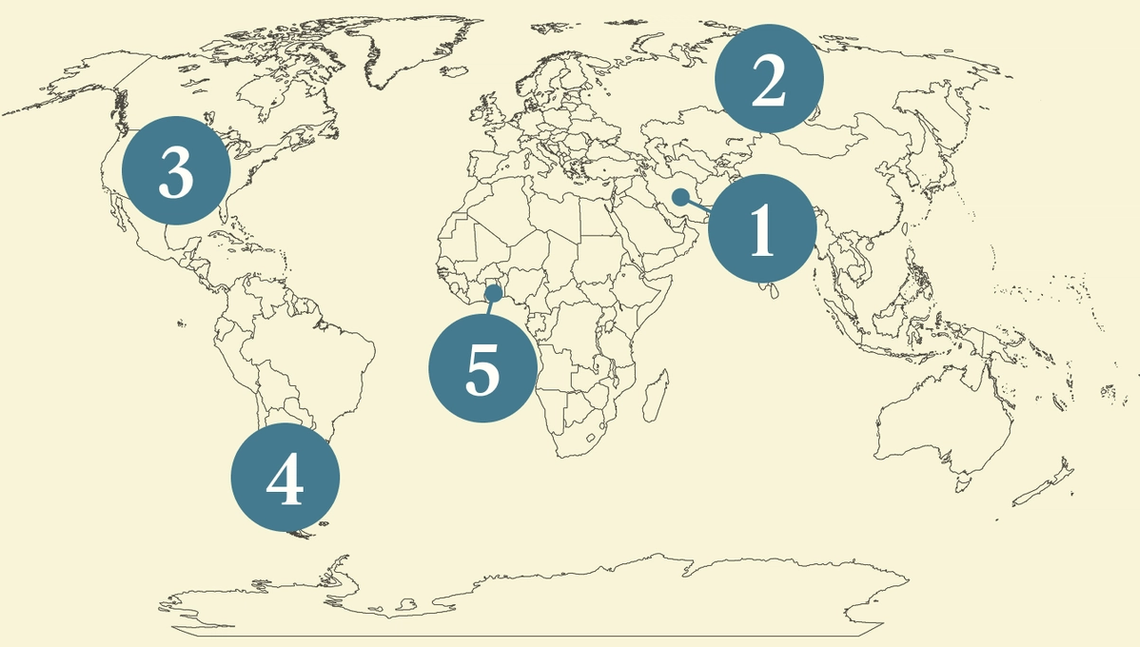 - Iran tensions redraw map
- Russia’s fuel shortfall
- The permitting puzzle
- Nuclear’s global revival
- Ghana gold dispute
 An oil major says it must make ‘fewer, better choices.’ |
|
Iran changes the energy map |
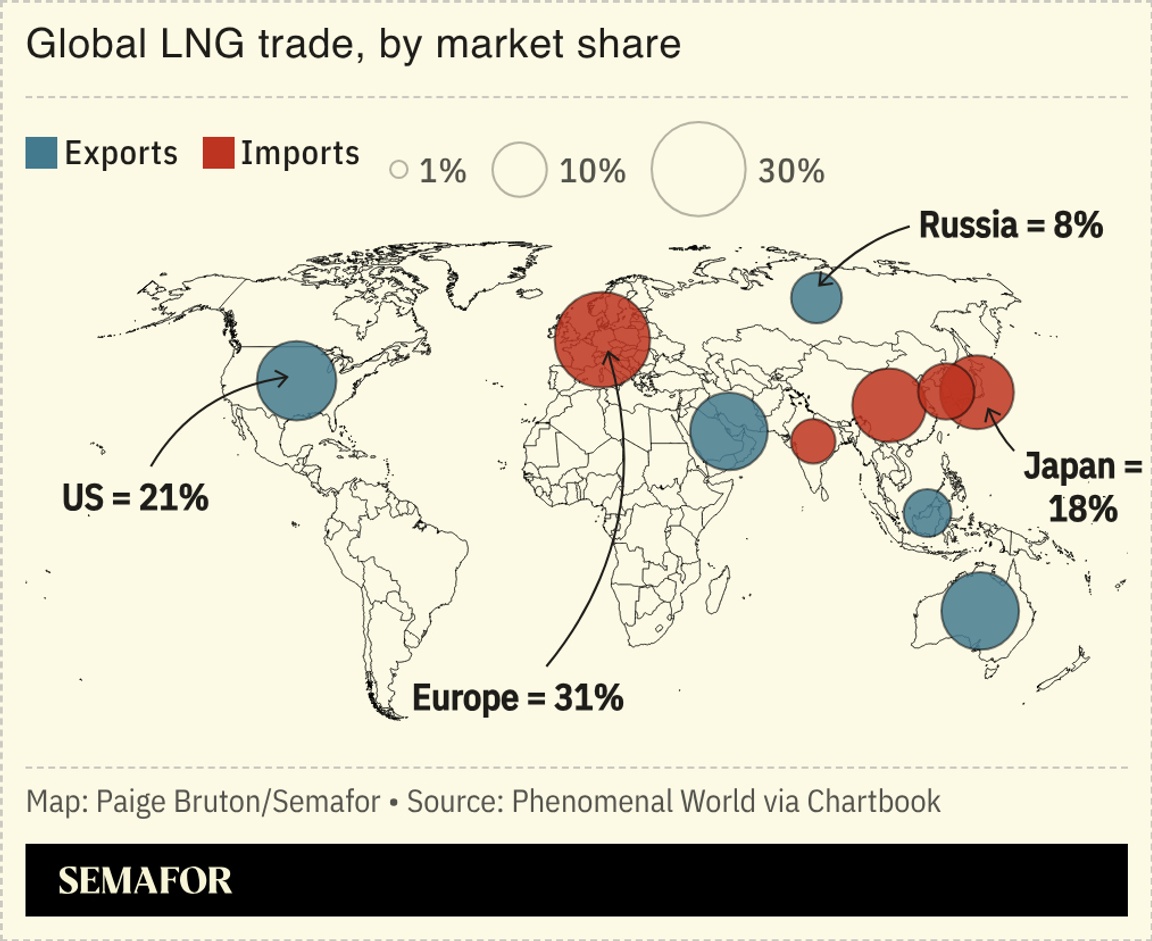 Oil prices jumped and stocks slid after the US and Iran traded strikes that President Donald Trump said marked the end of the countries’ fragile ceasefire. The renewed conflict has once again brought traffic through the Strait of Hormuz to a halt, with Iran’s top negotiator saying it would only reopen under Tehran’s orders. The fighting pushed up US diesel futures at the quickest pace in four years, compounding the political toll for Trump ahead of November’s midterm elections. Separately, the first shipment of Mexican natural gas to Asia is en route, evidence of the reshaping of global energy markets. Five years ago, the two main arteries for international oil and gas trade were Russian LNG pipelines to Europe, and the Middle East to Asia via the Strait of Hormuz. But both are profoundly changed, the International Energy Agency chief wrote in Foreign Policy, by Russia’s invasion of Ukraine and the US war in Iran. The implications are “long-lasting,” Fatih Birol argued, as nations look for ways to minimize risk, including renewables and diversification of supply. |
|
Russia faces fuel shortfall |
|
The problem of permitting |
| |  | Prashant Rao |
| |
 Carlos Barria/File Photo/Reuters Carlos Barria/File Photo/ReutersPermitting — more than access to capital — is the main obstacle to building out the global energy system, the heads of the natural resources group at JP Morgan’s investment bank write today. The issue is “most acute” in the US, they argue in an op-ed shared first with Semafor, but can also be seen in lengthening construction timelines in Australia, Canada, Germany, and the UK. The ultimate result is “generation capacity not coming online, grid upgrades not being delivered, and industrial facilities not being built. All of these inefficiencies show up as higher costs, tighter supply, and reduced resilience when needs are skyrocketing.” In the piece, due to be published in full today, they make the case for permitting that features “enforceable schedules, concurrent rather than sequential reviews,” and judicial oversight that makes rulings “on a timeline that matches economic reality.” |
|
The global nuclear revival |
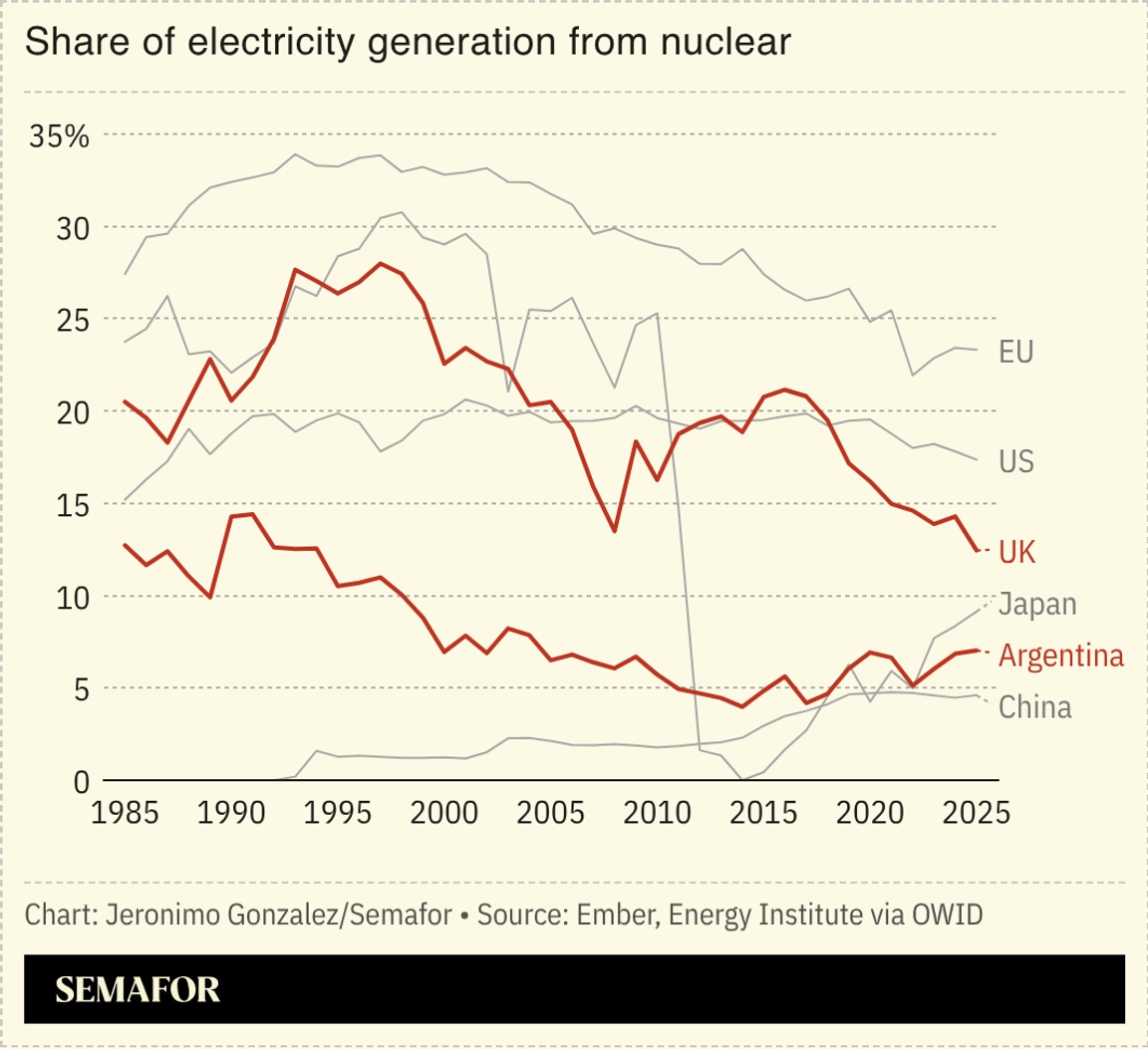 Argentina announced the construction of a new nuclear reactor and the UK extended the life of one of its existing ones, part of a worldwide revival of atomic energy. The Buenos Aires project is backed by $1.2 billion in US money; Britain’s Sizewell B will now run until 2055 rather than 2035. After decades of stagnation, nuclear energy use is expanding fast, BloombergNEF projected: Aggressive efforts to build reactors in China and India in particular are expected to boost global capacity 44% by 2036. China alone had 59 gigawatts of reactors under construction last year, enough to power around 50 million homes, and is on track to surpass the US as the world’s biggest nuclear nation by 2030. |
|
Ghana dispute with political overtones |
| |  | Alexis Akwagyiram |
| |
 Joey Pfeifer, George Appiah, Francis Kokoroko/Reuters Joey Pfeifer, George Appiah, Francis Kokoroko/ReutersA company headed by a brother of Ghana’s president has refused to hand back a $100 million gold mine at the center of an ownership row, defying a ruling by an international court, documents seen by Semafor show. The row involves a local mining firm whose founder and CEO is a brother of President John Dramani Mahama. A 2023 earn-in agreement that would enable the Ghanaian firm to acquire equity in the mine was disputed by investors, who say the company failed to fulfill the terms that would have enabled it to take ownership, according to the documents. The company has denied the allegations. The dispute is emblematic not only of the growing wariness among international investors around mining projects in Africa’s biggest gold producer, but also of the challenges faced by African policymakers trying to increase revenues from natural resources without deterring foreign firms. |
|
 New Energy- French oil major TotalEnergies said it divested its 170-megawatt portfolio of distributed solar generation assets in Europe, as it seeks to focus on larger renewables projects it considers to be more profitable.
Fossil Fuels- US LNG producer Venture Global said that average liquefaction fees, a key earnings component for US LNG plants, jumped 69% in the second quarter of this year, due to increased global LNG prices on account of the Iran war.
- Oil giant ExxonMobil is due to invest $1 billion in Nigeria’s Usan offshore oilfield, a move expected to add 40,000 barrels per day of production.
- BP’s new chief executive said the British oil major needed to make “fewer, better choices” to gain investor trust.
Politics & Policy Hot weather warnings at the ongoing Wimbledon tennis tournament. Toby Melville/Reuters. Hot weather warnings at the ongoing Wimbledon tennis tournament. Toby Melville/Reuters.- The UK grid operator announced its third warning already this summer over tight electricity supplies, as another heatwave stretches power systems.
EVs- Two former US defense officials argue that US EV brand Rivian may be as important to America’s national security as SpaceX, Heatmap reports.
|
|
| |



