| | In today’s edition: Dubai is spending its way out of the Iran war downturn and Riyadh steps back fro͏ ͏ ͏ ͏ ͏ ͏ |
| |  | Gulf |  |
| |
|
 - Dubai is still spending…
- … amid weaker UAE outlook
- Dar’s Saudi property sales
- ACWA invests in Mauritania
- Saudi gives up tennis final
- Gulf at Ayatollah funeral
 “A private members’ club on a spaceship.” |
|
Dubai presses on with megabuilds |
 A rendering of Emaar Properties’ Dubai The Valley complex. Courtesy of Emaar Properties. A rendering of Emaar Properties’ Dubai The Valley complex. Courtesy of Emaar Properties.Dubai is pouring billions into “building a city that does not pause,” Crown Prince Sheikh Hamdan bin Mohammed said, as it looks to bounce back from the economic fallout of the Iran war. The emirate’s executive council, chaired by the crown prince, approved an 18 billion-dirham ($4.9 billion) spending plan for a raft of new measures aimed at improving the attractiveness of the UAE’s most populous city, while the ruling family is also plowing resources into its largest developer, Emaar, and Emirates airline is running an international TV ad campaign using the slogan “We’re back.” The spending plans include cutting red tape for new businesses, setting up an Islamic finance technology center, and building an elevated highway parallel to the main artery, Sheikh Zayed Road, that could alleviate the gridlock that is a mainstay of residents’ complaints. Emaar, meanwhile, is forging ahead with a $54 billion “city within a city” — dubbed Dubai Estate and among the developer’s largest-ever projects — with backing from Dubai Holding, AGBI reported. In May, the sprawling firm owned by the ruling family became Emaar’s largest shareholder. — Kelsey Warner |
|
The UAE’s struggling non-oil economy |
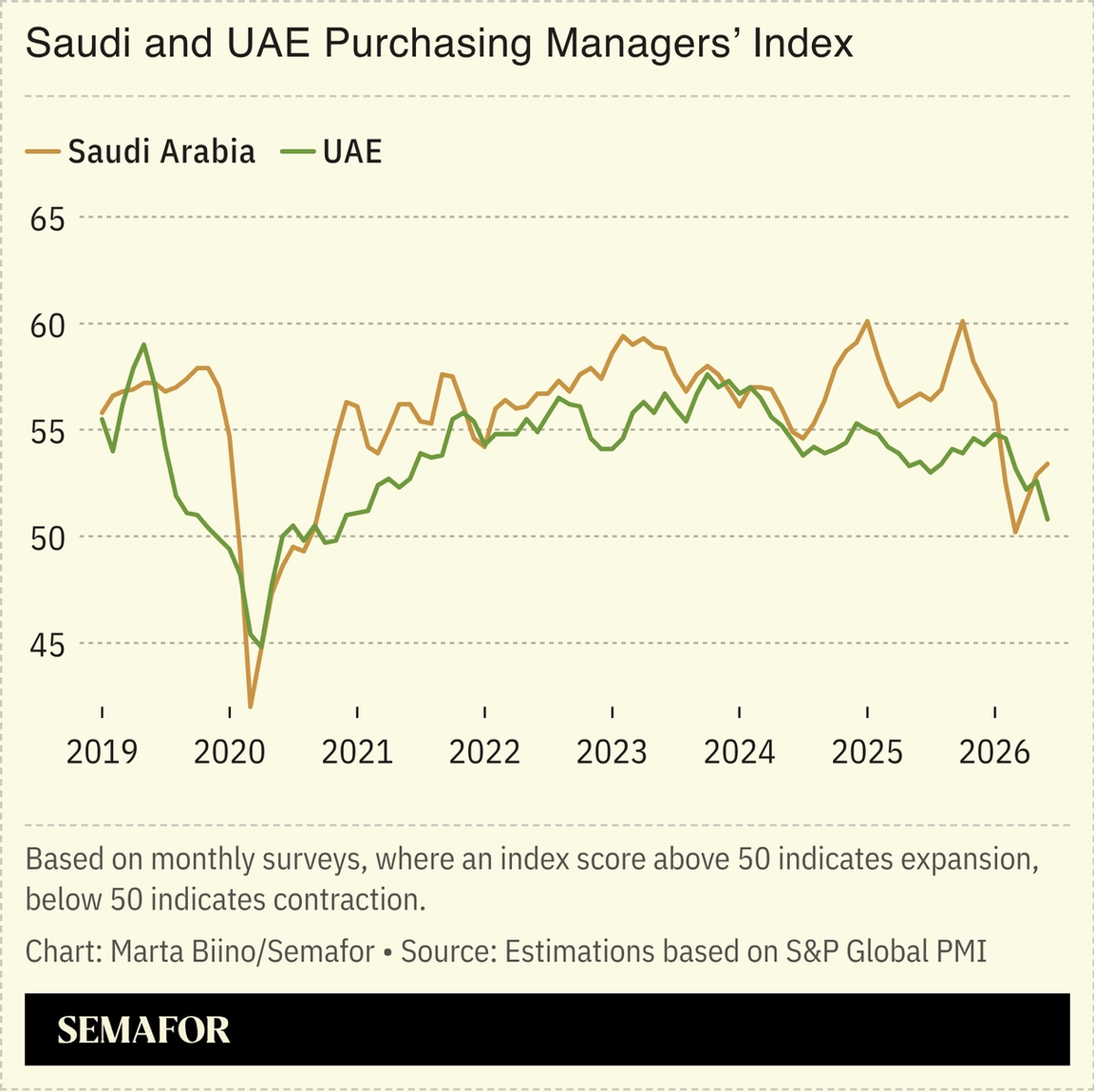 The UAE’s non-oil economy is experiencing its worst period since the COVID-19 pandemic, with the private sector at its weakest in more than five years, and employment falling faster than at any time since 2020. The Purchasing Managers’ Index compiled by S&P Global — which measures activity in the non-oil private sector — fell to 50.8 in June, only just above the 50-point threshold that separates growth from contraction. It was the lowest reading since February 2021 and a reflection of weak demand, disrupted supply chains, and rising costs due to the Iran war. Improved trade flows through the Strait of Hormuz in June eased the pressures, but S&P warned that any rebound may take time to materialize. In contrast, Saudi Arabia’s non-oil PMI rose to 53.3 points in June, its highest since February. Confidence among investors and domestic consumers in the kingdom appears relatively strong. The indices for Kuwait and Qatar remained below the 50-point mark. |
|
Dar banks on Saudi property sales |
 A rendering of Rayana mansions in Diriyah. Courtesy of DarGlobal. A rendering of Rayana mansions in Diriyah. Courtesy of DarGlobal.Buyers of high-end property have been active in Saudi Arabia this year, even as the Iran war has dented sales of the priciest homes elsewhere in the Gulf, according to DarGlobal CEO Ziad El Chaar. The London-listed developer, which focuses on branded luxury residences, said its international reach had helped cushion the impact of the conflict: While some foreign buyers paused purchases in Dubai and Doha, “in Saudi and Spain, sales are still holding up beautifully,” El Chaar told Semafor. DarGlobal has partnered with brands including Aston Martin, FENDI, W Hotels, and the Trump Organization; the US president’s family business accounts for roughly 13% of DarGlobal’s portfolio, according to El Chaar. Those who want to live in Trump-branded properties — currently being built in Oman, Qatar, Saudi Arabia, and the UAE — are not put off by the president’s political controversies. “Love or hate, Trump is a successful brand,” El Chaar said. — Mohammed Sergie |
|
Saudi backs West Africa power project |
 Courtesy of ACWA Power Courtesy of ACWA PowerSaudi Arabia’s ACWA Power has signed a $700 million deal to build Mauritania’s first large gas-fired power plant, as the Gulf utility giant extends its push into Africa. The 230-megawatt facility will be supplied from an offshore gas field shared with neighboring Senegal. ACWA Power, which is backed by the kingdom’s sovereign wealth fund, will hold 60% of the project, and be responsible for financing, building and operating it; the Mauritanian state-owned utility Somelec will own the rest. The Saudi company has said it will increase its spending in Africa by $22 billion over the next four years, in line with a broader push by the kingdom to deepen economic and political ties with the continent. So far, ACWA Power has focused its efforts on Egypt, Morocco, and South Africa. |
|
Women’s tennis exits Saudi |
 Hamad I Mohammed/Reuters Hamad I Mohammed/ReutersOne of the most important events in women’s tennis is leaving Saudi Arabia a year ahead of schedule, after tournament organizers asked to move to a venue outside the region. The 2026 WTA Finals, due to be held in November, will now take place at Indian Wells in California after Saudi officials agreed to end the three-year deal after just two editions, according to The New York Times. WTA executives had requested the change after deciding it was too dangerous to hold the event in the region once the Iran war broke out. The Saudi deal has been a lucrative one for participants: Prize money ballooned by 66% in the first year, with the second year delivering the biggest winnings in the history of women’s sports as champion Elena Rybakina netted $5.3 million. The exit fits a broader recalibration of Riyadh’s sports spending: The government’s Public Investment Fund has pivoted more toward domestic investment, while pulling funding for LIV Golf and canceling plans to host the 2029 Asian Winter Games. |
|
Funeral diplomacy, with Quranic jabs |
 Mohammed Salem/Reuters Mohammed Salem/ReutersSaudi Arabia and Qatar sent senior officials to the funeral of Iran’s slain supreme leader, a display of diplomatic protocol that drew criticism after Iranian organizers appeared to taunt the visiting delegations. As Saudi Arabia’s deputy foreign minister approached Ali Khamenei’s coffin, Quranic verses recalling the Prophet Muhammad’s victory over a much larger army were recited — widely interpreted as a reference to Tehran’s confrontation with Israel and the US. Softer passages accompanied the Qatari and Omani delegations. Bahrain, Kuwait, and the UAE did not attend. The funeral was also used to project defiance, with thousands of mourners filling Tehran and chanting for revenge. Iranian state media described one group of mourners as a Gulf Shia delegation, but Observer Research Foundation researcher Mahdi Jasim Ghuloom said this overstated their significance: “The front row consists of a US-designated terrorist [and the] term ‘delegation’ is also debatable given that its members are mostly based in Iran.” — Mohammed Sergie |
|
 Checking In- Private jet travel out of the Middle East has plunged around 30% since the start of the Iran war, and recovery to pre-conflict levels — which were particularly fast-growing in the UAE — remains uncertain, according to analysts. — Bloomberg
- Gulf carriers Etihad and Saudia are in talks with Boeing and Airbus to grab earlier delivery slots for new aircraft, potentially freed up by Air India, which is under pressure to rein in losses. — Bloomberg
Crypto- A dirham-pegged stablecoin has been ushered through by regulators, to be bought and sold on some cryptocurrency exchanges by retail users. The DDSC stablecoin, developed by a subsidiary of Sheikh Tahnoon bin Zayed’s International Holding Co. and Abu Dhabi lender FAB, has logged $41 million in transactions since launching earlier this year. — The National
Deals- Abu Dhabi-based BlueFive Capital co-led a $3 billion funding round for Chinese video generation firm Kling AI, giving the company an $18 billion valuation.
Markets- The Saudi markets regulator invited companies to apply for a license to operate the country’s first commodity exchange, which it aims to have up and running by early 2028.
Sovereign Wealth- Abu Dhabi’s Mubadala will transfer management of a $25 billion private credit portfolio to its alternative asset manager Mubadala Capital and open up the business to outside investors, the latest example of the emirate trying to position itself as a manager for other investors. — Bloomberg
|
|
 Courtesy of Riyadh Air Courtesy of Riyadh AirRiyadh Air’s new business class has been likened to “a private members’ club on a spaceship” by Condé Nast Traveller. In a broadly positive review, the magazine pointed to the deep purple suites with curves echoing the lines of a Bedouin tent and crew in couture shown on a Paris Fashion Week runway, but, like Saudi’s other airlines, not a drop of booze on board. The kingdom’s newest carrier, owned by its sovereign wealth fund, flew its first passengers this month, starting with a London service; it is aiming to reach 100 destinations by 2030. The review found the seat tighter than Qatar Airways’ Qsuite, but providing a better night’s sleep, though the Wi-Fi is slower than the Starlink speeds on offer with many regional rivals. The effort appears more polished on its debut than many airlines achieve after years of trying, and provides a serious challenge to the tired premium cabins of flag carrier Saudia. |
|
|


