|
|
|
|
Good morning, and welcome to the back half of 2026. In focus this week, we plumb the depths for Ottawa’s submarine-contract announcement, and map the renewed pipeline debate. |
|
|
|
|
|
|
|
|
|
|
|
|
|
|
|
|
Takeovers: Waste-management giant GFL is weighing a cash takeover bid from American private-equity firm Apollo. |
|
|
|
|
Defence: The industry’s leading association is seeing record membership as institutions across sectors position for Ottawa’s spending boom. |
|
|
|
|
Retail: Limited construction of new commercial properties in Canada is giving landlord RioCan an edge. |
|
|
|
|
|
|
|
|
|
|
|
|
|
|
|
National Defence Minister David McGuinty, South Korean Prime Minister Kim Min-seok, Prime Minister Mark Carney and Hahnwa Group Vice-Chariman Kim Dong Kwan at a shipyard in South Korea last October. Adrian Wyld/The Canadian Press
|
|
|
|
|
|
|
|
|
|
|
|
|
|
|
|
|
1. Submarine dreams: Prime Minister Mark Carney will announce today in Halifax whether Germany or South Korea will win a lucrative contract to build 12 submarines for Canada, Steven Chase reports. |
|
|
|
|
|
|
|
|
- The multibillion-dollar purchase will bring an end to a hard-fought campaign by Germany’s TKMS and South Korea’s Hanwha, rivals in a contest that will shape the Royal Canadian Navy for decades.
- Monday’s announcement will name a preferred bidder, not hand over a signed contract; Ottawa is not expected to finalize a deal until around 2028.
- The procurement is ultimately expected to be worth $20-billion to $30-billion for the subs themselves, and as much as $40-billion to $50-billion for operations, maintenance and upgrades.
|
|
|
|
|
2. Temperature check: The Bank of Canada releases on Monday the second-quarter issues of the Business Outlook Survey and the Canadian Survey of Consumer Expectations. |
|
|
|
|
Because the data were pulled in May – when oil averaged more than US$102 per barrel the results won’t capture the relief that followed a subsequent retreat to about US$68. Any near-term corporate anxiety in the report will likely be discounted by markets because of that price drop, but the data will still show how deeply the spring shock triggered defensive behaviour, locking in spending and hiring freezes that might drag on economic output in the months ahead. |
|
|
|
|
The silver lining to watch for is whether long-term inflation expectations managed to hold their ground despite that massive price spike. |
|
|
|
|
If they did, RBC assistant chief economist Nathan Janzen says it gives the central bank breathing room. If long-run expectations remain well-anchored, he told me, “it would be a reason to increase confidence that the Bank of Canada wouldn’t need to raise rates in response to an oil price shock were prices to jump higher again.” |
|
|
|
|
3. Raise days? The federal government’s dramatic pullback on immigration and temporary-resident growth is helping slow Canada’s population gains, easing pressure on the labour market and improving opportunities for individual workers. |
|
|
|
|
On Friday, economists expect a key Statistics Canada jobs report to show the unemployment rate stayed flat at 6.6 per cent. |
|
|
|
|
While that’s down from last fall’s 7.1-per-cent peak, it remains stuck above the 6-per-cent average from 2017 to 2019, in the “before” times. |
|
|
|
|
Because immigration caps are tightening the work force, even soft hiring is giving workers unexpected underlying leverage. If you were waiting for the right time to ask for a raise, you could do worse. |
|
|
|
|
Just tell them I said the economics for this request are highly accommodative and enjoy strong structural tailwinds. |
|
|
|
|
4. What markets are watching: Investors will be looking for clues this week on where U.S. interest rates and NATO defence spending go next. |
|
|
|
|
- NATO leaders gather in Turkey on July 7 and 8 under pressure to show progress after pledging to lift defence spending to 5 per cent of GDP by 2035. The summit could also bring movement on a proposed NATO bank championed by Prime Minister Mark Carney, while allies watch for fresh threats from U.S. President Donald Trump.
- Minutes from the Federal Reserve’s June meeting – the first under new chair Kevin Warsh – will be studied on Wednesday for signs of internal division, especially after markets read the decision as more hawkish than expected. Warsh has suggested that anyone hoping for cuts should temper their expectations.
-
Earnings reports from PepsiCo and Delta Air Lines will also offer an early look at the second-quarter profit backdrop.
|
|
|
|
|
5. All things considered: For all the challenges ahead for Canada in the second half of 2026, it’s worth noting that there are more than a few signs the country is holding strong in the storm, BMO senior economist Robert Kavcic argues. |
|
|
|
|
“We won’t discount the challenges facing the Canadian economy right now,” he wrote in a client note on Friday. “But they are proving manageable.” |
|
|
|
|
- Strong oil and gas production is generating cash flow and supporting incomes, helping Alberta, Saskatchewan and Newfoundland and Labrador lead the country in economic growth.
- Rising investment in AI and data centres has pushed output in computing infrastructure, data processing and related services more than 10 per cent higher over the past year.
- A rapid increase in defence spending has injected roughly $10-billion into the economy and lifted defence-sector output by nearly 10 per cent from a year ago.
- Record equity markets and robust dealmaking are boosting financial-sector activity despite housing-market weakness and mortgage-renewal pressures.
|
|
|
|
|
|
|
|
|
|
|
|
|
|
|
|
|
|
|
|
|
|
|
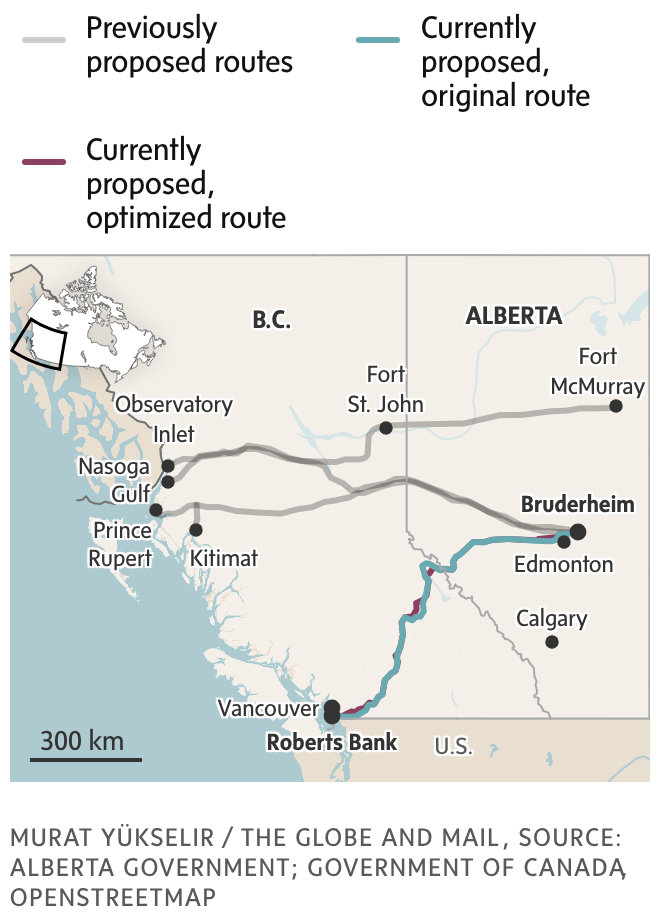
The West Coast pipeline proposal |
|
|
|
|
|
|
The Alberta government has proposed a southern route for a new oil pipeline to the Pacific,
which will be planned and built by the federally owned Trans Mountain Corp., working with Pembina Pipeline Corp. Perhaps most striking about a plan being touted as a nation-building project, Stephanie Levitz and Jeffrey Jones |