|
|
|
|
|
|
|
|
|
The Home of the Week is a former rooming house in Toronto's Little Italy. Mshati Productions
|
|
|
|
|
This week: The tell-tale signs of AI in real-estate listings, and why condo developers are using NDAs to offer steep price discounts. Plus, the debate over putting front lawns behind us, and one property worth a look. |
|
|
|
|
|
|
|
|
|
|
More real estate listings are being written with AI. Here’s how to spot them |
|
|
|
|
|
|
|
|
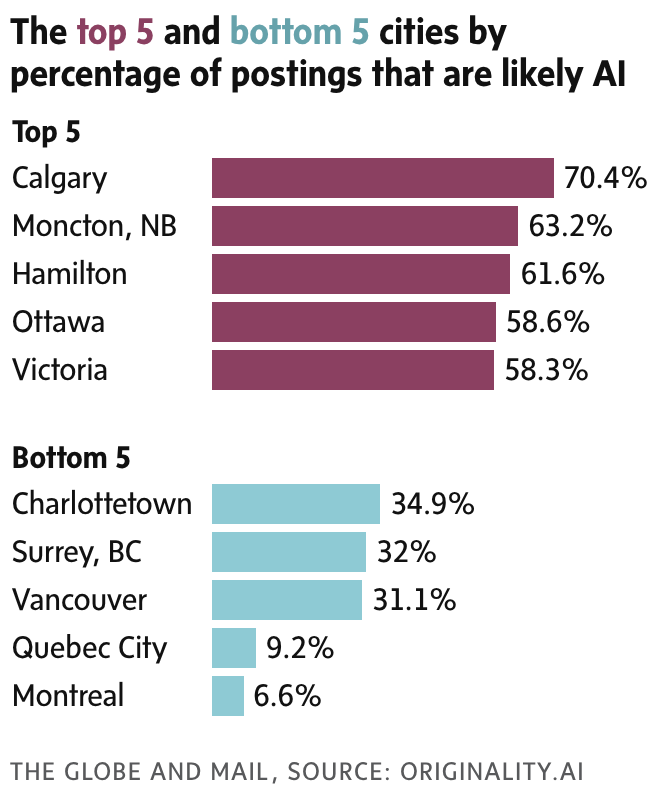
No, it’s not just you noticing the weird tones and out-of-place word choices. If you’ve been house-hunting lately, about one-third of online real-estate listings are likely written by artificial intelligence,
according to a new report from AI-detection firm Originality.ai. The rate is around 41 per cent for home sales and 21 per cent among rentals, and as Salmaan Farooqui reports, the proportion also varies wildly between cities (Calgary tops the list at 70.4 per cent). |
|
|
|
|
|
|
AI use in real estate has become common and controversial, and realtors have been fined for duping buyers
with misleading photo edits. Just last month, I had a gut feeling about a listing photo and asked our photo team to help investigate. Lucky we caught it before the story published because, sure enough, the real estate agent confirmed AI had been used to enhance the photo. |
|
|
|
|
Of course, using AI can also help busy realtors focus on what matters most: the people. Calgary-based Amanda Ku says it helps her shave as much as thirty minutes off the hours it takes to write a listing, but “the onus is on realtors to carefully read and edit what is being produced and check it against reality.” Salmaan took a closer look at the data and tell-tale signs AI wrote a listing, and
here’s his guide to the punctuation and vocabulary you should look out for. |
|
|
|
|
|
|
|
|
|
|
Some developers are offering steep condo discounts – as long as you sign an NDA |
|
|
|
|
|
|
|
|
|
Photo illustration by The Globe and Mail/iStockPhoto / Getty Images
|
|
|
|
|
Looking to buy a condo soon? The listing price might not be what units are selling for at all, and you might get a better deal if you agree to stay quiet.
Some developers are asking buyers to sign non-disclosure agreements when offering steep discounts on condos, a Globe investigation has found. One equity researcher posing as a mystery shopper in Vancouver was offered a discount of around $700 per sq. ft. if he signed an NDA, he told Erica Alini. A realtor said his client recently bought a new condo in Oakville, Ont., for $75,000 less than the original price in a deal that included an NDA. |
|
|
|
|
As Erica reported earlier this year, pre-emptive NDAs are used in some pre-sale contracts
to prevent buyers from speaking about issues that might arise with the developers building their homes. “With these NDAs, though, the main concern is about other buyers,” she told me. “The point of these NDAs seems to prevent people from finding out that some units changed hands at prices much lower than those advertised in market listings. A big discount on one unit can depress the value of other similar units in the same condo complex or nearby units. The point of keeping the price hush-hush is to reduce the risk of that.” |
|
|
|
|
The tactic is also a sign builders are willing to get creative to move units in this sluggish market. “On the one hand, an NDA can make developers more comfortable with offering a one-off extraordinary deal to a struggling buyer who might otherwise default,” Erica told me. “But what about other buyers? That information would help them negotiate lower prices on similar units.”
Read the full investigation here. |
|
|
|
|
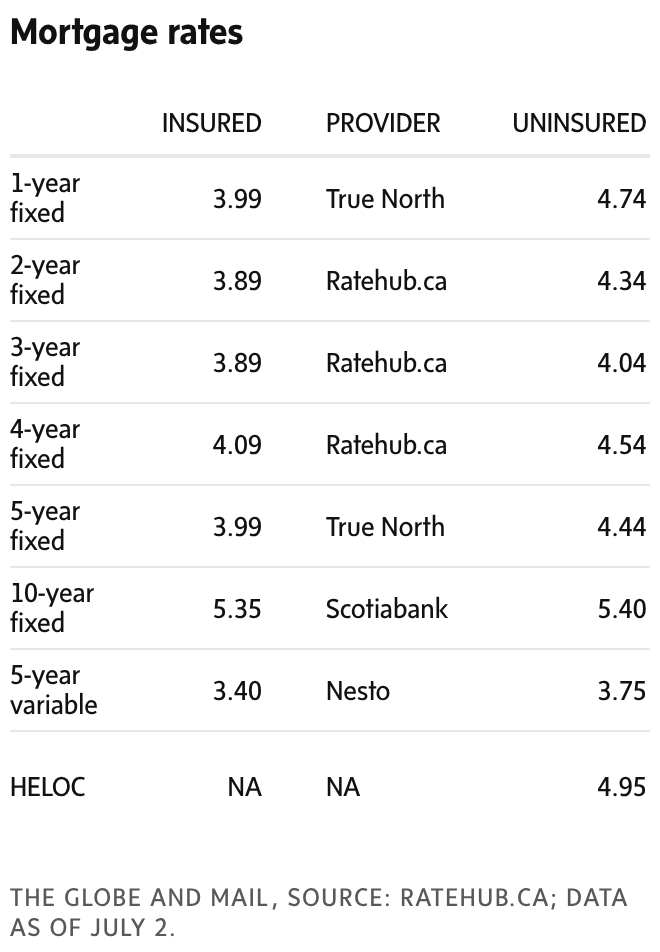
This week’s lowest fixed and variable mortgage rates in Canada |
|
|
|
|
|
|
|
|
|
|
|
|
|
|
|
|
|
|
The prolonged U.S.-Iran war is keeping the housing market stagnant |
|
|
|
|
If you were waiting for mortgage rates to drop or for a bit more economic certainty, don’t hold your breath this year. The dampening effect of the Iran war
could have been short-lived, but now it’s become a long-term guest in the market – no matter when the conflict ends. As the war has dragged on for five months, all of its immediate economic impacts – higher bond yield and fixed mortgage rates, skyrocketing energy prices and zapped consumer confidence – have become entrenched. Even if the conflict ended tomorrow, analysts told Salmaan Farooqui it’s unlikely you’ll see pre-war energy prices or mortgage rates back before 2026 is out. |
|
|
|
|
That’s largely due to the months-long near-shutdown of the Strait of Hormuz, which has created a backlog of oil shipments and a build-up of inflationary pressure that will take time to ease. And if the Bank of Canada feels it has to hike rates to combat the inflationary pressure – as it has warned it is willing to do – that would make variable mortgage rates rise as well. Not to mention the general economic uncertainty now that our trade deal with the U.S. hasn’t been renewed and negotiations are up in the air. |
|
|
|
|
While hopes that 2026 could see modest gains in home sales and prices have been dashed by the half-way mark, some analysts are more optimistic the market will notably improve next year. “This feels like a real Goldilocks moment to me,” Kari Norman, a senior economist with Desjardins, told Sal. “Prices are reasonable relative to history, and mortgage rates are about as low as they’re going to go.” And ultimately, buyers can only wait so long to purchase a home. “At some point, if it’s the right house, right time and the balance sheet works for consumers, they’ll pull the trigger and make a deal,” Coldwell Banker Canada’s CEO Karim Kennedy said. Read the full outlook for the rest of the year here. |
|
|
|
|
|
|
|
|
|
|
Is the era of the front lawn behind us? |
|
|
|
|
|
|
|
|
|
Lawns have stood the test of time for their utility, but some say it's time to embrace greener and less time-intensive options. IRINA NAZAROVA/Getty Images
|
|
|