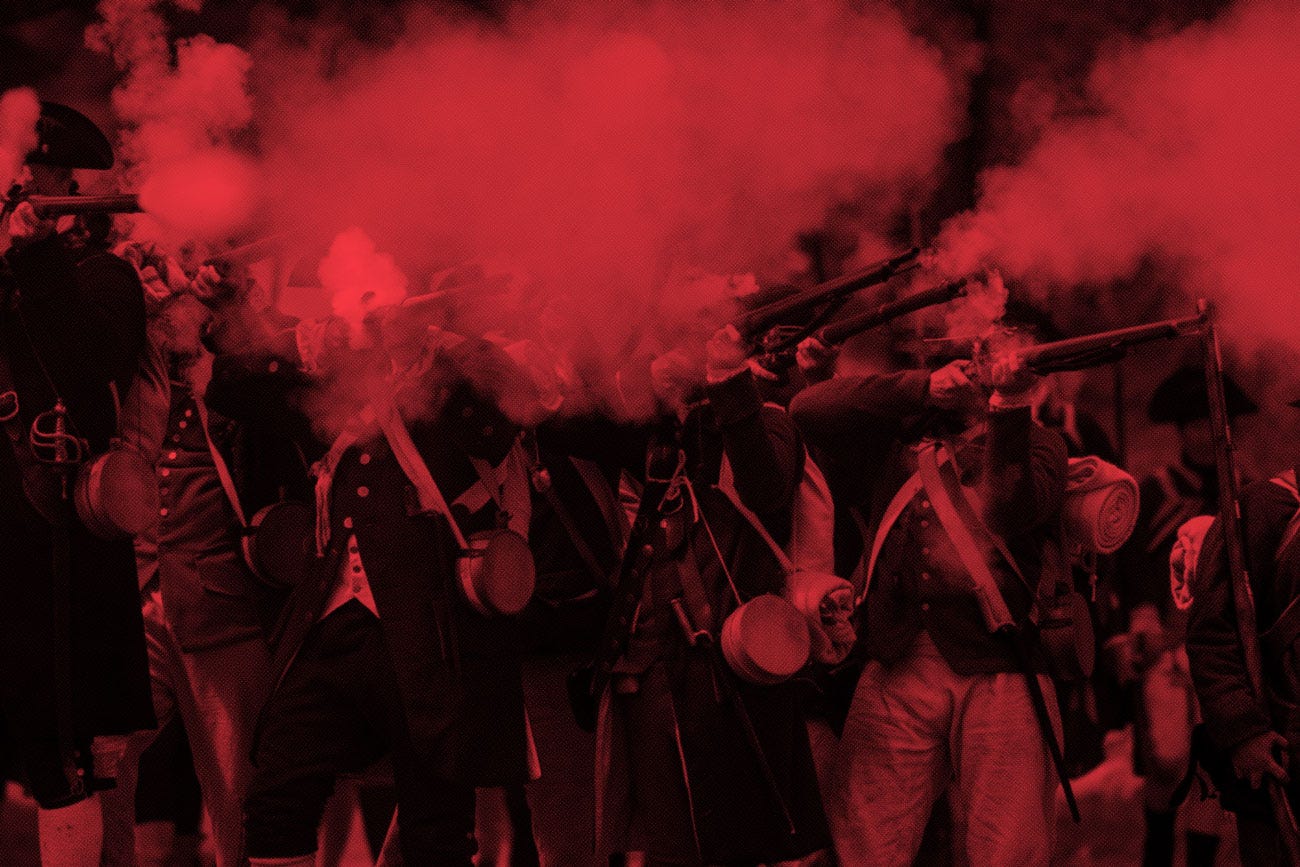
In a desperate effort to defend a key stronghold from advancing British troops, the Continental Army dug in at Philadelphia’s Fort Mifflin in September 1777. What followed was among the most brutal sieges of the Revolutionary War. The patriots’ meager defenses couldn’t withstand the constant British barrage, and one patriot after another was “cut in two.” A survivor, Joseph Plumb Martin, later described the ordeal: “In the cold month of November,” he fought “without provisions, without clothing,” without even “a scrap of either shoes or stockings.” As the battle neared its end, Martin surveyed lines of dead comrades, observing later that “if ever destruction was complete, it was here.” He was just 16 years old.
Many defeats and relentless hardships followed over the long years of the revolution. Often, soldiers survived on whatever they could find: bark from trees, dog and horse flesh, strips of leather boiled down to bitter soup. Martin recalled regularly marching “24 or 48 hours . . . night and day without rest or sleep.” At times, he fell asleep on his feet, only to be jolted awake by the man next to him. Soldiers slept and fought without adequate clothing, blankets, or, like Martin, shoes. “You might have tracked the army . . . by the blood of their feet,” George Washington said about the long winter march to Valley Forge in Pennsylvania. Those who escaped death from starvation, exposure, or enemy fire often succumbed to disease. And for all this, the small wages the men were promised often went unpaid or arrived in currency so devalued as to be nearly worthless.
This article is featured in America at 250. Sign up here to get an update every time a new piece is published. Soldiers were not alone in their sacrifice. Across the colonies, ordinary people contributed in countless ways. Women organized boycotts of British goods, joined resistance groups like the Daughters of Liberty, and tended to soldiers as nurses and cooks. Farmers left their fields to join local militias and fight alongside the Continental Army. Children kept households and managed businesses in their parents’ absence. Many, like Martin, volunteered to serve. Emily Geiger was 18 years old when she rode through enemy lines to deliver an important message to a patriot general. Richard Lord Jones was 10 when he became an army fifer; after his discharge three years later, he walked 150 miles home. And when the British caught the 21-year-old spy Nathan Hale, he met death with resolve: “I only regret that I have but one life to give for my country.”
This year marks the 250th anniversary of our nation’s independence. We are celebrating with fireworks, barbecues, and parades. But we might also pause to reflect on the courage and sacrifice of the founding generation and ask: What moved so many ordinary people to do so many extraordinary things?...