
|
 |


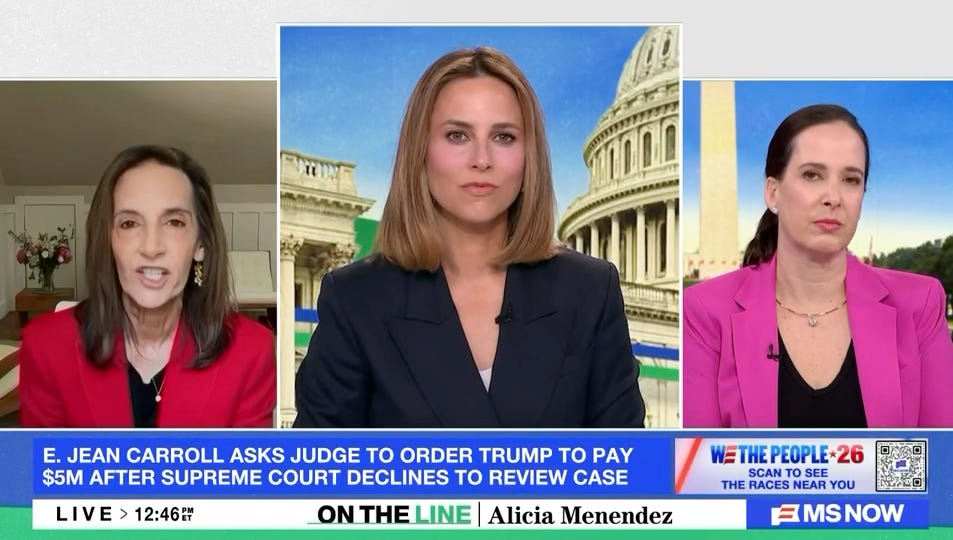 |
When Donald Trump appealed the $5 million dollars the jury awarded to E. Jean Carroll in the first of her two defamation victories against him, he put that money, plus extra to cover interest, into escrow. The money would go to her immediately if the appeal terminated in her favor. Trump stipulated that would be the case if, once he asked the Supreme Court to hear his appeal on a writ of certiorari, they declined to do so, which would finalize the decision in Carroll’s favor. That’s exactly what happened on Monday. That means it’s time for Donald Trump to pay up.
So of course, he did, right? He’d made an agreement and he honored it.
Alas—and as you all undoubtedly anticipated—that did not happen. Donald Trump, in fact, did not honor his agreement. He was not, yet again, a gracious loser. He has not paid up. He owes Carroll $5,779,783.00, the amount of the judgment plus post-judgment interest. Instead, he wants to delay making the payment. It’s so on brand. But it’s not going to work this time.
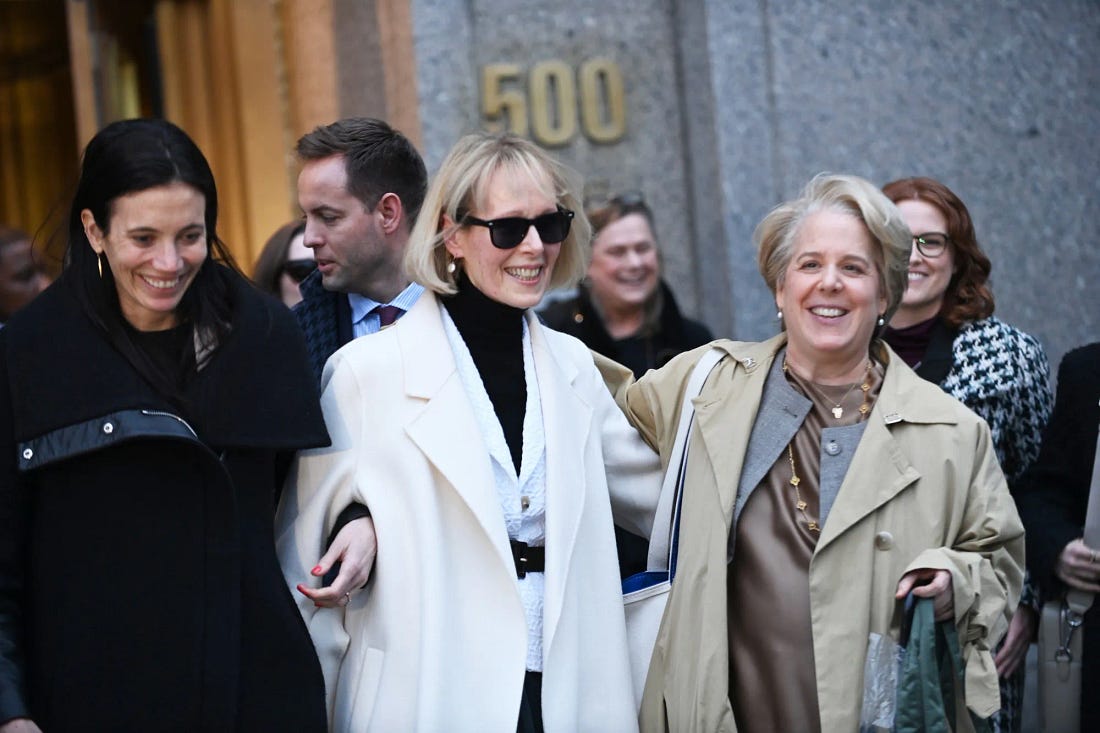
We know all of this because Carroll’s lawyer, the incomparable Robbie Kaplan, had to explain it all to a judge.
 |
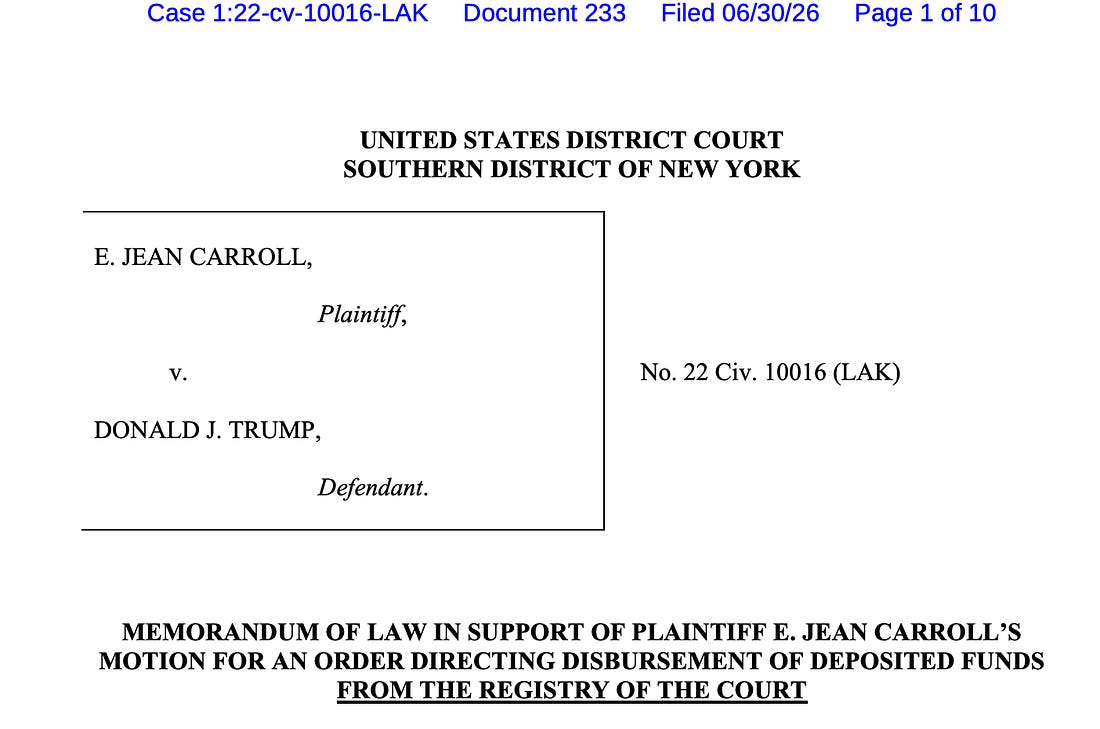
She laid it all out in a legal memorandum in support of a motion asking the judge to issue “an order directing the disbursement of funds held in the Court Registry Investment System (‘CRIS’) to Plaintiff pursuant to the terms of the Stipulation.” The motion and memo in support of it were filed shortly after the Supreme Court denied cert. In the vernacular, E. Jean Carroll and her lawyer were loaded for bear. They seem to have anticipated what was coming.
 |
They start by laying out the facts:
The denial of cert “as the Parties agreed and this Court expressly ordered, entitles Carroll to ‘collect any moneys owed by Defendant to Plaintiff.’”
“Having lost his bid to obtain review before the Supreme Court, Defendant continues ‘being dilatory’ and ‘slowroll[ing] his defenses, asserting or inventing a new one each time his prior effort to delay the case fails.’”
Trump “remarkably seeks to further delay Carroll’s collection of the judgment awarded to her in 2023 by stating that he is considering whether to move for reconsideration of the Supreme Court’s denial of his petition.”
That last bit, the idea that there’s any chance the Supreme Court would reconsider denying cert, is a stone-cold loser. The parties have already briefed the issue. Neither the facts nor the law have changed since then. There is no reason for the Court to reconsider, especially in light of the fact that the Supreme Court only grants cert in 1% to 4% of the civil cases where a losing party asks it to. There is a 1955 criminal case where the Court changed its mind after the law changed, revisiting its earlier decision to deny cert. But that’s about it as far as cases where a defendant wants the Supreme Court to engage in a full review of the case. And it’s not about to happen in this case. Trump’s case is over. He’s lost. As Robbie Kaplan writes, “But this is the end of the line.”
Donald Trump refused to acknowledge that. In fact, he posted on Truth Social shortly after the order in which the Court rejected his request was made public.
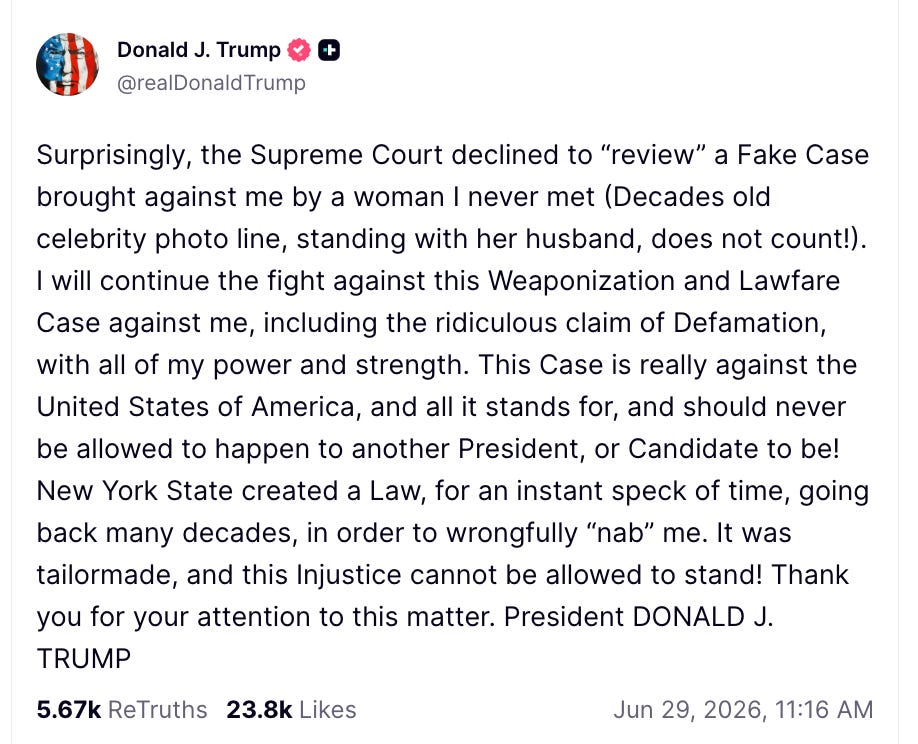 |
After essentially repeating his defamation, calling Carroll’s case “Fake” and claiming he never met her, despite a photo of them together, Trump tried to morph the case into one that “is really against the United States of America.” It isn’t. It’s a case about Trump defaming a woman who claimed he sexually assaulted her, no matter how hard he tries to make it about “the fight against this Weaponization and Lawfare Case against me.” Despite Trump’s post of tired, false claims, it’s over; a jury has spoken, as has the Supreme Court. This is about the facts and the law, and no matter how Trump tries to claim it’s lawfare, he owes E. Jean Carroll $5 million plus interest.
Carroll advises the court about what happened shortly after the social media post: “Within minutes of that Truth Social post, Defendant’s counsel contacted Carroll’s undersigned counsel to inquire whether Carroll would consent to a further stay of enforcement of the judgment in this action so that Defendant can ask the Supreme Court to reconsider its denial of certiorari in her case. Counsel for Carroll explained that Paragraph 8 of the Stipulation and Order provided for disbursement of the award owed to Carroll immediately upon denial of a petition for certiorari, and counsel for Defendant clarified that he was requesting that Carroll consent to a ‘new stay or continuance’ of execution. That afternoon, Carroll’s undersigned counsel notified Defendant’s counsel that Carroll does not consent and inquired whether Defendant would agree to stipulate to the immediate disbursement of the funds owed to Carroll.”
Let me translate: The client has a temper tantrum because he doesn’t want to pay a judgment against him. His lawyers call the plaintiff’s lawyers to ask for more time—they know they’re not entitled to it, and they know the lawyer will say no because it’s a frivolous request, but they ask anyway. It must be embarrassing to represent a client like this in a case like this, a client who refuses to follow the rules and brags about it on social media.
Carroll’s lawyers ask the court to “enforce the plain language of the existing Stipulation and Order and