
|
 |
The investigative reporting that you are about to read is not optimized to trend on TikTok. It is exponentially more expensive to produce than AI slop. And it will never be supported by corporate advertisers.
We believe in the old school approach to journalism — poring over obscure government databases, pursuing leads, connecting the dots, checking our facts, and holding power to account.
As you’ll read below, this approach has unearthed a damning set of facts. But I’ll be blunt: the technological, political and legal trends are all working against us. We are swimming against the current and we need your help.
If you would like to see more in-depth reporting like the story you are about to read, and you can afford $6 per month or $50 per year, please upgrade to a paid subscription.
GOP Senate candidate spent $400,000 of taxpayer money on campaign-style ads
Georgia Congressman Mike Collins is using public funds to pay a political ad firm — the same firm that makes his Senate campaign ads.
| |||||||||||||||


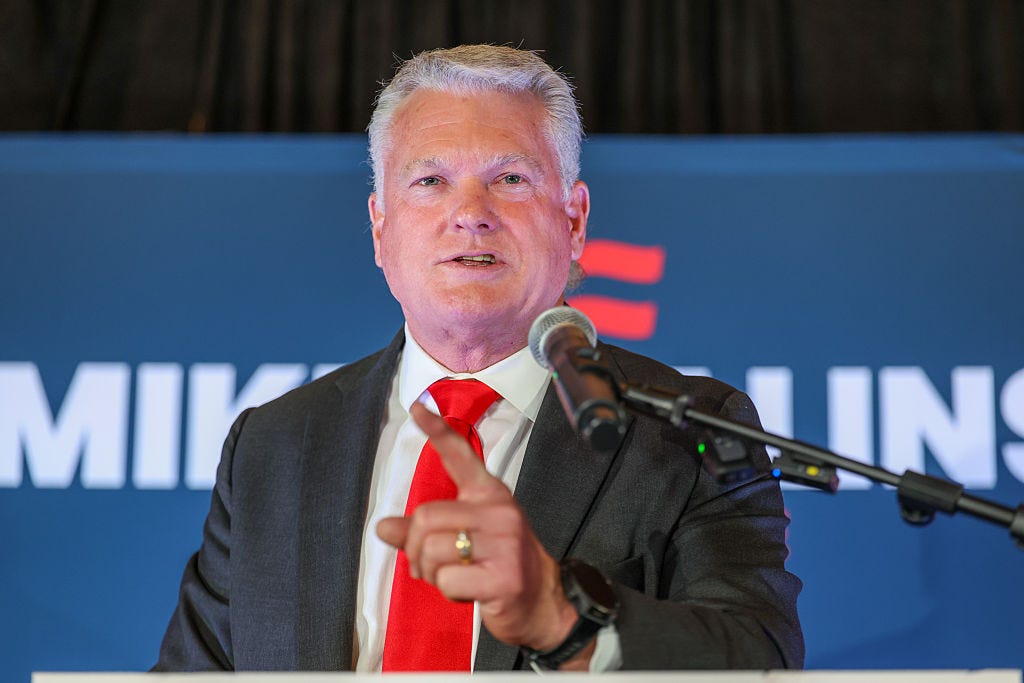 |
Congressman Mike Collins (R-GA), the Republican nominee for a hotly contested U.S. Senate seat in Georgia, spent over $400,000 of taxpayer money designated for office expenses on TV ads that are virtually indistinguishable from his campaign ads.
Collins paid for these ads using funds provided for the operation of his congressional office. Although it is permissible for such funds to be used for “mass communications” to constituents, the House Communications Standards Manual states that such communications “should not be used for political or personal business.” Further, the manual states that mass communications paid for with office funds should contain “no campaign content” and “no content laudatory of a Member on a personal or political basis.”
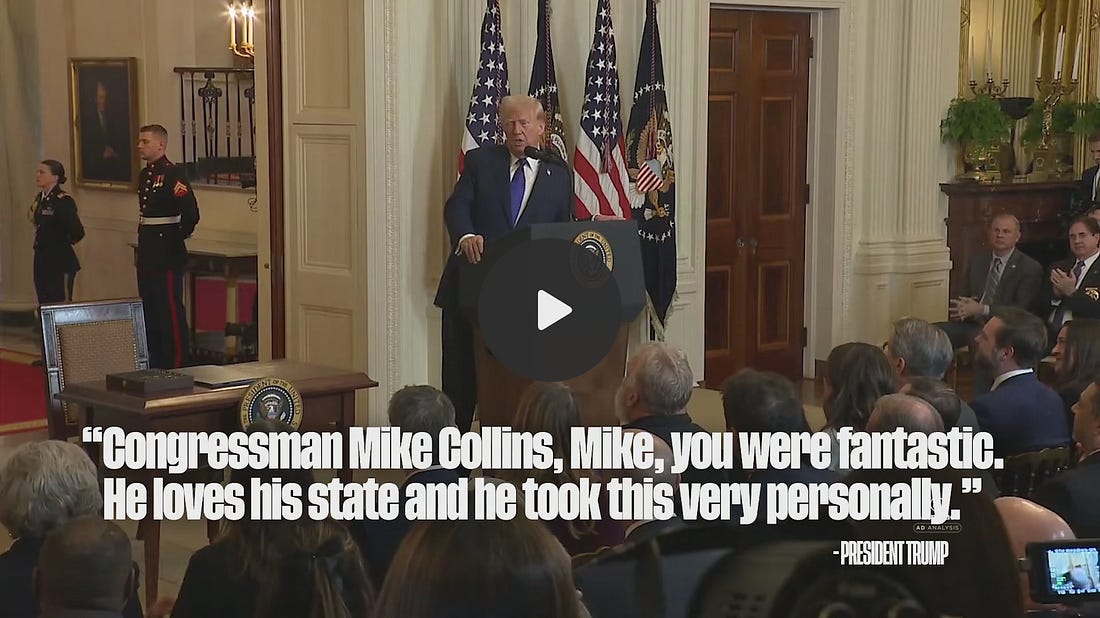
“Congressman Mike Collins. Mike you were fantastic,” President Trump says at the beginning of one ad paid for with Collins’ office funds. A narrator then states, “Mike Collins is protecting Georgia by working with President Trump to pass the Laken Riley Act.” The 30-second ad concludes by playing Trump’s praise of Collins again. “He loves this state and he took this very personally,” Trump says. “Thank you, Mike.” The only indication that the ad is not a campaign ad appears in small type for four seconds: “PAID FOR WITH OFFICIAL FUNDS BY THE OFFICE OF MIKE COLLINS.”
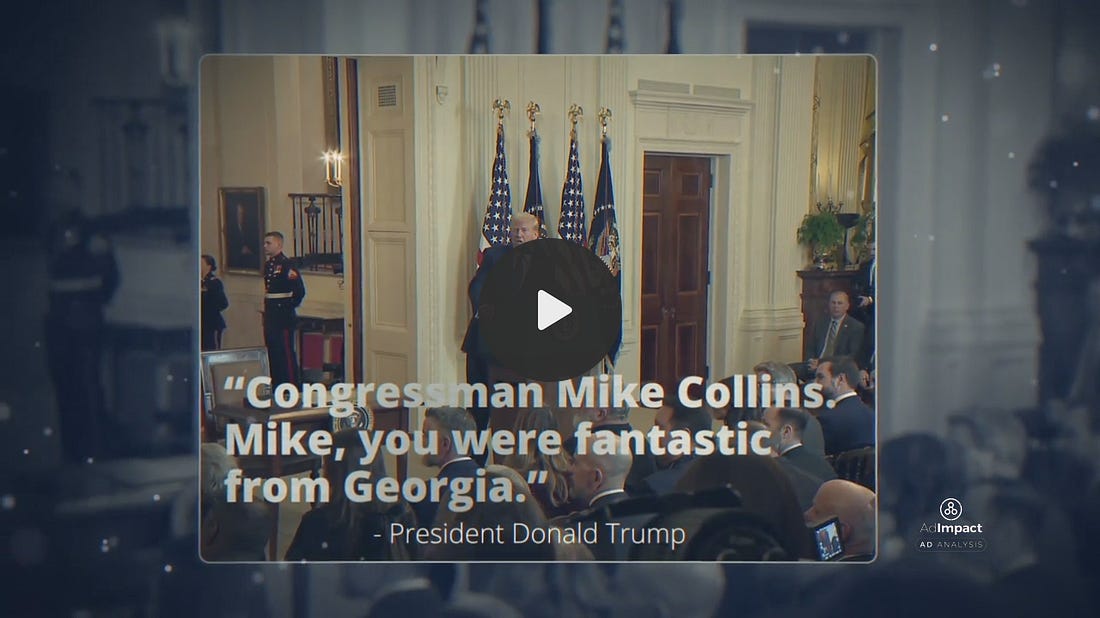
Indeed, Collins’ Senate campaign is currently running an ad that is substantively identical. Both ads include the exact same quote from Trump praising Collins, paired with the same video. In his taxpayer-funded ad, a narrator says Collins is “protecting Georgia by working with President Trump to pass the Laken Riley Act.” In his campaign ad, Collins says he “wrote the Laken Riley Act… to protect Georgia families.”
Another reason why these ads were so similar: it appears they were created by the same political ad firm, Smart Media Group. On its website, Smart Media Group says it “powers winning campaigns” and is “trusted by all the top Republican committees.” The firm says it leverages data to produce ads that “help campaigns win elections.” The House Communications Standards Manual also prohibits the distribution of “content developed using campaign resources.”
According to the House Statement of Disbursements, where each member must report their office expenses on a quarterly basis, Collins’ House office paid Smart Media Group over $400,000 between October 2025 and March 2026. This includes a payment for $307,160 on March 16, 2026.
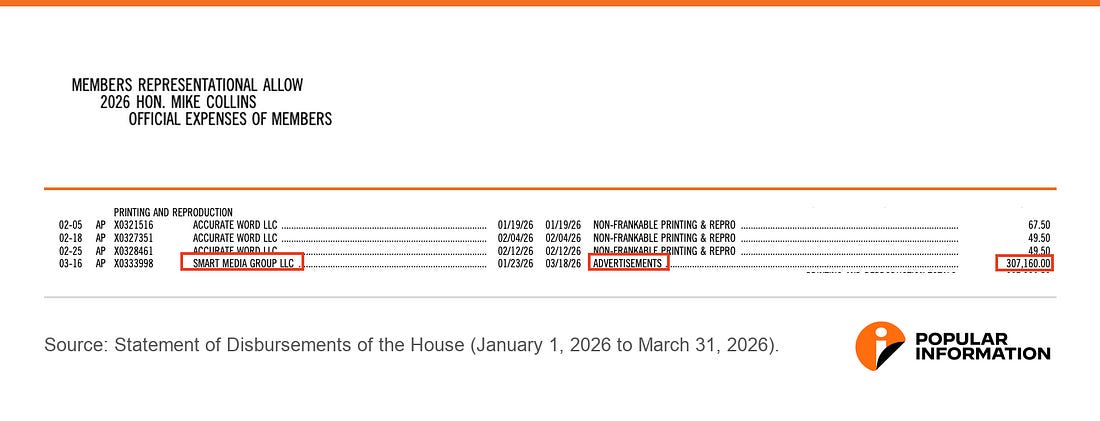 |
To put that figure in perspective, over the same six-month period, the average Congressional office spent about $33,000 on all mass communications. A Popular Information review of the spending of every House member from 2020 to the present found that the payment of over $300,000 to Smart Media by Collins’ office was the single largest recorded payment for advertising.
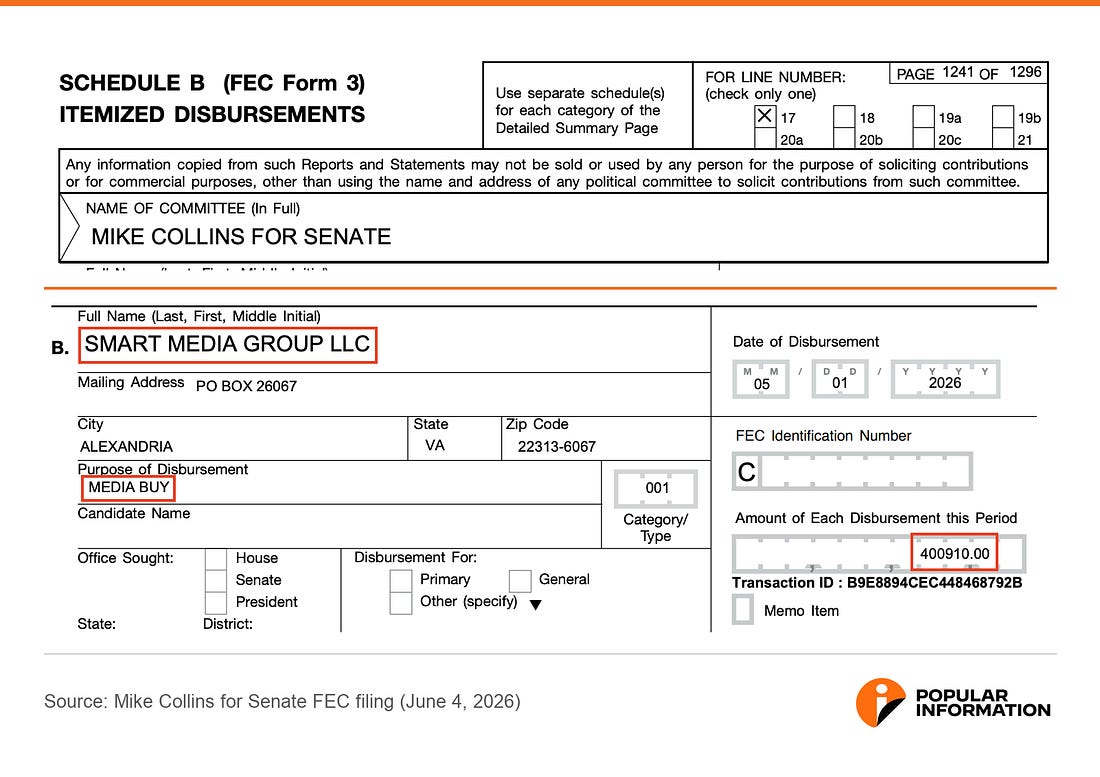
Meanwhile, on May 1, 2026, Collins’ Senate campaign paid Smart Media Group $400,910 for an ad buy.
 |
Unsolicited mass communications paid for with Congressional office funds are prohibited within 60 days of an election. Collins’ taxpayer-funded ad ran through March 18, 2026, just before that 60-day cutoff ahead of the May 19 primary in Georgia.