
|
 |
Bulwark fam, today we have an emergency Huddled Masses to wade through not just the momentous U.S. Supreme Court decision striking down Trump’s birthright citizenship executive order but other major news from the Court: a ruling that could make it possible for the Trump administration to wipe away the legal status of an enormous number of immigrants.
Send in questions: If you’ve got any questions on the birthright citizenship ruling, the temporary protected status ruling, or the Court’s other decision on asylum seekers at the border, feel free to drop us a line in the comments and we’ll answer some of them on video with experts this week.
Meanwhile, I want to invite you to sign up for a Bulwark+ membership. Our members make this newsletter—and all our reporting and commentary!—possible. This week, in honor of July Fourth, we’ve got a sale going on: You can sign up for a year for $86. (Get it?) Consider it your own way of declaring independence.
–Adrian
Trump Lost on Birthright Citizenship. But He’s Winning the Immigration Wars.
SCOTUS rejected his brazen constitutional gambit—but cleared the way for potentially the largest revocation of legal immigration status in American history.
|

| ||||||||||||


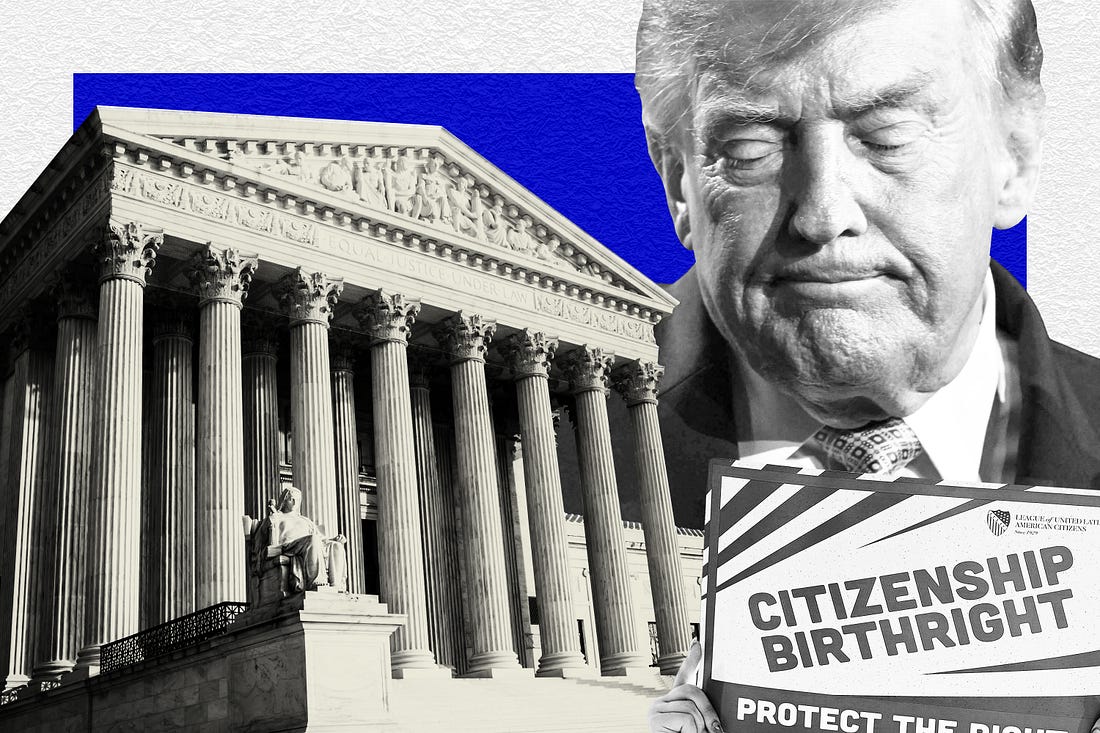 |
THE U.S. SUPREME COURT DEALT a major blow to Donald Trump’s mass deportation program Tuesday morning in Trump v. Barbara with a 6–3 decision striking down his executive order that purported to end birthright citizenship.
But how much of a blow was it really?
I’ve been grappling with that question ever since the ruling came out on Tuesday morning. And in my various conversations with legal scholars and immigrant advocates, it is clear that the fear they felt coming into decision day has been only partially alleviated.
Yes, the Supreme Court’s decision upheld that children born in the United States to parents unlawfully or temporarily present are “subject to the jurisdiction” of the United States and “are citizens at birth under the Fourteenth Amendment’s Citizenship Clause.”
And yes, Chief Justice John Roberts, who wrote the majority opinion, said “citizenship, then and now, was the right to have rights—to freely participate in our political community. The Framers of the Fourteenth Amendment extended that promise to ‘every free-born person in this land.’ . . . We keep that promise today.”
But step back from the prose and take note of the purpose. Roberts wasn’t making the case just to the public. He was making it to his colleagues.
Justices Clarence Thomas, Samuel Alito, and Neil Gorsuch dissented. (Justice Brett Kavanaugh affirmed the judgment but dissented in part and did not join Roberts’s majority opinion.) In other words, four Supreme Court justices were willing to state that they do not believe birthright citizenship is enshrined in the Constitution—a fact that would have shocked most legal scholars not too long ago.
So yes, the Court’s rejection of Trump’s order reveals the limits of his expansive and often illegal view of executive power that extends to modifying the Constitution via such orders. And yes, more than 250,000 babies born in the United States each year who would have been affected had the executive order been upheld, were not.
But opponents of Trump’s executive order still have future developments to fear. The door remains open to a future Congress restricting birthright citizenship through legislation, with only one justice needed to flip for that goal to be achieved.
THIS ISSUE BECAME the stuff of 72-point headlines when, among the many executive orders Trump approved in the hours after being sworn in for his second term, he signed one attempting to abolish birthright citizenship.
Ratified in 1868 to grant citizenship to formerly enslaved black Americans, the Fourteenth Amendment makes those born on U.S. soil full citizens entitled to all the associated rights and privileges thereof and ensuring “equality under the law, regardless of race, ancestry, or parentage,” as the American Immigration Council puts it. The amendment overrode the Supreme Court’s 1857 Dred Scott decision, which held that black people “are not included, and were not intended to be included, under the word ‘citizens’ in the Constitution.”
Or as John Bingham, author of the amendment, once said, its purpose was to end the “horrid blasphemy . . . that this is a Government of white men.”
But that intention has been contested at times in history since. As Columbia University’s Mae Ngai, a historian specializing in immigration, told me, while the struggle over birthright citizenship is profoundly important, it is not new. She said today’s fight over the issue mirrors past episodes, such as the one in which Frederick Douglass challenged racialist and nativist positions in his famous 1867 lecture, “Our Composite Nation.” At the time, Douglass was speaking in opposition to attempts to restrict Chinese immigration and naturalization. He charged that post-Civil War American democracy must include all races.
This was the singular American identity the Trump administration sought to destroy.
“As the Trump administration lawyer said: We live in a different world today. And [Chief Justice] John Roberts said [during oral argument in April], ‘Yes it’s a different world, but it’s the same Constitution,’” Ngai noted.