
|
 |
This holiday belongs to everyone who believes in this country enough to fight for it. That’s us. That’s you. Join Bulwark+ for $86 a year—14 percent off, this week only.
Take back the Fourth! Declare your independence today and 86 the B.S.
The Supreme Court Just Made the Case for Its Own Expansion
Today’s birthright citizenship ruling wasn't a win for constitutionalism. It was a warning.
|

| ||||||||||||


 |
1. “Winning”
On the one hand, yes, it is very nice that the Supreme Court rejected the Trump administration’s BLATANTLY UNCONSTITUTIONAL order to unilaterally end the constitutional guarantee of birthright citizenship.
This is nice in the same way that it is nice when a person walking past you on the street doesn’t pull out a gun and shoot you.
The Court’s majority followed the Constitution. Yay. Let the celebrations begin. Give each of the six justices in the majority a cookie.
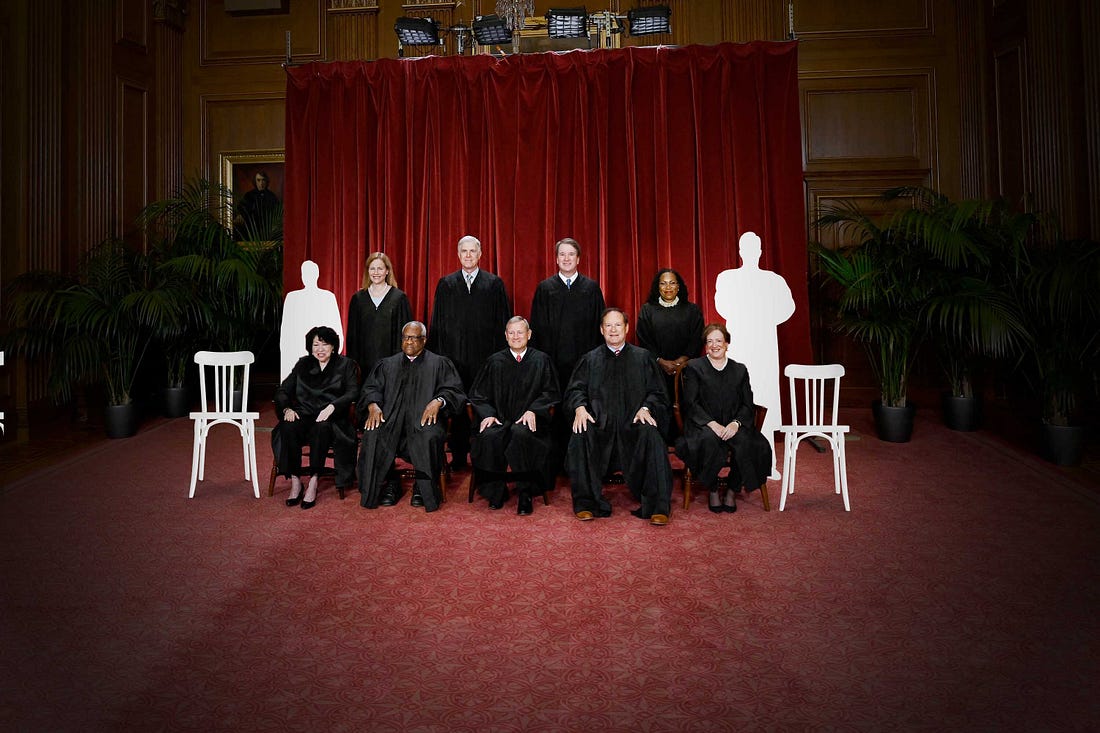
On the other hand: The fact that three justices took the anti-constitutional side of this fight is evidence that the Court itself cries out for reform.
Let’s not play make-believe. There was no “case” here. The Trump administration has lost this argument at every single level. The lower-court judges who heard the case were gobsmacked that the Trump administration would even try to end birthright citizenship via executive order.
It started in January 2025 when a district court judge granted a temporary restraining order blocking implementation of the policy.
“This is a blatantly unconstitutional [executive] order,” Judge John Coughenour said. He was not done:
I’ve been on the bench for over four decades. I can’t remember another case where the question presented was as clear as this one is. This is a blatantly unconstitutional order.
Where were the lawyers when this decision was being made? There are other times in world history when we look back, as people of good will, and say, “Where were the judges? Where were the lawyers?” And frankly, I have difficulty understanding how a member of the bar could state unequivocally that this is a constitutional order. It just boggles my mind.
Coughenour is not one of your socialist DEI judges—he was appointed by Ronald Forking Reagan.
Six months later, in July 2025, Judge Joseph Laplante, a George W. Bush appointee in the District Court of New Hampshire, granted certification for the class-action lawsuit that would challenge the administration’s policy.
Another version of the case, State of Washington v. Trump, was heard by the Ninth Circuit Court of Appeals. It ruled against Trump as well.¹
The majority, upholding a lower court’s injunction, ruled that the lower court had “correctly concluded that the Executive Order’s proposed interpretation, denying citizenship to many persons born in the United States, is unconstitutional.”
The first time the Trump administration was able to find any judge, anywhere in America, to state that it had the ability to do away with birthright citizenship was when it got to the Supreme Court.
And then it found three of them.
2. Reform
What does it mean when a third of the Court wants to blow up the Constitution?...
Join The Bulwark to unlock the rest.
Become a paying member of The Bulwark to get access to this post and other subscriber-only content.