
|
 |
After SCOTUS Ruling, Haitians Prepare for Disaster
Springfield, Ohio meets MAGA cruelty with humanitarian dignity.
|



| ||||||||||||


All this time later, the Epstein story still isn’t going away as quickly as the White House would like: Yesterday, a federal judge ruled that acting Attorney General Todd Blanche had “conceded” the Justice Department remains in violation of the Epstein Transparency Act. The judge issued a preliminary injunction that—per Politico—“gives Blanche a week to release certain names and other information redacted by DOJ from the millions of pages of the Epstein files, or provide a more detailed explanation for withholding them.” Happy Friday.
Join JVL and Catherine Rampell for Receipts Live today at 12:30 p.m. EDT on Substack and YouTube.
 |
Forward Together, Backward by Order
by Jim Swift
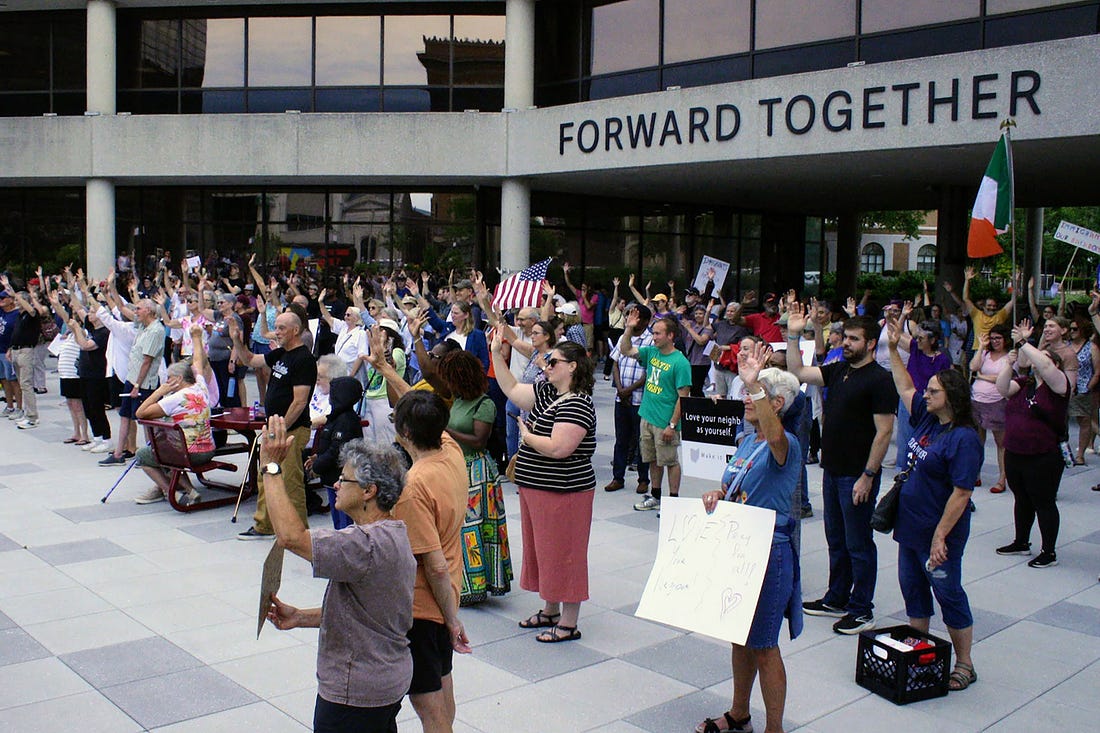
SPRINGFIELD, OHIO—What organizers had hoped would be an evening of celebration was instead an interfaith prayer service. Ministers, immigration lawyers, community organizers, Haitian families, and hundreds of their neighbors gathered in front of Springfield City Hall beneath the city’s motto, “Forward Together,” alternating between English and Creole as they decried the Supreme Court’s decision and prepared for what many fear could become mass deportations.
Thursday morning, after the Supreme Court cleared the way for the Trump administration to end temporary protected status for Haitians, the people who helped revive Springfield, Ohio, were trying to figure out how long they could keep their jobs and their driver’s licenses, and whether they should start preparing for deportation. Pastor Carl Ruby captured the mood: “We had hoped this would become a time of celebration . . . but it has become a time of lament.”
Fleeing gang violence and what has become a de facto civil war, thousands of Haitians have helped reverse decades of decline in Springfield since 2010. They filled factory jobs, opened businesses, started churches, and helped stabilize the city’s population after years of shrinkage. But that growth stopped after JD Vance amplified a pernicious lie about Haitians in Springfield eating dogs and cats.
Now the Trump administration is set on removing many of the very people who helped bring Springfield back.
Yesterday’s 6–3 ruling by the Supreme Court cleared the way for the Trump administration to end TPS, meaning that although litigation may continue, many Haitians here in Ohio and all across America under TPS are subject to deportation immediately.
On a live zoom press conference earlier yesterday held by Springfield G92, a volunteer-led group of churches and faith advocates that focus on immigrant rights and mutual aid, Geoff Pipoly, a lead attorney on the TPS case, Mullin v. Doe, explained that while they’re reviewing what’s left of the case to determine whether any further legal appeals from his plaintiffs were tenable, the situation for Haitians here varies by their status.
Haitians here under TPS could consider filing asylum claims—if they can find an immigration lawyer to help them. The immigration court system is, to put it mildly, a shitshow right now. Donald Trump is purging judges who don’t deport a lot of people, the New York Times reported this week.
The data say the purge is having its desired effect: In Fiscal Year 2025, the denial rate for asylum claims more than doubled—from 14.3 percent to 30.8 percent—while the grant rate fell from 12.0 percent to 9.9 percent, its lowest level since 2017.
Those here under TPS alone are facing a lot: Their state-issued driver’s licenses are set to expire on July 6, as Ohio provided them with temporary extensions due to the uncertainty of their TPS status. Before the stay, Haitians were unable to renew their driver’s licenses because DHS made it clear that Trump wanted to end their protected status. Their expiry in ten days will make driving illegal, not that many are going to be venturing out due to the chance that ICE could stop them and deport them. And, unless they have another legal basis to remain, they won’t have jobs to drive to: the end of TPS will mean the end of their work authorization.
Biassou Pierre, a community organizer from Haiti, told the crowd: assembled in front of city hall, “Today many people call me asking, ‘How will I feed my children if I lose my job? What will happen to my family if I get detained by ICE?’ Unfortunately, we don’t have a good answer.”
But even if one had the money and could find an immigration lawyer with availability to take up their case, that doesn’t mean a quick return to work. “People who have pending asylum applications may be eligible to a