
|
 |



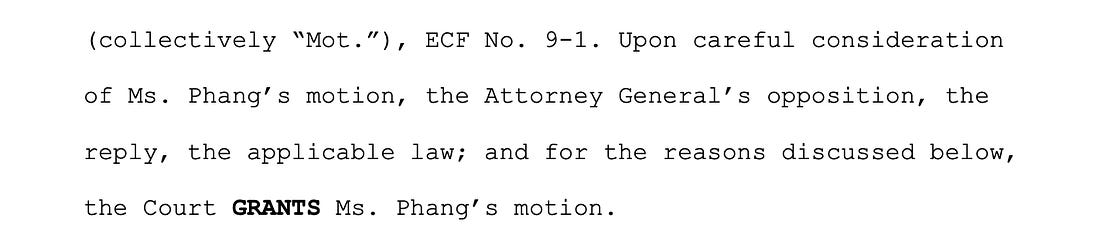
Back on May 1, my friend Katie Phang joined us for Five Questions. Four days earlier, she had sued Todd Blanche over DOJ’s failure to fully release the Epstein Files in compliance with the Transparency Act. At the time, I called it “a novel theory, but one that’s very elegant.” And tonight, I can add successful. Late this afternoon, the Judge entered an injunction in her favor.
 |
The terms of the injunction require the Justice Department to correct parts of its incomplete production of the Epstein Files by fixing the following failures in its compliance with the Epstein Files Transparency Act that Congress passed last year:
Unredacting the names of senders and recipients in at least eight email exchanges that involve Jeffrey Epstein regarding a “torture video” and sexual activity with young women, including minors.
Unredacting the names of possible co-defendants identified in a draft indictment, the names of individuals identified as possible co-conspirators, and the names of the individuals who were the sender and the recipients of an internal DOJ email briefing on the prosecution.
Turning over notes from FBI interviews with a victim who alleged that in the 1980s, when she was about 13 years old, Epstein introduced her to Donald Trump, who assaulted her.
Reviewing and producing foreign language materials, all of which were previously not included.
Publishing logs detailing redactions that were made to documents and the reasons for them.
That obviously covers a lot of ground; all of it highly contentious. It’s material that the Act clearly called for production of and that the government simply refused to provide, without offering reasons that justified withholding it under the terms of the Act. Now, a federal Judge has called DOJ’s bluff.
Katie explained her lawsuit like this in Five Questions: “This lawsuit is about making lawyers actually obey the law. Since December 19, 2025 [the date Congress set for full release of the files], the Trump DOJ has violated the Epstein Files Transparency Act and, in doing so, it has prevented me from being able to do my job as an independent journalist.”
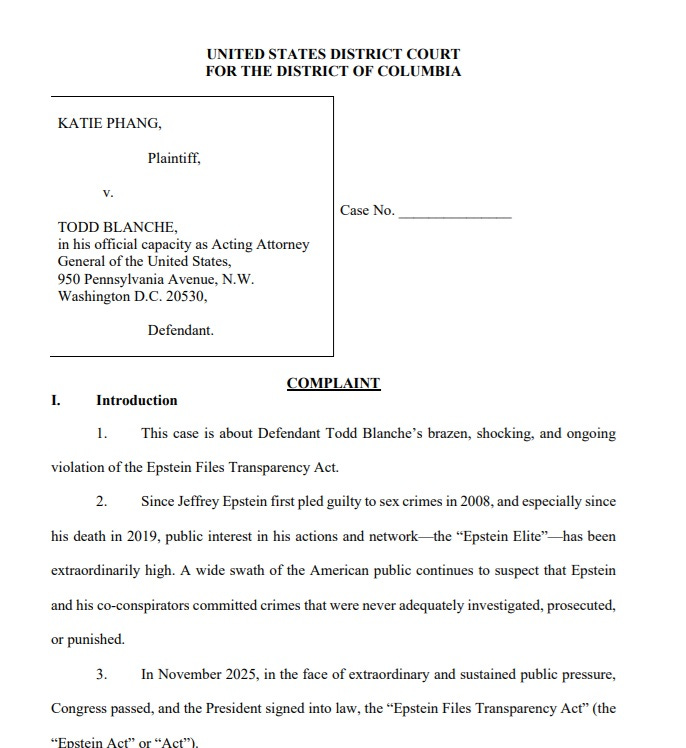 |
The law required DOJ to “make publicly available in a searchable and downloadable format all unclassified records, documents, communications, and investigative materials” relating to Epstein, Maxwell, and others. But it didn’t do that, releasing about half of the files, while botching the redactions, and then claiming nothing else had to be released. Specifically, the law prohibited the government from withholding or delaying anything in the files “on the basis of embarrassment, reputational harm, or political sensitivity, including to any government official, public figure, or foreign dignitary.” But it was permissible to withhold/redact information that would identify a victim, depicted sexual abuse of a child, jeopardize an ongoing investigation [Blanche had already said they didn’t have any], show death/injury/abuse of any person, or that “contain[ed] information specifically authorized under criteria established by an Executive order to be kept secret in the interest of national defense or foreign policy and are in fact properly classified pursuant to such Executive order.”
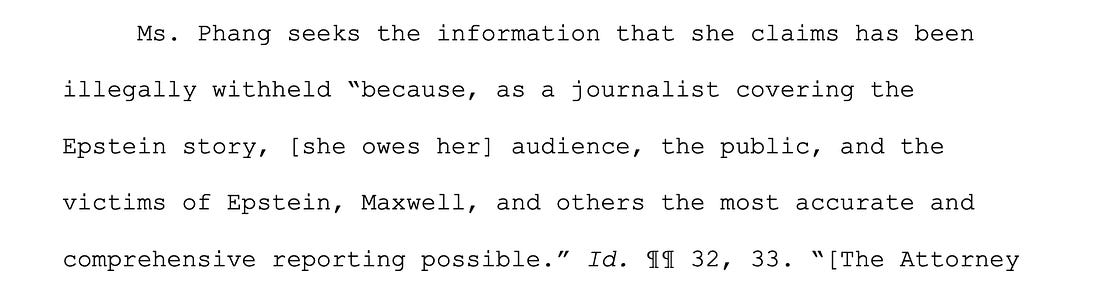
Katie sued under the Administrative Procedure Act, arguing she had standing because she could not fulfill her obligation to report as a journalist without access and that DOJ’s failure to release the Files in compliance with the law impacted her financially because of limitations on her work, as well.
 |
Although the motion for an injunction was limited to the specific items listed above, when it moves beyond the injunction stage of the case, the lawsuit asks the court to:
Declare that the Attorney General has failed to comply with the Act;
enjoin the Attorney General’s ongoing violations of the Epstein Act and require him to remove all unlawful redactions, explain the bases for any remaining lawful redactions, reproduce all materials that were produced but unlawfully redacted, and produce all materials that have not been produced but should be; and
appoint a special master to oversee the Attorney General’s compliance with the law.
Standing has been a sticky issue in many of the cases where private parties have tried to challenge government action. Plaintiffs have to establish that they’ve suffered an injury that was caused by the defendant’s conduct and that if the court rules in the plaintiff’s favor, that injury can be “redressed.” Here, Senior District Judge Emmet Sullivan in the District of Columbia determined that Katie met the high standard for granting an injunction, which involves a likelihood of success on the merits and irreparable injury if the injunction isn’t granted. He was satisfied that standing existed, both because “a denial of access to information qualifies as an injury,” and because she has been economically injured because she cannot report on what the government doesn’t disclose. The Judge called the government’s response “unpersuasive” in places and “without merit” in others.
The government tried to argue that the only remedy available would be a request made pursuant to the Freedom of Information Act (FOIA). But the Judge rejected that argument, noting that “the Attorney General ignores the fact that the Epstein Act requires disclosures that would be exempt under FOIA.”
Katie’s attorney, Brendan Ballou, assessed the bottom line as a result of the Judge’s order like this: “The government ignored its own law and blew off a judge’s order, all for the sake of protecting the very powerful and the very rich. Doing so had consequences, and now the public will finally get transparency around Jeffrey Epstein and his network.” But classified information is supposed to be declassified “to the extent possible,” under the Transparency Act.
The motion for a preliminary injunction got very specific about the information that it sought, for instance, providing document numbers for items it challenged as inappropriately redacted or withheld. The highly specific, targeted, and justified nature of the items the lawsuit asks the Judge to order the government to disclose in the injunction seems to have been a strategic choice that facilitated the Judge’s decision to enter the injunction. This example gives you some idea of how specific the requests got: