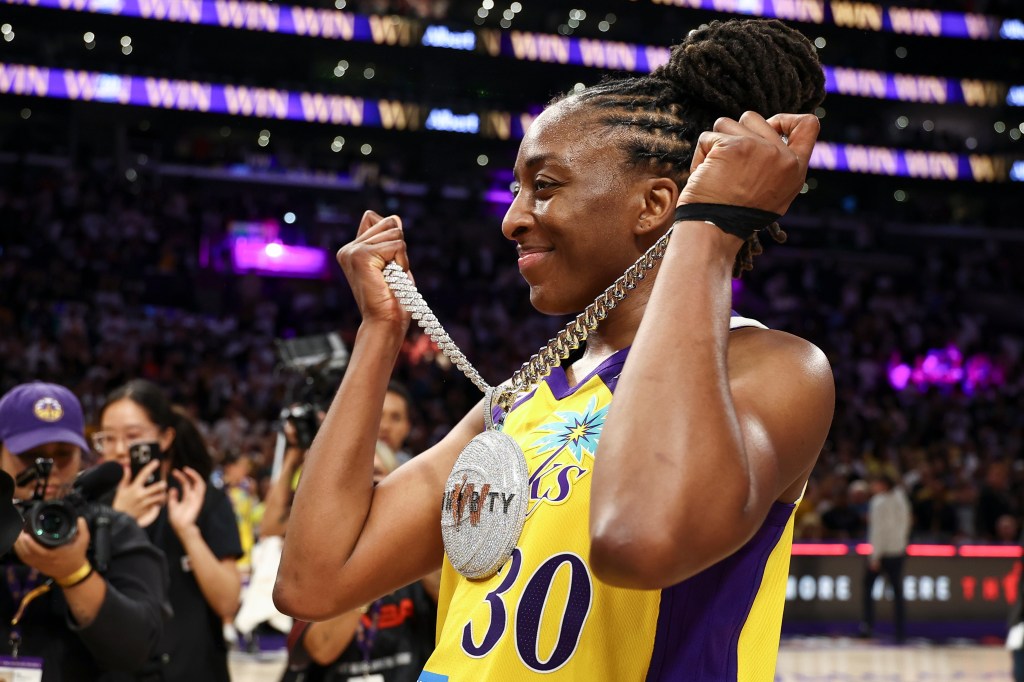
Last night, the Los Angeles Sparks
beat the New York Liberty 98-97 in Los Angeles. Nneka Ogwumike, the head of the WNBA’s players’ union, sank the game-winning shot. It was more than a typical regular-season game. The June 21 face-off marked the league’s 30th season. The WNBA’s first-ever game, between these same two teams, took place on that date in 1997.
It was emotional for Ogwumike, who has played for 15 years—or half the league’s existence. Both teams honored the players who were part of that very first game. Lisa Leslie and Kym Hampton were at center court for the pregame tip-off. “It’s emotional seeing all of these legends in the building. People who didn’t get paid their value, and they’re still coming here and supporting us,” Ogwumike
said after the game. “I’m so grateful.”
Other stakeholders—namely, ESPN—celebrated their role in the WNBA’s 30 seasons too. Before Sunday’s game, I spoke to Rebecca Lobo, one of the league’s first stars and an original player for the New York Liberty. She’s been an ESPN women’s basketball analyst since 2004, shortly after she retired from the sport. She remembers that very first game—driving across L.A. and seeing her face on a billboard with the debut season’s tagline, “We got next.” For the first time, she played with celebrities sitting courtside. Now 52, her career has been tied to the WNBA for more than half her life, she realizes.
“When I was in college, there was no pro league, so I didn’t ever think that I would be commentating on women’s basketball because there weren’t enough games on television to make a living at it,” she says.
And how things have changed. In more basketball news, on Friday I
broke the story that new WNBA star Azzi Fudd is joining the yet-to-debut global league Project B. Fudd, who now plays for the Dallas Wings, was the No. 1 draft pick for 2026. And Project B is being built by a business-minded group chasing a billion-dollar opportunity to build a truly international league for both men and women. Its founding team includes a former Facebook exec, the cofounder of Skype, and LeBron James’ business partner Maverick Carter as an advisor; Bloomberg once reported the league was looking to raise as much as $5 billion, but cofounder Grady Burnett
told me that number was a “little high.”
On the women’s side, the appeal of this league to a player like Fudd speaks to how much has changed. For decades, women’s stars played abroad during the WNBA off-season—it was essentially a requirement, to maximize their earnings during their playing careers while WNBA salaries were so low. Now, Project B’s exhibition-style games from Tokyo to Valencia appeal to Fudd because she wants to see the world; she was struck by the power of international fandom when she visited Chongqing, China with Steph Curry and fans handed her Labubus. But players have options—and with higher pay and their own social media followings and brand deals, they can choose to stay stateside if that’s what’s right for them. Read my full story
here for more on Fudd, Project B, and a transformative 30 years of professional women’s basketball.
Emma Hinchliffeemma.hinchliffe@fortune.comThe Most Powerful Women Daily newsletter is Fortune’
s daily briefing for and about the women leading the business world. Subscribe here.