
|
Pizza wheels are bad, Japanese toilets are great
So why do Americans use the former and not the latter?
|

| |||||||||||||||


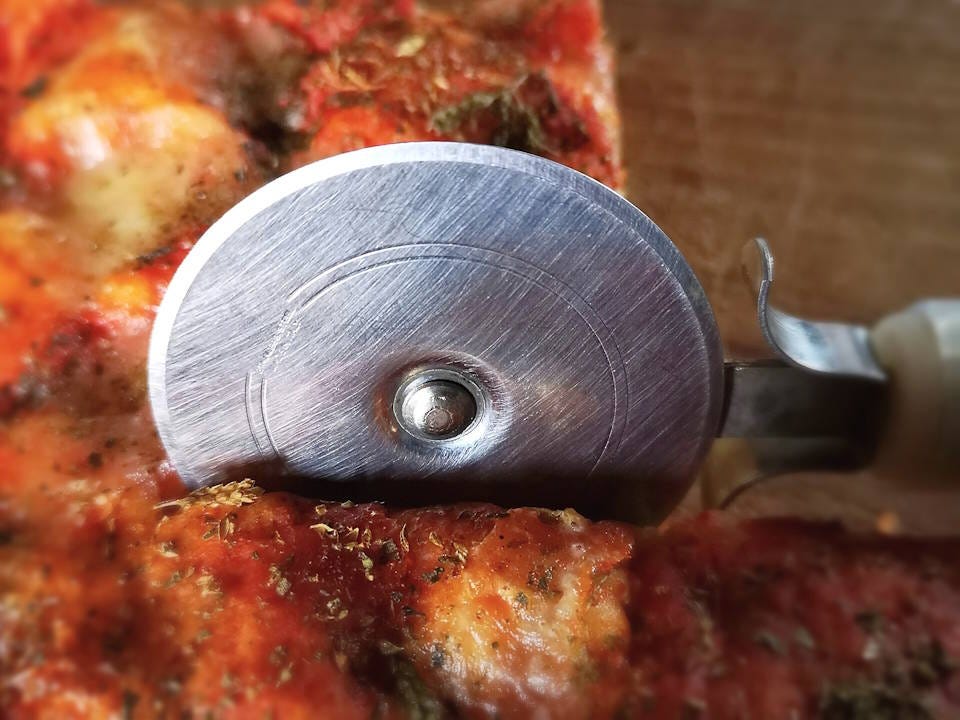 |
A pizza wheel — also known as a rolling pizza cutter or just a “pizza cutter” — is not a great tool for cutting pizza. I know that’s a statement that’s going to anger a lot of people when I say it, but it’s true. I’m hardly alone in saying this — Wirecutter, Eater.com, and plenty of others have noted the same drawbacks. But anyway, let’s go through the many reasons why pizza cutters are not fit for the job they’re named after.
First, it’s hard to make a very strong cut with a pizza cutter. This is because when you roll a cutting wheel forward, your hand isn’t pushing straight down — it’s pushing forward and down at the same time, meaning that only some of the force from your cut is being delivered to the pizza itself. That makes your job harder.
On top of that, the amount of force that goes into the pizza isn’t constant across the cut. As you extend your arm across the pizza while pushing the roller forward, the angle changes — when the cutter is right under your arm, most of the force goes down into the pizza, but when it’s at the far end of the pizza, most of the force is going forward instead of down. This means that you basically have to do one of three things:
Be very good at dynamically adjusting your force level as you cut
Roll the pizza wheel back and forth over the pizza several times
Push down really, really hard the whole time
The first of these is hard and takes a lot of skill. The second results in little slivers in your pizza — since it’s very hard to keep the wheel in the groove as you cut back and forth — and often causes the dreaded “cheese drag”, in which the wheel drags the cheese right off of the top of the pizza. The third method blunts the cutting wheel, and cuts deep grooves into your cutting board. And all three methods require you to expend a lot of energy.
Pizza wheels are also notoriously hard to maintain and store. Cleaning cheese off of an exposed, rotating blade is difficult, because the blade keeps spinning as you try to wipe it, and because you’re constantly in danger of slicing yourself on the edge. Storing an exposed blade makes it easier to cut yourself when you reach into the drawer. And sharpening a circular, rotating blade is extremely difficult.
Fortunately, there are better tools out there for cutting pizza. The first, which works great for thin-crust pizza, is a scissors — either a standard pair of kitchen shears, or a dedicated pair of pizza shears. The latter looks like this:
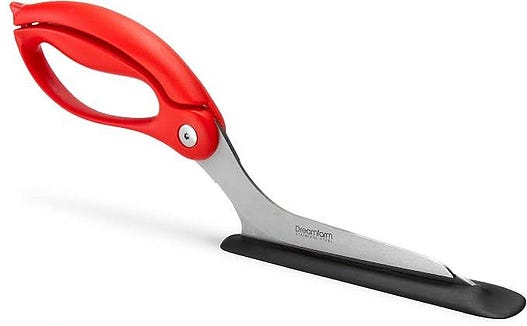 |
As Wirecutter notes, Italian chefs tend to just cut pizza with scissors. They also note that a standard pair of kitchen shears is very versatile, so if you use it to cut your pizza, that’s one less tool you need to keep in your kitchen.
An alternative — which works especially well if you’re making thick-crust pizza — is a rocking pizza cutter, which takes very little arm strength, is easy to clean, and gets it right every time. It looks like this:
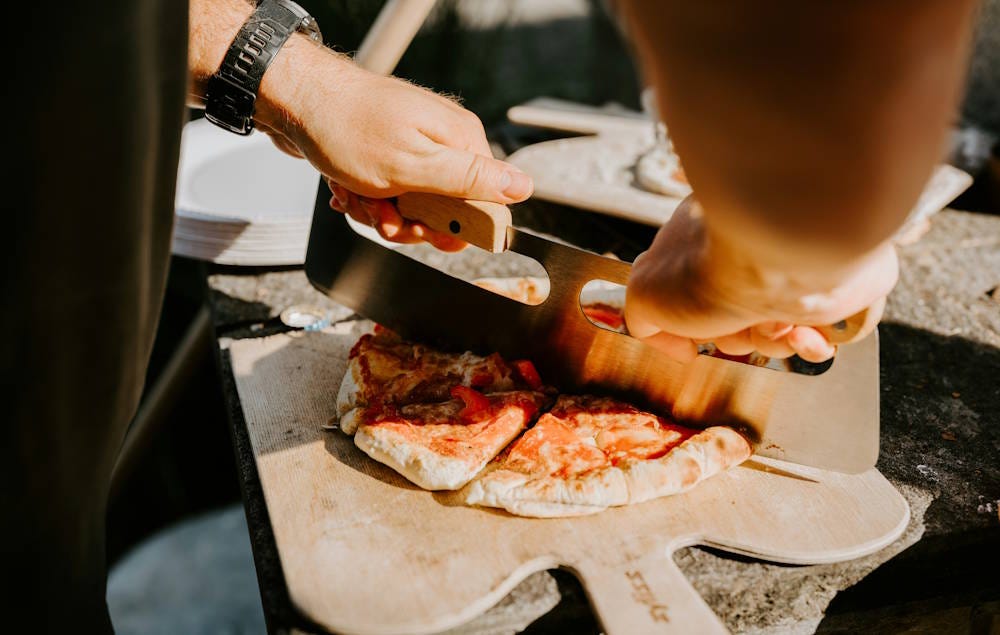 |
Eater.com recommends the rocking pizza cutter. There’s also a one-handed variant. The rocking pizza cutter is a specialized tool (so it takes up storage space), and it can cut a groove into your cutting board, but it’s easy to sharpen and clean, doesn’t get stored in a drawer, and has the added advantage of actually being able to cut pizza effectively.
(A third alternative for cutting pizza, which works decently well for either thick or thin crust, is just the tried-and-true “large kitchen knife”.)
Anyway, as I said, I expect lots of people to be angry at this take, because whenever I point this out in public, people get angry. Tons of Americans use pizza wheels — I couldn’t find reliable survey data, but browsing on Amazon, talking to people, and consulting AI all suggest that pizza wheels are very common in American households. But I’m right here — the physics doesn’t lie.¹
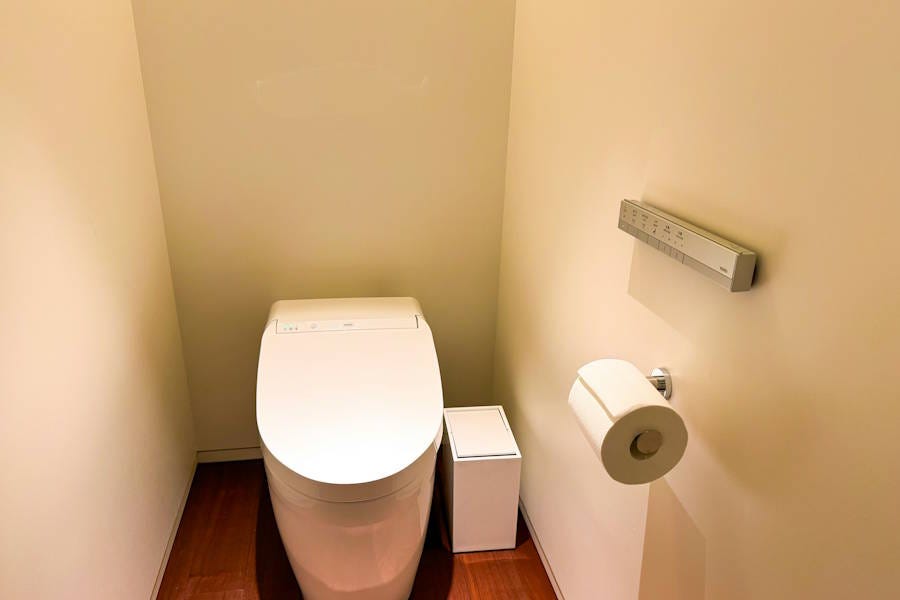
Now on to the Japanese toilet, also known as the “washlet”:
 |