| | In today’s edition: Hormuz traffic is changed for good, and Dubai’s plan for a global food security ͏ ͏ ͏ ͏ ͏ ͏ |
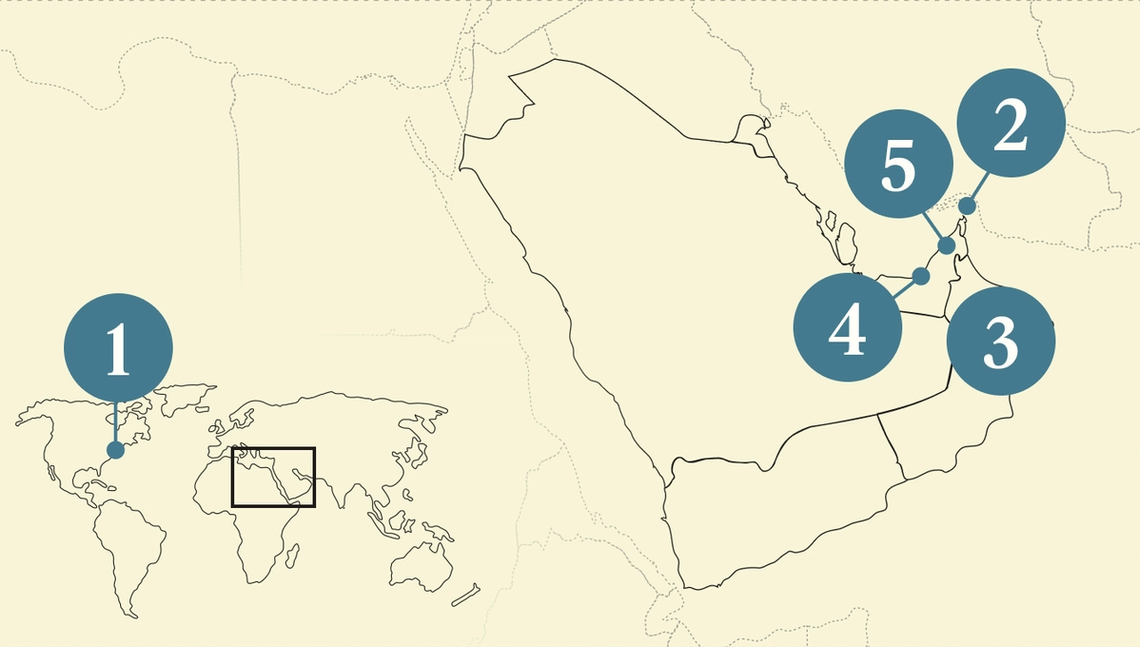
| |  Washington DC Washington DC | Mecca | Dubai |
 | Gulf |  |
| |
|
 - The Gulf in the MoU
- Hormuz will never be ‘open’
- Oman-UAE trade boom
- Abu Dhabi’s big PPP bet
- Dubai’s food security hub
 The sacred calligraphy. |
|
US downplays Iran concessions |
 Ships stuck in the Strait of Hormuz. Mohammed Sergie/Semafor. Ships stuck in the Strait of Hormuz. Mohammed Sergie/Semafor.As the region awaits the signing of the interim peace deal between Iran and the US — and the official release of the document that sets the scene for further talks — a consensus is emerging that Tehran won major concessions. US officials have sought to play down the details, but a leaked version grants the Islamic Republic the right to sell its oil on global markets immediately, alongside the prospect of significant additional economic relief, reportedly including a $300 billion economic development program. American negotiators told CNN that the document did not account for backroom agreements. It is in this nebulous space that Gulf countries can hope to secure their interests, which are not explicitly addressed. Countries across the region have urged an end to the conflict and the restoration of free passage through the Strait of Hormuz. While they have historically looked to Washington as the guarantor of regional security, there is growing recognition the war has accelerated the fragmentation of power. As a scholar at the Center for Strategic and International Studies wrote in Foreign Policy, the war showed the Middle East is “a region in which every actor can impose costs, but none can impose order.” Whatever the outcome, most Gulf countries are preparing for the next confrontation. Nadim Koteich, an Emirati political adviser, told The Wall Street Journal that the underlying factors that sparked the conflict remained: “I would bet on fraying before I bet on a settlement.” |
|
The changing face of Hormuz trade |
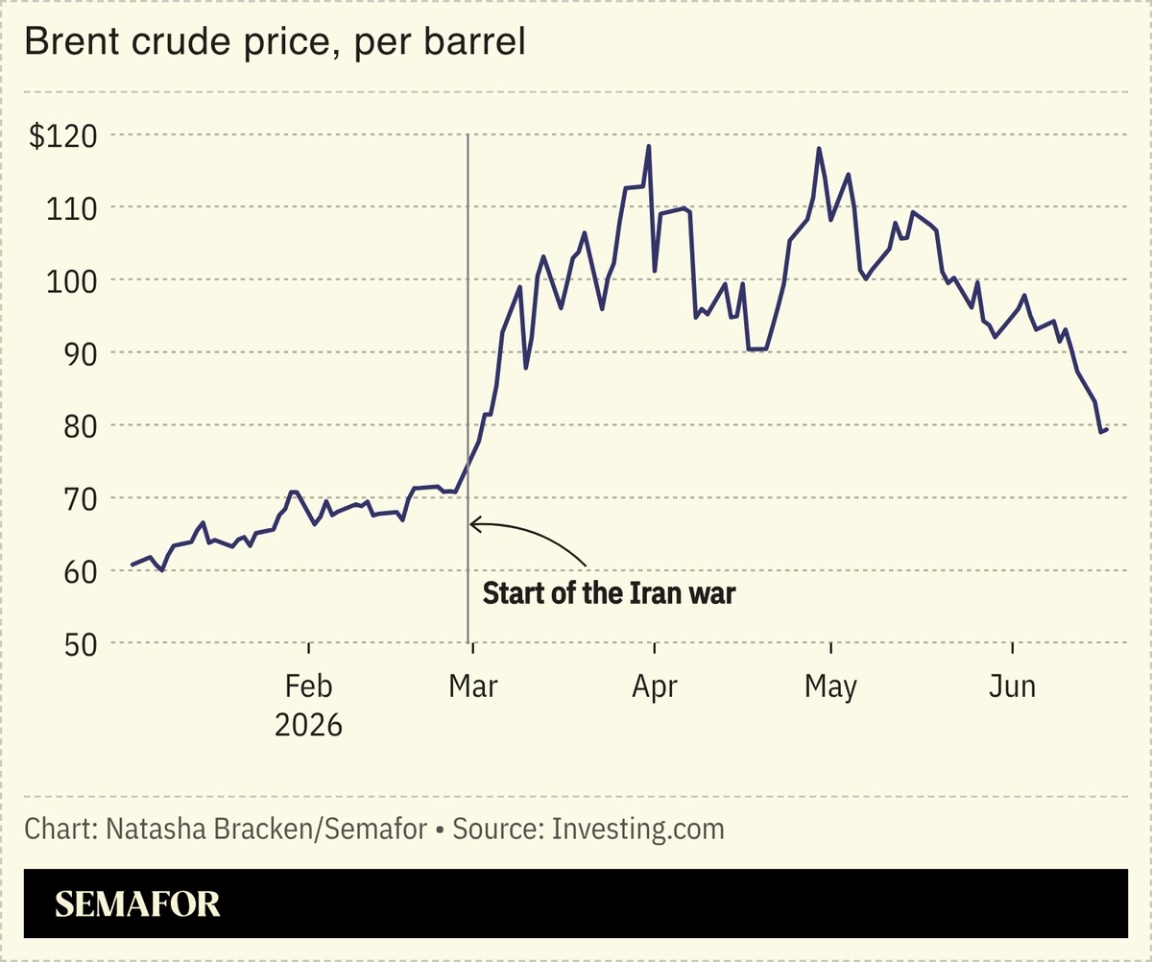 Oil and gas prices fell as the US-Iran truce raised hopes that the flow of fuels through the Strait of Hormuz might return to normal. Several tankers have passed through the waterway against the improving diplomatic backdrop, helping to send crude below the $80 mark. However, while traffic may revert to something resembling the pre-war norm, the global energy trade will never be the same, writes Semafor’s energy editor Tim McDonnell. No one believes the market will snap back to equilibrium: It could take months to clear out trapped tankers and bring in new empty ones, and to rebuild and restart damaged production and export facilities. Iran has proven it can shut the strait with relative ease, and may emerge with the long-term ability to exact “fees” for transit. Yet “Hormuz is a diminishing asset,” Richard Goldberg, an official in the US National Security Council until last year, said, as governments invest in more pipelines that bypass the strait. Gulf countries’ relationships with each other could also change. Whereas the years following the Arab oil embargoes of the 1970s saw them coordinating more closely on energy, the next few years may be defined more by competition, “as Gulf exporters seek to offer discounts against each other,” Columbia University’s Karen Young said. |
|
Oman trade gets wartime boost |
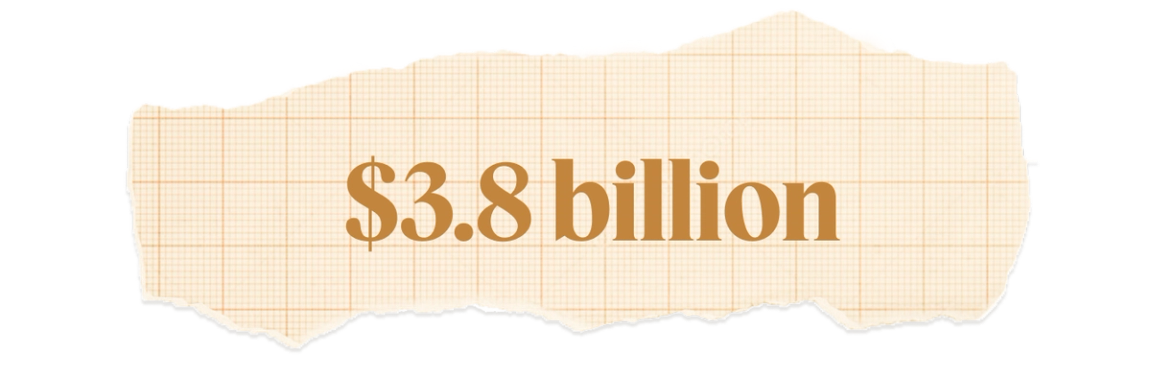 Trade between Oman and the UAE jumped 13% to nearly $3.8 billion in the first quarter, as Iran’s closure of the Strait of Hormuz pushed commerce away from blocked sea lanes and onto land routes through the sultanate. With its ports and borders sitting outside the strait, Oman has been one of the few economies in the region to benefit from the war: Trade with Saudi Arabia nearly tripled to a record $830 million in March, and customs declarations on Dubai’s “green corridor” with Oman climbed to nearly 100,000 in April. How much of that traffic survives once Hormuz reopens remains to be seen, but Oman is developing its infrastructure for the long-term. Construction began on a $2.5 billion project to build a rail line to the UAE last year, and a $1 billion economic zone is being created on the Saudi border. — Manal Albarakati |
|
Abu Dhabi targets private infra funds |
 Amr Abdallah Dalsh/Reuters Amr Abdallah Dalsh/ReutersAbu Dhabi has launched a drive to bring 55 billion dirhams ($15 billion) of private capital into its infrastructure build-out. Until now, the emirate has mainly used public-private partnership deals for power and water projects. It now wants to broaden that out to a far wider range of assets, including dams, roads, schools, sports facilities, and urban landscaping. A slate of 24 projects is due to be launched this year and next year under the expanded PPP program. The program will test investor appetite for Gulf deals at a time of heightened geopolitical risk, but ratings agency S&P Global said it had already attracted commitments from global investors. If successful, it should enable Abu Dhabi to develop its infrastructure while preserving its own financial resources for other strategic priorities, including economic diversification and major energy sector investments. |
|
Global food security in Dubai’s sights |
 Luc Gnago/Reuters Luc Gnago/ReutersDubai’s largest free zone is pursuing an expansion plan focused around food security, at a time when global supply chain vulnerabilities have been starkly exposed by the Iran war. In the past year, Dubai Multi Commodities Centre has developed new hubs for traders in cacao, meat and protein, honey, and saffron, in a push beyond its historical dominance in gold and diamonds. The free zone, which hosts nearly 27,000 companies and accounts for 7% of the emirate’s GDP, is now “going to get very aggressive,” Ahmed Bin Sulayem, executive chairman and CEO of DMCC, told Semafor in an interview, adding that the moves would present opportunities to deepen ties with Africa, India, and Sri Lanka. Bin Sulayem said he expected Fujairah, the east coast emirate that lies outside the Strait of Hormuz, to grow rapidly in the coming years, echoing the UAE trade minister’s comments to Bloomberg that the UAE was now looking to cut its dependency on the strait entirely. — Kelsey Warner |
|
 Crypto- Dubai commodities free zone DMCC has agreed to work with stablecoin leader Tether to develop its blockchain infrastructure, digital assets, and tokenized finance. The agreement will allow DMCC to expand its crypto payments systems and other digital asset settlements.
DefenseReal Estate- KAFD DMC, the developer of Riyadh’s King Abdullah Financial District, secured a $3.2 billion credit facility from a consortium of 10 banks to support the next phase of the business hub’s growth, with plans to double the development’s size. — AGBI
- Saudi Arabia’s construction activity rebounded in May, with residential and commercial building driving growth as firms resumed projects and reported stronger demand. — Enterprise AM
|
|
 Khaled Abdullah/Reuters Khaled Abdullah/ReutersMuslims around the world celebrated the Hijri new year this week, a moment when the black silk cloth that drapes the Kaaba in Mecca is taken down and remade from scratch. The Quranic verses are hand-embroidered in gold thread on the Kiswa by scores of craftsmen at a cost of more than $5 million. For centuries the covering was woven in Egypt and carried to Mecca by ceremonial caravan, until King Abdulaziz (the founder of the modern Saudi state) moved production into the kingdom in 1927. There are few personal signs, but the name of the late Abdul Rahim Amin Bukhari is an exception. The Mecca-born calligrapher spent more than three decades shaping the inscriptions, rendered in the sweeping curves of Thuluth — the Arabic script long regarded as the hardest to master — working on 21 Kiswas and the calligraphy of three of the Kaaba’s gates. In recognition of his contribution, his name was stitched into the cloth during the reign of King Faisal, and continues to be included to this day. — Manal Albarakati |
|
|


