| | In today’s edition: Qatar’s role in securing the US-Iran deal, Saudi’s World Cup moment, and snakes ͏ ͏ ͏ ͏ ͏ ͏ |
| |  | Gulf |  |
| |
|
 - A ‘very general’ peace deal
- Saudi non-oil output and…
- … summer tourism boost
- Dubai promotes longevity
- It’s Saudi’s World Cup
 Dozens of lizards, scorpions, and snakes found in a suitcase in Dubai. |
|
Region left waiting for peace deal details |
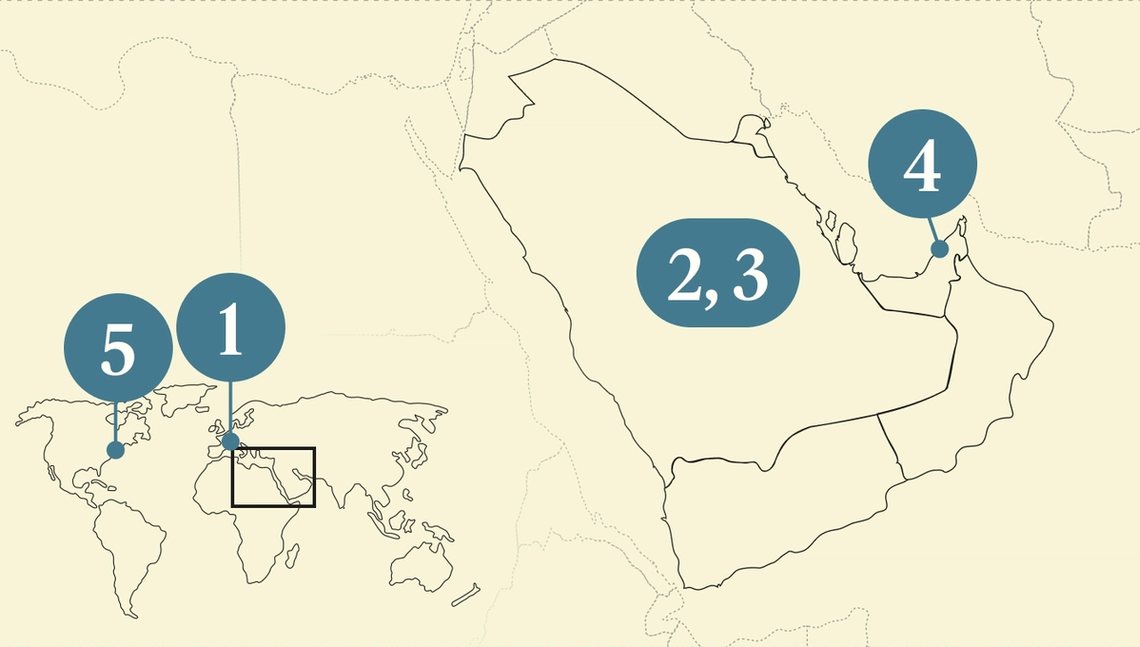
 Evelyn Hockstein/Reuters Evelyn Hockstein/ReutersThe diplomatic dance to end the Iran war is moving to Europe, with Switzerland hosting a signing ceremony on Friday for the interim deal between Washington and Tehran. France is also holding a G7 summit where the issue is high on the agenda, and where the rulers of Qatar and the UAE will be present. Just what is in the memorandum of understanding is still unclear, with the text — signed remotely by US President Donald Trump — unpublished; Vice President JD Vance described it as a “very general document.” The indications are that it includes an end to the US blockade on Iranian ports, Tehran allowing ships to pass freely through the Strait of Hormuz, and a 60-day time frame to reach a full agreement. While Pakistan has been the lead mediator in public, one diplomat said Qatar “quietly did most of the heavy lifting” to get to this point, the Financial Times reported. Further Gulf support may be needed. Vance said a final settlement could provide Iran with a $300 billion rebuilding fund from the “Gulf Coast Coalition” — presumably a reference to the six-member Gulf Cooperation Council and a name which at least one analyst in the region viewed positively. Others could frustrate progress though: The interim deal has had a poor reception from some in the US, and in Israel, which has been sidelined in the peace process. — Dominic Dudley |
|
Saudi’s resilient non-oil economy |
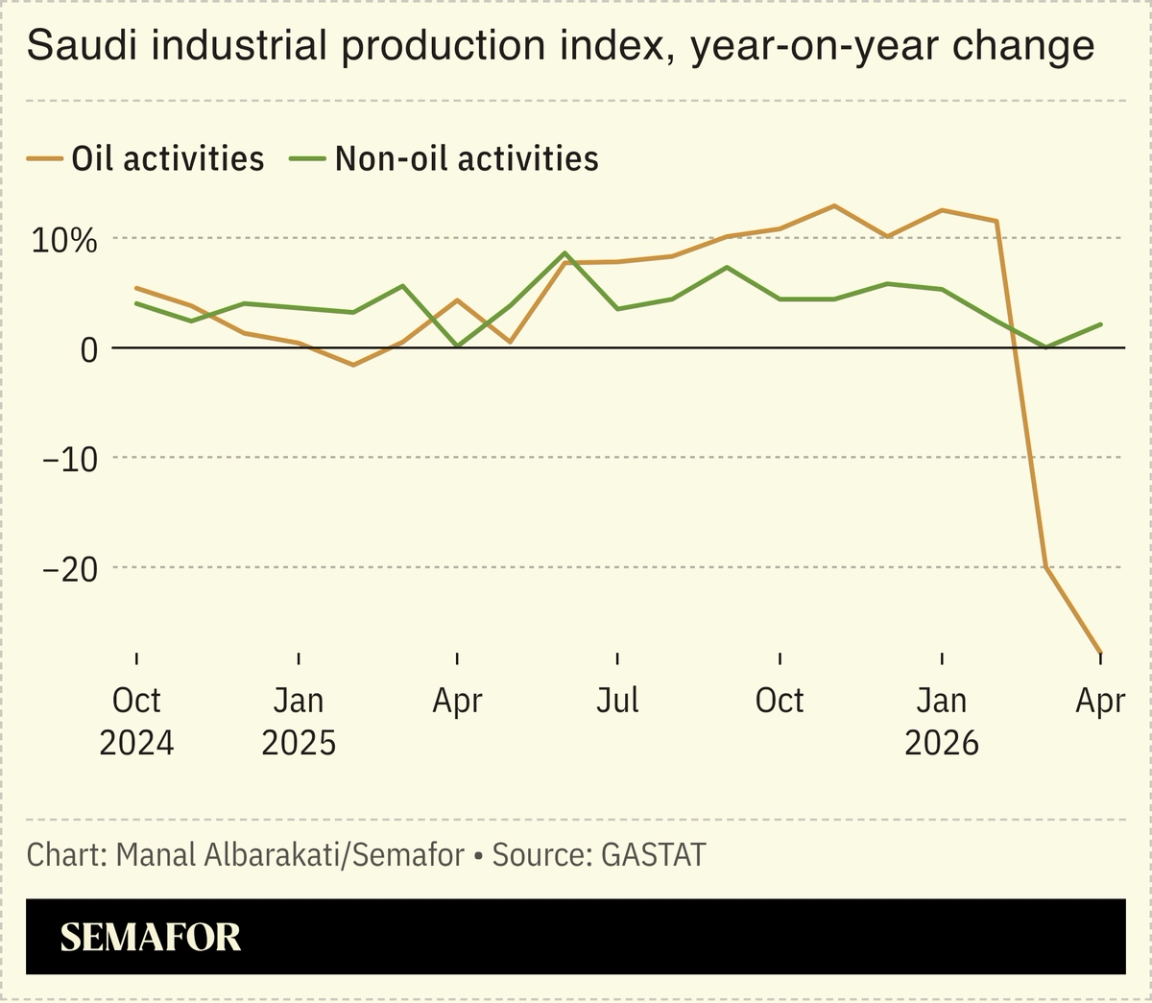 Relatively healthy levels of non-oil activity are helping the Saudi economy cushion the blows from the Iran war. A sharp fall in oil production sent overall industrial output down 19% year-on-year in April, and oil activity was almost 28% lower during the period. But non-oil industries — which lie at the center of the kingdom’s diversification strategy — have rebounded from the initial shock of the war, posting a 2.1% rise. Saudi Arabia’s oil output has been hit by the closure of the Strait of Hormuz, although higher crude prices have offset the lost barrels. Overall, its wider economy grew by 3% in the first quarter. |
|
 Eric Lafforgue/Hans Lucas via Reuters Eric Lafforgue/Hans Lucas via ReutersAt this time of year, most of Saudi Arabia is baking under a scorching sun, prompting many locals to head to Aseer, the cool green southwest, home to the country’s highest peak and the “flower men,” who wear marigold crowns said to fend off headaches. This month, Aseer launched its summer season — a companion to the Riyadh Season entertainment festival and the Diriyah Season’s culture fixtures in the cooler months — aiming to draw more than 3 million visitors with 122 events across its highland villages. Once one of the kingdom’s more conservative areas, Aseer is now courting domestic crowds and foreign tourists alike. Unlike the flashing lights and international stars of Riyadh Season, its events lean toward “authentic experiences” — think traditional crafts and hikes. The Saudi tourism economy is increasingly running on the home market, with the kingdom recording 28.9 million domestic tourists in the first quarter of this year, up 16% from a year earlier. They spent $9.3 billion at a time when the Iran war was unsettling travel plans across the region. — Manal Albarakati |
|
Dubai wants residents to live longer |
 Sheikh Hamdan bin Mohammed Al Maktoum. Amr Alfiky/Reuters. Sheikh Hamdan bin Mohammed Al Maktoum. Amr Alfiky/Reuters.Add Fazza to the list of millennials looking to live forever — Dubai Crown Prince Sheikh Hamdan bin Mohammed Al Maktoum has been tapped to lead the new Dubai Longevity Authority. Set up by his father, Dubai Ruler Sheikh Mohammed bin Rashid, the body is tasked with rolling out regulations covering R&D through to patient care, in a bid to attract investment, talent, and partnerships, according to a statement. The new group builds on years of government-backed longevity initiatives. Dubai’s economic road map to 2033 is targeting a top global ranking in life expectancy, and PureHealth, owned by Abu Dhabi sovereign wealth fund L’IMAD, has focused research on extending residents’ lifespans by up to 25 years. The global longevity market, a driver of capital into everything from advanced pharmaceuticals to wellness-focused real estate, is forecast to be worth $8 trillion by the end of the decade.
|
|
View: Saudi has charted a path to football glory |
  Sam Navarro/Imagn Images via Reuters Sam Navarro/Imagn Images via ReutersThe first goal of the 2026 men’s soccer World Cup came from a Mexican national who plays in the Saudi Pro League. As he celebrated, Aramco’s logo flashed on the pitch. This is the culmination of years of sports spending that has bought the kingdom a seat at soccer’s elite table, independent commentator and Saudi economy specialist Wael Mahdi writes in a column for Semafor. “This World Cup has validated the Saudi Pro League’s growing stature. A total of 47 players across 18 national teams competing in the tournament play their club football in Saudi Arabia — more than any league outside Europe’s top five,” writes Mahdi. |
|
 In this special episode of Compound Interest, Semafor’s Chief Commercial Officer Rachel Oppenheim sits down with Todd Heimes, Vice President and General Manager at our season sponsor, Amazon Business. Todd and Rachel sit down to discuss how Amazon Business is reshaping how organizations buy. Heimes, who has been with Amazon since 1999 and helped build Amazon Business since 2016, discusses how the platform is making purchasing smarter and more strategic — reducing friction through broad selection, fast delivery, and a customer-first approach grounded in trust.
Disclaimer: This season of Compound Interest is sponsored by Amazon Business. This episode is commercial content produced by Semafor Global Studio with Amazon Business. |
|
 Art- Kuwait stripped citizenship from two of its most celebrated, octogenarian musicians. Authorities revoked citizenship from singer Abdul Mohsen Al-Muhanna, born in Kuwait in 1938, and his brother, composer Yousif, who together shaped the country’s culture over a six-decade career. More than 2,000 people were affected in the most recent purge. — Al Araby Al Jadeed
Communications- Mubadala Investment Company bought a $200 million stake in Greenlink, which operates a subsea power transmission cable connecting Great Britain with Ireland, in a push into infrastructure in Europe.
Defense- France is in talks with the UAE on a partnership to develop an upgraded Rafale combat aircraft, after plans to build a next-generation fighter with Germany collapsed. If the project moves forward, the new aircraft is expected to enter service in the next decade. The UAE already owns and operates the current generation of Rafale fighters. — Financial Times
Real Estate- Dubai’s Emaar Properties, the developer behind the Burj Khalifa, is planning a $54 billion district in the city for nearly 150,000 residents, with landmark towers, a gated villa enclave and metro connections spread across more than 4.5 million square meters.
|
|
 @DubaiCustoms/X @DubaiCustoms/XWhen Gulf customs officials intercept contraband, it’s usually drugs, cash, or counterfeit goods. Sometimes, it’s exotic animals. As Camilla Wright wrote for us last year, the region’s fascination with lions, tigers, and other creatures has long fueled demand for wildlife traffickers. Dubai Customs recently made a terrifying discovery: an abandoned suitcase containing 129 lizards, 36 scorpions, eight snakes, and 50 frogs. The animals survived the ordeal and were rescued, faring better than those discovered during a thwarted smuggling attempt last month, when two endangered bears were found stuffed inside luggage, both dead. — Mohammed Sergie |
|
|


