|
|
|
|
Morning. Officials organizing Canada’s turn as World Cup host point to billions of dollars in economic gains, but critics argue the final receipt will far outweigh the actual returns. In focus today, we’re busting out our calculators. |
|
|
|
|
|
|
|
|
|
|
|
|
|
|
|
|
Banking: Canada will likely avoid the “grey list“ after a global review of its financial-crime controls. |
|
|
|
|
Fast food: Tim Hortons is firing back at franchisees who sued the company over their declining profits. |
|
|
|
|
Deals: Montreal digital payments giant Nuvei Corp. has struck a deal to buy Nasdaq-listed Payoneer Global Inc. for US$2.75-billion. |
|
|
|
|
|
|
|
|
|
|
|
|
|
|
|
A fan watching Canada score against Bosnia-Herzegovina. Kaleb Tatum/The Associated Press
|
|
|
|
|
|
|
|
|
|
|
The beautiful, expensive game |
|
|
|
|
At a World Cup countdown event in Toronto last June, fans gathered in front of City Hall to mark one year until the tournament’s arrival in Ontario’s capital and Vancouver. Senior public officials and tournament organizers used the occasion to promote a FIFA-commissioned report by Deloitte Canada that projected $940-million in economic output across Toronto – and roughly $230-million in B.C., where Premier David Eby has argued the global exposure will trigger a $1-billion long-term tourism windfall over the next five years. |
|
|
|
|
There is no doubt that the 45,000-odd seats at BC Place will be filled on Thursday for Canada’s match against Qatar – and that the stadium’s corporate concessionaires will benefit from a spike in beer sales – but early indications suggest a temporary bump in economic growth that does not bode well for a sizeable boost, let alone a sustained source of revenue. |
|
|
|
|
Tickets for marquee matches cleared out instantly, but secondary market demand for mid-tier group stages has flattened. In Toronto, hotel occupancy rates were tracking below last June, according to the Greater Toronto Hotel Association. In Vancouver, tourism officials said before kickoff that the month’s bookings were running behind last year. |
|
|
|
|
|
|
|
|
|
|
|
|
|
|
This isn’t to suggest it isn’t possible that the World Cup ultimately generates the amount calculated by Deloitte Canada. (And hey: It’s fun! This is fun. Joy is hard to quantify.) It’s just that the math gets a little fuzzier at this point. |
|
|
|
|
The Parliamentary Budget Officer has estimated that Canadian governments will spend north of $1-billion to support the 13 matches being played in Toronto and Vancouver, including $473-million from the federal government. |
|
|
|
|
To help the public better understand the goal of those expenditures, officials often rely on economic impact studies – sweeping reports that track a dollar spent from a visitor’s hotel room to a restaurant supplier’s payroll to an employee’s spending in a neighbouring community. |
|
|
|
|
Proponents say these models highlight how hosting the World Cup and other mega-events can be lucrative long-term plays for cities, spurring a multi-year media “halo effect” that will keep the tourists coming. |
|
|
|
|
Tracking the activity that flows as visitors, organizers and governments spend cash is a common way of estimating how event spending moves through an economy. But many experts say these models are best understood as conditional exercises. Even Deloitte’s own reports come with boilerplate disclaimers noting that the results are entirely dependent on assumed, unverified client data. |
|
|
|
|
A dollar here, a dollar there |
|
|
|
|
One blind spot is what economists call “displaced spending.” A visitor flying from Switzerland for a match is new money. A Vancouver resident who spends $80 near the stadium instead of $80 closer to home isn’t adding anything. (Nothing personal, Vancouver resident.) |
|
|
|
|
In a research note to clients earlier this month, BMO economists Erik Johnson, Shelly Kaushik and Sal Guatieri wrote that while the World Cup will deliver a “modest lift” to GDP, the public sector ultimately bears most of the costs, while the private sector reaps the benefits. Resident spending mostly represents money diverted away from other local businesses, rather than a net economic gain. And regular tourists often stay away entirely to avoid the chaos, meaning some benefits may take years to show up – if they can be measured at all. |
|
|
|
|
Because Canada’s host cities account for a high concentration of the country’s economic output, national measures like GDP paper over the fact that most provinces won’t see a dime. |
|
|
|
|
And because of its larger stadium capacities and higher volume of games, the U.S. is expected to draw four-fifths of all fan spending. Mexico and Canada will see just over a tenth each. |
|
|
|
|
For Canada’s host cities, then, the tournament might be less an economic engine than it is an expensive, fun, fleeting party. But what a party it is. |
|
|
|
|
|
|
|
|
|
|
|
|
|
|
|
|
|
|
|
|
|
|
|
|
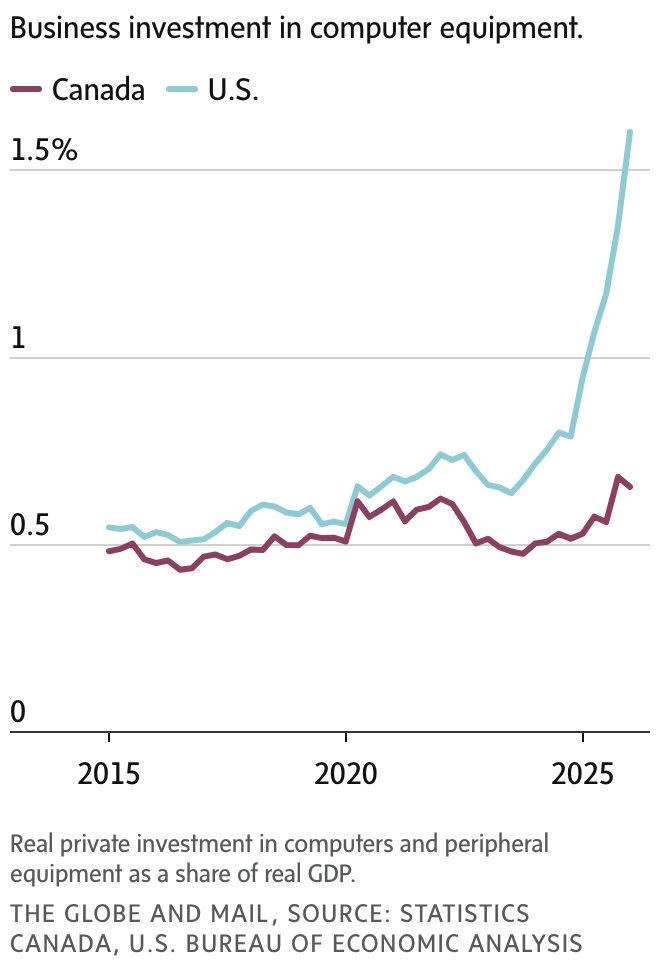
As a rush of AI investment drives an economic boom in the U.S., Canada’s chronic tech underinvestment risks leaving the country behind. |
|
|
|
|
|
|
|
|
|
|
|
|
|
|
|
|
|
|