Es Devlin to lead Homo Faber 2026, how the Iran war is robbing Japan of its colour, and we visit Dharma Park and Inson Wongsam Art Gallery.
|
Wednesday 10/6/26
|

|
|
London
Paris
Zürich
Milan
Bangkok
Tokyo
Toronto
|
|
|
|

Good morning from Midori House. For more news and views, tune in to Monocle Radio. Here’s what’s coming up in today’s Monocle Minute:
THE OPINION: Like the wheel, it’s time for AI’s road test
DESIGN: Es Devlin to lead Homo Faber 2026
AFFAIRS: How the Iran war is robbing Japan of its colour
DAILY TREAT: Visit Dharma Park and Inson Wongsam Art Gallery, Lamphun
THE LIST: Stories that you might have missed
|
|
AI isn’t reinventing the wheel but it should heed the lessons of human innovation
By Andrew Leigh
|
In the Carpathian Mountains around 6,000 years ago, copper miners faced a major problem: ore was heavy and dragging it out was proving a pain. Their solution was to create a cart mounted on circular wooden discs, with each pair joined by an axle. Copper miners in the place that we now call Ukraine had invented the wheel – and with it comes a lesson about humanity’s new frontier of innovation, AI.
Solid wooden wheels were heavy and hard to steer. Even so, in the right places, wheels changed daily life. They let nomads carry harvests, household possessions and tired kids, as well as trade goods. Wheels allowed people to remain mobile while owning more than they could shoulder. Later, spoked wheels made chariots lighter and faster, turning a device for hauling into one associated with ceremony, racing, hunting and war.

|
|
|
Wheels up: AI can scrape a few lessons from humanity’s early ingenuity
|
|
The wheel is the sort of discovery that seems inevitable once you’ve seen it. Simple, round, portable and useful. And yet wheels only prospered in the ecosystems that suited them. In many societies the technology didn’t roll out until thousands of years later. Far from a failure of imagination, the delay was the natural environment talking. In the sandy deserts of Egypt, the stones that built the pyramids were moved by river barges, then dragged into place on sleds. In sub-Saharan Africa, dense forest, river routes, human porters and the scarcity of large draught animals made wheeled transport less practical. In the mountains and jungles of Papua New Guinea, wheeled carts offered little advantage compared with human porters. An invaluable invention on hard-packed plains can be useless on sand or steep hills.
But wheels also needed help where they were adopted. They became more useful in societies that built roads, such as ancient Rome. When Roman roads decayed, wheeled transport became less attractive. As late as the 1700s in London and Washington, streets were essentially dirt tracks, meaning that carriages frequently sank into deep mud and they could be easily outpaced by horses. The lesson is simple: wheels need good roads. To judge their historical usefulness by today’s standards is to put the cart before the horse, since the roads that surround us were built to make the most of the wheel.
Great inventions rarely arrive fully formed. They often wait for complementary technologies, systems or cultural shifts to unlock their full potential. Writing, for example, began as a method of accounting before it became the foundation for literature, law and bureaucracy. Printing started with religious texts and calendars before it helped to spread scientific ideas and political messages. The early internet was populated by digital brochures; the social and commercial uses came later. General-purpose technologies often improve slowly, spread across sectors and then inspire further inventions.
This is one way to think about artificial intelligence. Like sailing ships, railways and electricity, AI won’t transform everything overnight. The technology is built on prior roads: faster chips developed for gaming, large stores of labelled data, open research communities and decades of trial and error. Its future will depend on its own roads too: reliable energy, trusted institutions, skilled workers and rules that encourage use while curbing harm.
Innovation lengthens lives and lifts living standards but it also produces failures and dangers. The right response is to help ensure that good ideas can flourish and bad ones can be checked. That means encouraging innovative tinkering, facilitating diverse teams and promoting freer trade in ideas across the world. It also means letting cosmopolitan cities, universities, labs and firms combine what they know.
The wheel is a beautiful invention because it is uncomplicated. But its history is a warning against a simplistic view of innovation. The device is rarely the whole story. Progress comes when the road is ready.
Andrew Leigh is an author and member of the Australian Parliament. His new book, ‘The Shortest History of Innovation’, is published in the UK on 25 August.
|
|
affairs: japan
The Strait of Hormuz crisis is robbing Japan of its colour
Ota-san (our Tokyo bureau’s favourite handyman) has spent the past few months trying to get hold of thinner, waterproof sheeting, styrofoam insulation boards, vinyl pipes and cabinet adhesives – all to no avail (writes Luke Tamada). The culprit is the shortage of the same unglamorous feedstock: naphtha. Produced during the refining of crude oil, this light petroleum distillate is fed through steam crackers to yield ethylene, propylene and butadiene – the primary ingredients of synthetic rubbers and industrial plastics. Like most infrastructure that sustains modern life, it is taken for granted until shortages strike.
In Japan, oil crises often disrupt unexpected industries. In the autumn of 1973, the Organisation of Arab Petroleum Exporting Countries imposed an oil embargo that sent much of the industrialised world into crisis. The Japanese government urged frugality, appealing to households to use paper sparingly. When a supermarket in Osaka advertised a one-day special, four loo rolls for ¥138 (€0.74), residents drew their own conclusions. Within days, a rumour born in a single neighbourhood became a nationwide frenzy. Panic-buying soon spread beyond loo roll to detergent, sugar, salt and soy sauce.

|
|
|
Off colour: Supply-chain crisis leaves Japan looking a bit pale
|
|
The “Toilet Paper Panic” might have been born of rumour but the fear behind it was not wholly irrational. In 1973, Japan sourced 77.5 per cent of its crude oil from the Middle East. By 2024, that figure had risen to 95.9 per cent. Half a century after the first oil shock, Japan – the world’s fourth-largest consumer of the stuff – has grown only more dependent on a region beyond its control.
Since the Strait of Hormuz closed in late February, senior ministers have spoken calmly of strategic reserves, stockpiles and resilient supply chains. Prime minister Sanae Takaichi has insisted that supplies of petrochemical products can continue “beyond the end of the fiscal year”. There was, officials implied, no shortage – only a supply-chain “bottleneck”. Yet the disruption has surfaced in places few consumers would think to associate with Middle Eastern oil. Calbee, Japan’s largest snack maker, has switched to black-and-white packaging for 14 products as supplies of inks and solvents tighten. Kagome has even reduced the number of painted tomatoes dotted on its flagship ketchup packaging. Call it a bottleneck if you like but Ota-san is still waiting for supplies.
|
|
design: italy
Homo Faber names British designer Es Devlin as its artistic director for 2026
Biennial celebration of contemporary craftsmanship Homo Faber returns to Venice this September (writes Ed Stocker). Given that Italy is already starting to slow down for the summer, it’s best to get the announcements in early. Hence why Milan’s Centro Svizzero hosted a preview of what’s to come at the Fondazione Giorgio Cini on the island of San Giorgio Maggiore yesterday. The 2026 edition will feature more than 800 objects from hundreds of artisans representing some 70 countries. But the biggest news is that British designer Es Devlin – who worked on the 2012 Olympics closing ceremony, among many other projects – will be its artistic director, overseeing an edition titled “An Island of Light”. According to organisers, the idea is to shake up Homo Faber – now in its fourth edition – and offer a radically different experience.

|
“She operates like a conductor imagining entire universes,” said Hanneli Rupert, vice-chair of the Michelangelo Foundation for Creativity and Craftsmanship, of the new creative director. Devlin will help showcase the artisan pieces through 15 installations, with poetic names such as “An infinite birdsong” and “A full moon rising”, and one room including a kinetic shadow sculpture and another a large-scale kinetic mirror. Home Faber 2026 promises to be an immersive experience with a simple aim: shining a light on the hands behind each piece.
Homo Faber runs from 1 to 30 September at Venice’s Fondazione Giorgio Cini.
Further reading?
–
Homeware brand Via Arno debuts to provide a commercial platform for artisans
|
|
• • • • • DAILY TREAT • • • • •
Visit Dharma Park and Inson Wongsam Art Gallery, Lamphun
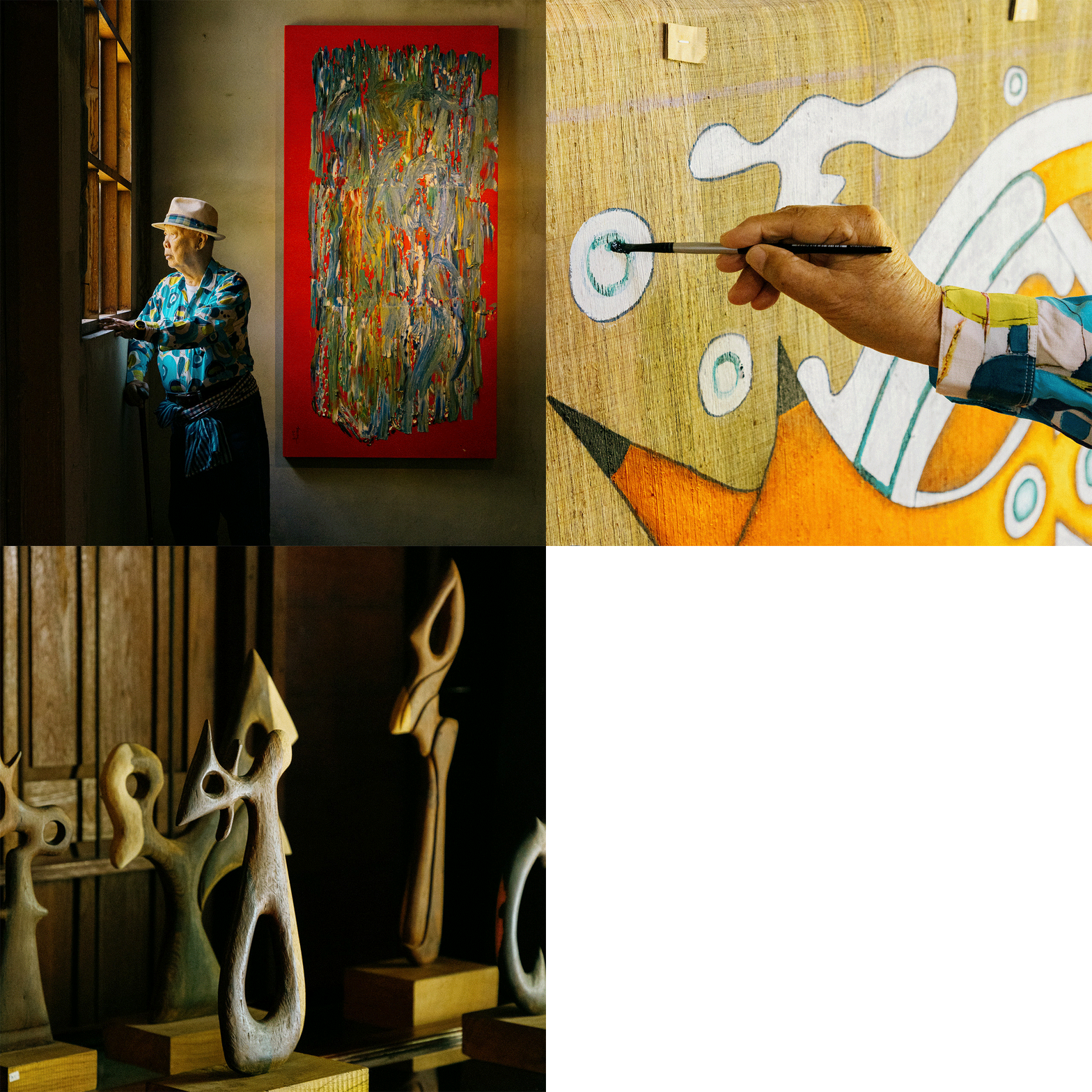
Thai artist Inson Wongsam (pictured) is the son of a temple goldsmith who lived and worked in Paris and New York during the 1960s and 1970s before returning to his hometown of Lamphun. Here this private museum, sculpture garden and café is located alongside his home and studio.
Wooden buildings in the Lan Na vernacular of northern Thailand house galleries dedicated to the different stages of his long and prolific career. Wongsam has shifted his emphasis this century more towards woodblock prints and large-scale oil paintings, his use of colour becoming more vibrant and radiant with each passing year.
109 Ban Pa Sang Noi 2, Ban Paen, Mueang Lamphun District, 51000, Thailand
|
|
| | |