| | In this edition: WHO launches $500M push to fight Ebola, Ramaphosa vows to crack down on undocumente͏ ͏ ͏ ͏ ͏ ͏ |
| |  Kinshasa Kinshasa |  Pretoria Pretoria | Nairobi |
 | Africa |  |
| |
|
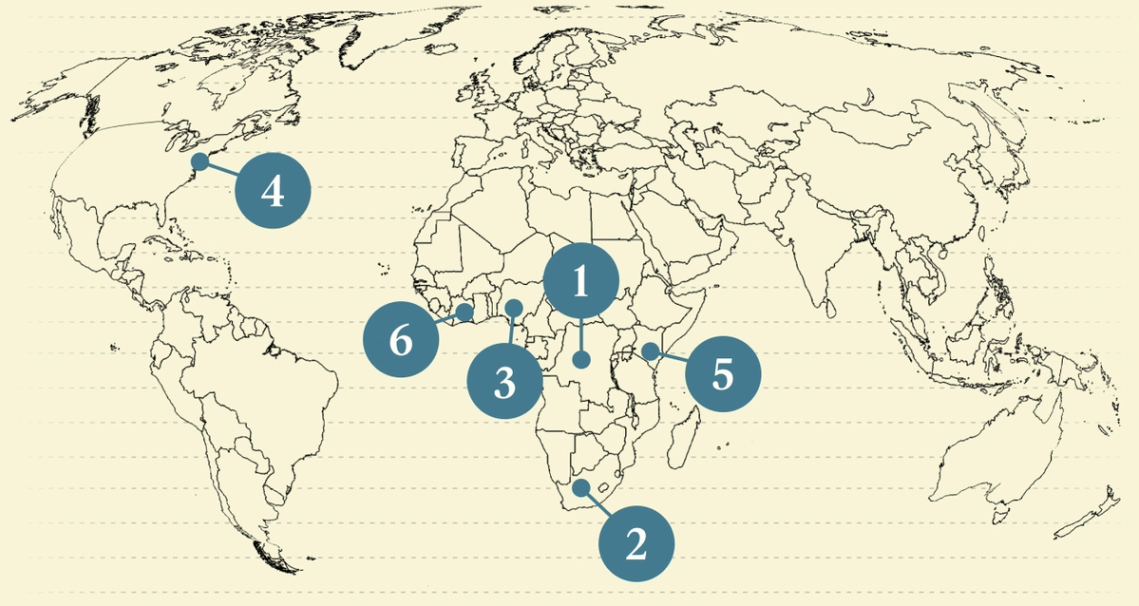 - WHO fund to fight Ebola
- S.Africa’s migrant crackdown
- MTN’s cost sharing push
- African staff push proposed
- Iran war hits phone shipments
- Europe dominates investment
 Vuvuzelas banned from World Cup. |
|
 Africa’s wealthy class is growing in number faster even than the Gulf, according to a new report, thanks to rising commodity prices as well as resilient private enterprise. Yet Capgemini’s World Wealth Report also revealed one of the continent’s biggest weaknesses: Rich Africans often end up seeing their homeland as a place to generate capital — but not to store it. Economic dynamism has, in effect, advanced faster than the financial systems needed to retain wealth. This happened even as many African economies grappled with currency weakness, debt burdens, and slow growth. Morocco was the standout performer, posting the continent’s fastest growth in millionaires at 16.8%, reflecting the benefits of a diversified economy, rising property values, and a deepening financial sector. But the Capgemini data only tells part of the story. A separate report by Standard Bank, based on interviews with some of Africa’s wealthiest individuals and their advisers, offers insight into how the continent’s rich think about money. Unlike in developed markets, these high net-worth individuals are overwhelmingly self-made, built through businesses operating in volatile environments with weak infrastructure and limited access to finance. That experience shapes their approach to wealth. Standard Bank’s report argues that Africa’s high-net-worth individuals are often less focused on accumulating wealth than on protecting it. Once profits are generated, the priority frequently shifts to diversification, hard-currency assets, and offshore investments. Moving money abroad is not necessarily a sign of pessimism about Africa’s prospects; rather, it reflects a search for stability, liquidity, and opportunities that remain scarce in many domestic markets, said Alan Wellburn, head of Wealth Management at Standard Bank. The broader lesson is that Africa is generating entrepreneurs capable of building substantial wealth, even in difficult conditions, but still struggles with a related challenge: creating environments where that wealth can be confidently retained and reinvested. Producing more millionaires is a sign of economic dynamism. Convincing them to keep more of their capital at home is the more important test. |
|
WHO readies $500M Ebola fight |
 Gradel Muyisa Mumbere/Reuters Gradel Muyisa Mumbere/ReutersThe World Health Organization launched a $500 million plan to curb the spread of Ebola in Africa, though questions remained over its capacity to secure the financing. The campaign came with confirmed cases in DR Congo topping 500; officials there have struggled to trace exposed contacts and to keep patients in care facilities. Misinformation and roiling regional conflicts have compounded the challenge for authorities, with rangers from the Virunga National Park, Africa’s oldest, being recruited to fight the disease too. Meanwhile modelling from the US Centers for Disease Control and Prevention showed the spread on a “dangerous trajectory.” The US CDC said the modelling showed that without strong public health interventions, the outbreak of the Bundibugyo strain — for which there is currently no vaccine — could become even larger than the 2014-2016 outbreak in West Africa. A version of this item first appeared in Semafor Flagship, subscribe here. → |
|
|
Ramaphosa vows migrant crackdown |
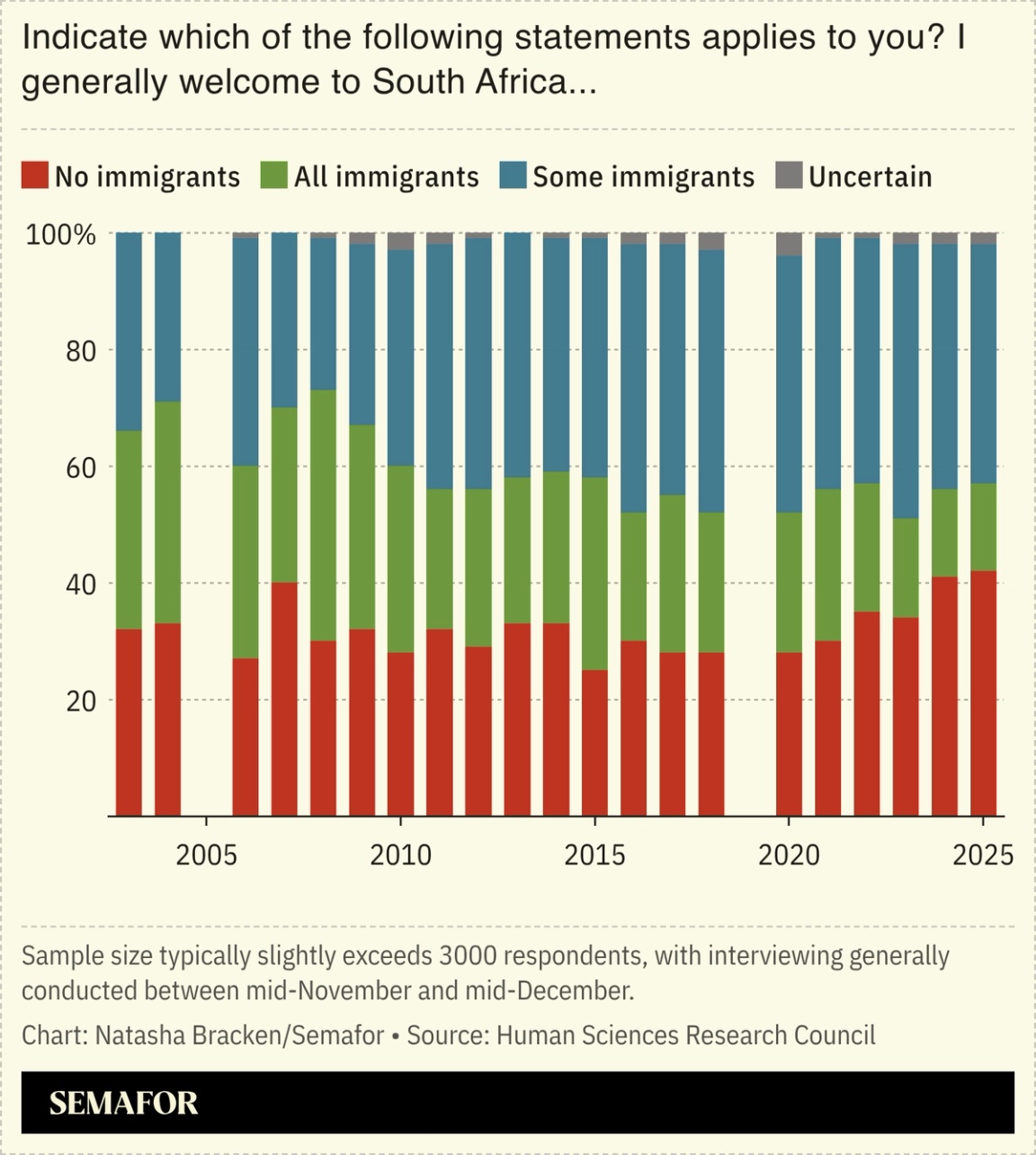 President Cyril Ramaphosa announced plans to crack down on undocumented migrants in an attempt to appease public anger after weeks of xenophobic violence. Yet his remarks came just days after he sent envoys across Africa to patch up strained diplomatic ties over the attacks on foreigners, pointing to his tricky balancing act between domestic politics and foreign relations. In a televised speech, Ramaphosa said Pretoria was finalizing plans to limit foreign workers and expand labour inspections. He also pledged prosecutions for corrupt officials who enabled illegal hiring. South Africa — ranked by the World Bank as the most unequal society with unemployment stuck at 33% — has been hit by xenophobic violence, including deadly attacks on Mozambicans. The unrest has prompted evacuations by the governments of Ghana, Nigeria and Malawi. Such flare-ups are recurrent in South Africa, erupting in waves since 2008, and researchers warn that political parties and self-appointed community leaders are weaponizing anti-immigrant sentiment to capture votes ahead of November local elections. Ramaphosa accused these groups of exploiting migration anxieties to sow division through lawlessness and violence. — Tiisetso Motsoeneng |
|
MTN seeks cost sharing model |
| |  | Tiisetso Motsoeneng |
| |
 Ralph Orlowski/Reuters Ralph Orlowski/ReutersAfrica’s biggest telecoms company MTN is leading an industry push to relax national telecoms rules, pitching shared networks as a fix for the continent’s $100 billion digital infrastructure deficit, a senior executive told Semafor. In practice, the shared model MTN proposes treats internet infrastructure as a critical public utility, with rivals co-investing in a single physical network and competing only on the services they run over it. MTN and other networks are in talks with governments, Senior Vice President Ebenezer Asante said, but did not disclose further details. The GSMA, the industry lobby group, has reinforced the message, calling for “urgent, coordinated action” to adopt a “shared responsibility” for the development of telecoms infrastructure. The World Bank estimates the continent faces a $100 billion funding gap to pay for the next generation technologies, such as 5G rollouts and localized AI models. |
|
Republicans propose Africa staff revamp |
 Annabelle Gordon/Reuters Annabelle Gordon/ReutersUS Republicans proposed a targeted hiring push for Africa specialists at the State Department to bolster diplomatic capacity on a continent where Washington is struggling to keep pace with rivals. The Foreign Service Modernization Act would address staffing and ambassador shortages amid broader efforts to shrink the professional civil service under the Trump administration. The bill also calls for greater investment in critical foreign-language expertise including Arabic, French, and Swahili to push for deeper regional knowledge. The bill was submitted to Congress a day after veteran naval officer Frank Garcia was sworn in as assistant secretary of state for African affairs, ending a lengthy vacancy atop the Africa bureau. Garcia takes over as the administration steps up its shift toward commercial diplomacy, strategic competition and security cooperation. Yet the State Department is facing questions about whether it has enough personnel and expertise to advance US interests in a region where China, Gulf states, Türkiye, and Russia have all expanded their presence. — Yinka Adegoke |
|
Iran war disrupts phone shipments |
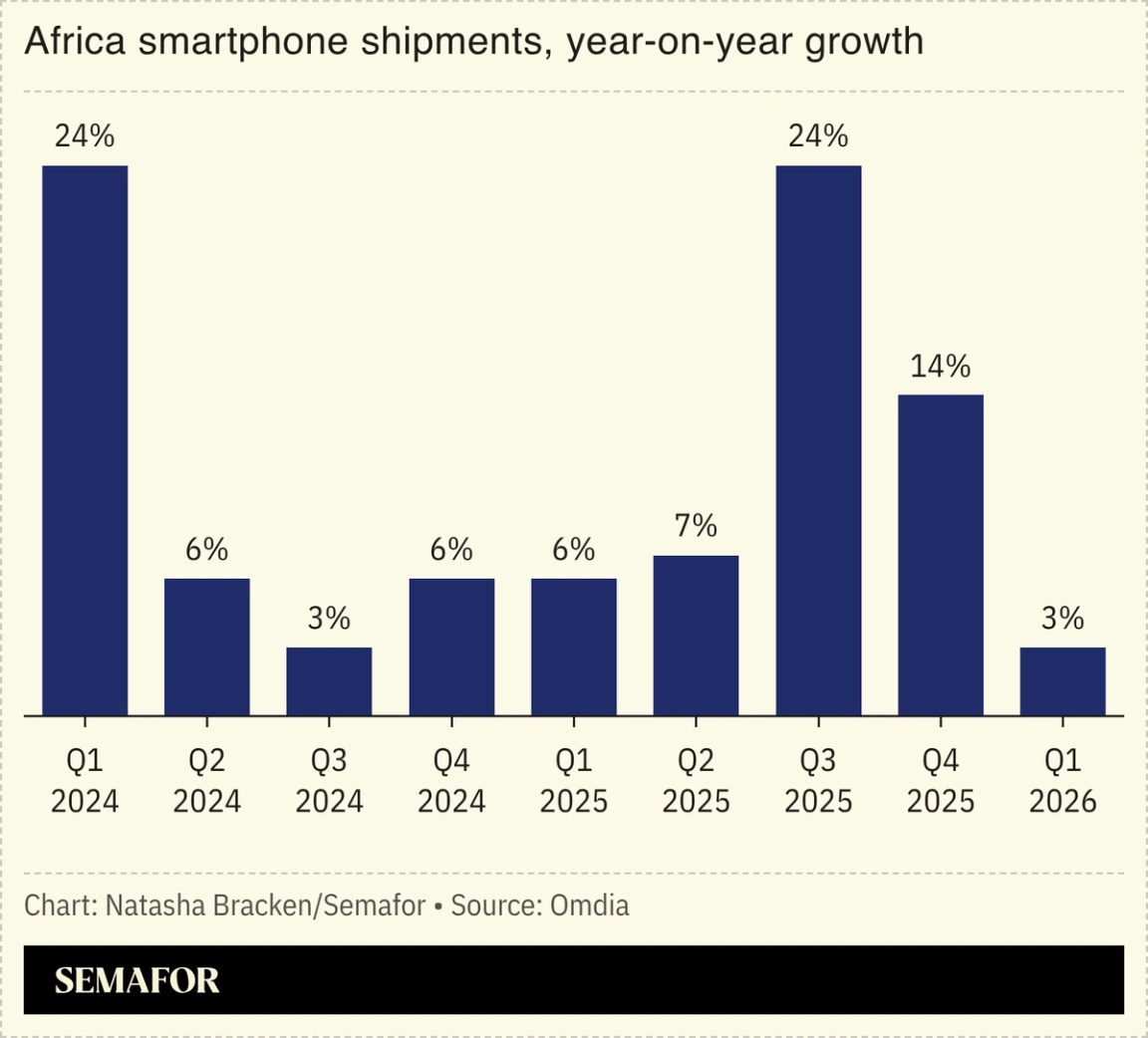 Disruption caused by the Iran war is weakening smartphone availability in Africa and making handsets more expensive, shipment tracking data to the continent showed. Rising costs of components, supply chain constraints, and weaker consumer demand that are all partly linked to the Iran war have depressed smartphone sales in much of the continent, resulting in the slowest growth of shipments to Africa in two years, research firm Omdia said. Transsion, the Chinese firm that is the continent’s top smartphone seller and specializes in the sub-$200 category of devices that dominate African markets, shipped roughly the same volume in this year’s first quarter compared to last. But that market for low-cost phones in Africa is “entering a structurally more challenging phase” with thinner margins this year, Omdia said, due to supply chain costs that, among other factors, stem from a two-year shortage of memory chips that has been made worse by the Middle East crisis. — Alexander Onukwue |
|
Europe’s DFIs lead African investment |
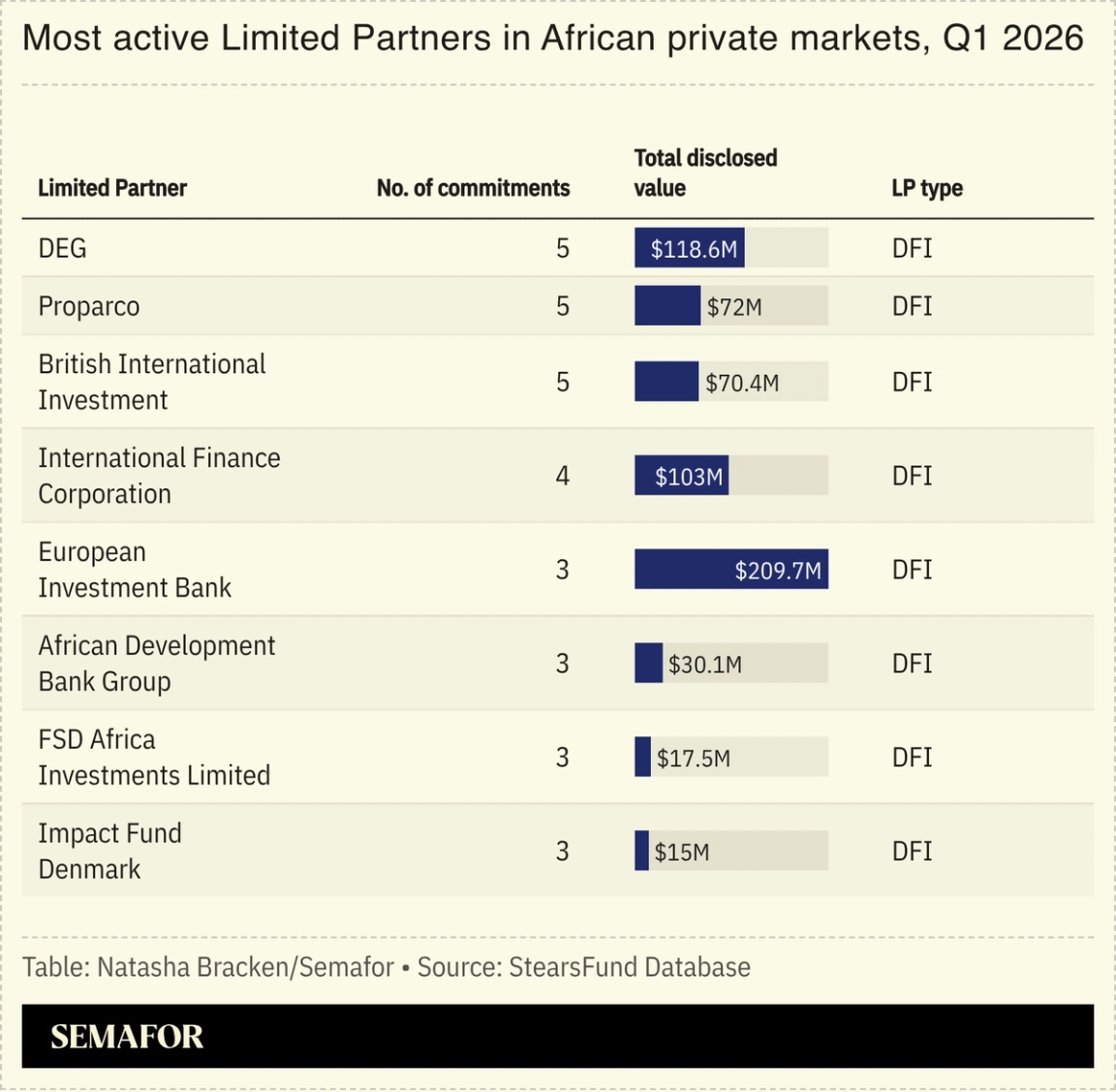 European development finance institutions were the most active investors in African private capital funds in the first three months of this year, research from the Nigerian financial data platform Stears showed, underscoring the continent’s continuing dependence on foreign capital for private investment. Attendees at the recently concluded African Development Bank annual meeting reinforced the need for the greater mobilization of capital from the continent to fill a $400 billion development financing gap. Investor concerns about paths to exit and recouping capital have long held back private capital inflows in Africa, but a growing market for secondaries is aiming to spur more investment. — Alexander Onukwue |
|
 Business & Macro |
|
|