
|
Why Europe should put up trade barriers against Chinese goods
There are benefits far beyond protectionism.
|

| |||||||||||||||


 |
As regular readers of this blog know, I’m pretty ambivalent about trade barriers as an economic policy. On one hand I think targeted tariffs and other trade barriers can be used to protect strategic industries from surges in underpriced import competition, especially by geopolitical rivals. On the other hand, broad tariffs like the ones Trump has used are generally bad — they hurt domestic manufacturing by making intermediate goods more expensive, they limit scale for domestic companies, etc.
And yet I do think that Europe should erect much higher trade barriers — both tariffs and non-tariff barriers — against Chinese high-tech manufactured export goods. The basic reason is that it’s important to protect Europe’s nascent modern defense industry. But I also think that blocking Chinese exports might nudge China to change its economic model to one that benefits regular Chinese people more.
In other words, China-Europe trade has some unusual characteristics right now that make trade barriers a much smarter idea than usual.
First, let’s talk about what’s going on with the Chinese economy. For the past few years, China’s government has unleashed an unprecedented torrent of subsidies for high-tech manufacturing industries. This — along with structural factors about how the Chinese economy works — has resulted in China making big global market share gains in industries like autos, pharmaceuticals, and shipbuilding. No one knows just how much of China’s market share gains are a result of government support, but as Paul Hannon reports, the OECD estimates that it’s more than half:
Government subsidies have driven most of the increase in the global market share of Chinese businesses over the past two decades as they have received three to eight times more support than their competitors, the Organisation for Economic Cooperation and Development said Monday…The analysis is based on the OECD’s Manufacturing Groups and Industrial Corporations database, which includes subsidy estimates and financial information for 525 of the world’s largest manufacturing groups spread across 15 key industrial sectors…[T]he OECD database tracks the amounts that firms are actually given…
“Industrial firms based in China receive more subsidies than their competitors based everywhere else,” the OECD said…For Chinese businesses, however, the share of [market share] gains explained by subsidies was…60%.
The Rhodium Group has a deeper dive into China’s new industrial policy. Essentially, instead of selecting a few industries to specialize in, China’s leaders just want the country to dominate everything — not just manufacturing, but services as well:
China’s industrial strategy…is becoming more systemic and pervasive, extending across all layers of production, from upstream inputs and industrial equipment to downstream applications, services, and frontier technologies…China’s next-generation industrial policy represents a shift from targeted sectoral intervention to what can be described as an “industrial policy of everything.”…While [Made in China 2025] focused on a defined set of strategic emerging industries, current policy frameworks extend across mature sectors, foundational supply chain nodes, and frontier technologies alike…
Even in mature industries facing overcapacity and severe price pressures, Beijing is providing continued support and pushing firms to upgrade production technologies to gain market share and lower production costs, rather than cutting capacity…Services, relatively neglected in earlier rounds of industrial policy, are getting more attention[.]
Basically, China does not want¹ to exist in a trading system, where goods are traded for other goods. China wants to make all the goods, and have other countries pay for those goods with debt.
There are two basic reasons China is doing this. The first is pure mercantilism; China is trying to export its way out of the economic slump created by its housing bust. The second, as the Rhodium Group report explains, is power. If China controls key segments of other countries’ supply chains, it can use the threat of export controls to bring those countries to heel.
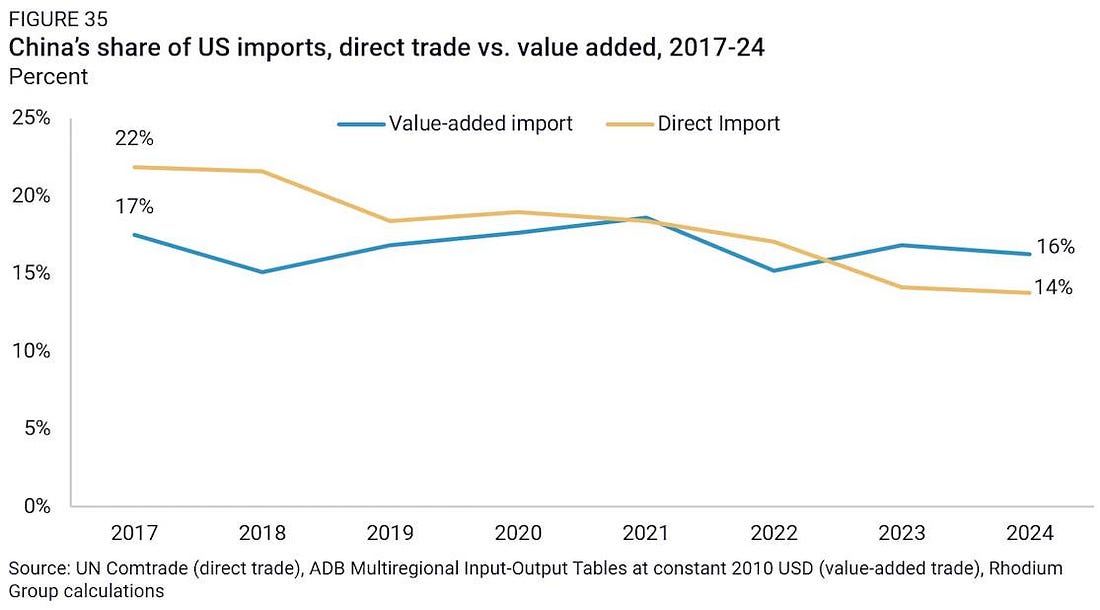
What should other countries do about this? The U.S. has chosen to respond with tariffs. These are of limited effectiveness, but they do appear to be doing something; even when you take into account the intermediate goods that China exports to America via third countries like Vietnam and Mexico, China’s share of America’s imports has fallen slightly from 2021 (or from 2017):
 |
There are almost certainly much more effective tools that the U.S. could use to accelerate the decoupling of the two economies and reduce dependence on China…but since when has U.S. policy been driven by a desire for effectiveness?
The question is now what Europe and other developed countries — who have marginally more rational decision-making processes — are going to do about China’s attempt to dominate all tradable industries. One proposal — which Germany seems to be following so far — is to do nothing, and to simply let China make all the physical objects in the world, while focusing on services instead. This is essentially the proposal of Tej Parikh, who writes that China “has a comparative advantage in industrial policy itself”, and that trying to compete with China in any manufacturing industry is therefore doomed to fail.
This annoys me, because it represents a deep misunderstanding of the entire concept of comparative advantage! The theory of comparative advantage is about traded goods; it’s about which traded goods can be produced relatively more cheaply by which countries. If I’m better at making TVs than cars, and you’re better at making cars than TVs, then I’ll make TVs and you’ll make cars and then we’ll trade. That’s how comparative advantage works. This is why you cannot have a “comparative advantage in industrial policy”. Industrial policy is a production input, not a traded good. No one buys and sells industrial policy!
“OK, Noah,” you’re about to say. “Stop being a pedant. You know what he means. He means China is better at making anything and everything, because they use industrial policy for everything.”
Yes, I know that’s what he means. And yes, this reflects a deep misunderstanding of the concept of comparative advantage.² Even if one country is better at making everything, it doesn’t have a comparative advantage in everything. That’s impossible. Every country has a comparative advantage at something!
That’s why in the theory of comparative advantage, trade is balanced. In the real world, China’s massive trade surplus means that trade is not balanced; much of the time, China isn’t trading goods for other goods, it’s trading goods for IOUs. Th