
|
 |


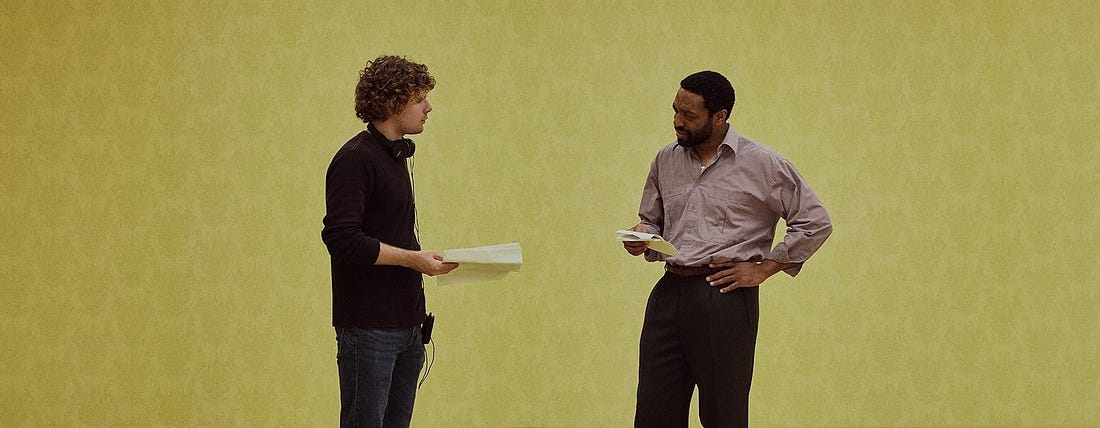
IT’S BEEN FUN WATCHING 20-year-old Kane Parsons—the director of the frightfully good Backrooms—take a victory lap this week. He is well-spoken, guarded in a way that belies his years, and thoughtfully provocative in ways you might not necessarily expect.
Consider his take on the use of AI in filmmaking. Speaking with the Australian, Parsons said, “If I could snap my fingers and make generative AI disappear forever, I probably would. Creatively, I get no enjoyment from using those tools. It defeats the purpose entirely for me.” When Matt Belloni, on his podcast, asked Parsons to elaborate, the young director made a crucial distinction:
When I see in a project online that generative fill or some sort of generative AI has been used in some way for some detail, the part of my brain that desires to really live with a piece of art and look into the details and the nooks and crannies and get excited about what I might see in the background or look for little details and just look for a general deliberate richness in the set direction—that immediately goes away.
Because if the artist is willing to make that kind of completely arbitrary choice and whatever the tool they’re using to create that piece of media is going to obviously not be something that came from them, it’s something they didn’t place there. If it becomes arbitrary, I’m then open to conclude almost any choice in that project is arbitrary on a human level.
I think the underlying issue with AI, at least from a creative perspective, is this precise question of intentionality, this idea that our work is our own. It’s why, when confronted with something like Steven Rosenbaum admitting to using falsehood-introducing AI in his book about AI and the nature of truth, we react with something like revulsion. At least, I do. Because what’s the point of writing if you are not choosing what to include and what not to include, if you are not doing the research yourself and instead trusting some hallucination box to do your work for you. And when I read Rosenbaum try to defend himself to Wired by saying, functionally, that everyone does it anyway, I just want to stand up and scream “No, actually, we don’t, and the fact that you think everyone does suggests no one should ever read anything you write ever again.”
It’s why it’s genuinely pretty disheartening to see Martin Scorsese (presumably) taking pallets of AI cash to shill for a company that generates storyboards. Because Scorsese, as a kid, learned how to conceive of shots by drawing storyboards by hand, a process he discovered on his own. “I was amazed by the size of the images on the screen, and I would come back and draw what I saw,” he recounts in an interview collected in Scorsese on Scorsese. “I made up my own stories, taking my cue from newspaper comic strips and books, and although I didn’t realize it at the time, I soon started using close-ups just like they did.” You can see some of his boyhood storyboards for yourself!
It’s a deeply human way of becoming an artist, starting with analyzing how others make their art and then beginning to tentatively explore how to create your own. And it’s a world apart from the pseudocreativity—really pushbutton parasitism—of generative AI.
The generative AI set will reply that their technology will unleash untold numbers of Scorseses. I guess. It’s certainly possible. But maybe what makes a Scorsese or a Parsons or any other interesting filmmaker is having to muddle through that process on your own, having to make and build and suss out different compositions and ideas. Intentionality is all artists have. I find it insane that we could think they can outsource it and remain artists.
Art, Human Choices, and Zombies
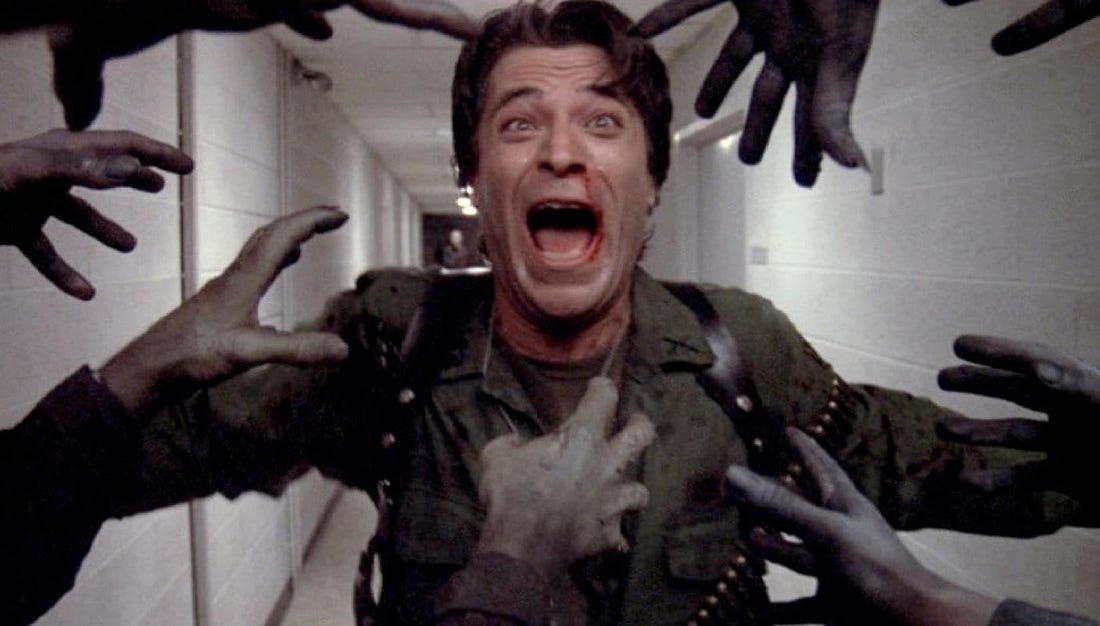 |
“INTENTIONALITY” IS A GOOD WORD to keep in mind when thinking about Day of the Dead, a huge new collector’s set of which is out on June 16 from Shout Factory.¹ I was lucky enough to score a review copy and spent a good solid week going through the film’s special features: an archival commentary featuring writer-director George Romero and legendary special-effects artist Tom Savini; a new commentary with critic Drew McWeeny and novelist Daniel Kraus; a full-length archival documentary from a 2013 Blu-ray of the film; and hours of brand new interviews with tons of cast and crew, as well as a behind-the-scenes look at the restoration process.
I interviewed John Harrison (the first assistant director and composer on Day of the Dead) and Jeff Roland (the producer at Shout Factory who put together this four-disc set) about both the making of this seminal film (I would argue it’s Romero’s best) and the work that went into putting this collection together; I hope you give it a listen:
