
|


Friends,
I rarely share with you anything written about me. But I decided to share this article from the British Prospect because I think it does a decent job summarizing my work (including my recent book “Coming Up Short,” and movie “The Last Class”) and because you’re unlikely to come across it on this side of the pond.
Robert Reich’s Good Fight
For decades, the former US labour secretary has waged a lonely struggle against corporate greed. Has he failed?
June 4, 2026
Robert Reich is short: 4ft 11in, to be exact. He has multiple epiphyseal dysplasia, also known as Fairbank’s disease, a rare genetic disorder affecting bone growth.
Throughout his career in government and academia, including stints as the United States’s secretary of labour under Bill Clinton and an economic adviser to Barack Obama, Reich has often made jokes about his height. In the late 1990s, he hosted a PBS talk show with the late Republican senator Alan Simpson called The Long and the Short of It (Simpson is 6ft 7in). And when Reich ran unsuccessfully in the 2002 Democratic primaries for governor of Massachusetts, he titled his concurrent book I’ll Be Short. The Boston Herald even ran the front-page headline “Short People are Furious with Reich” for joking about his height on the campaign trail.
From the title Coming Up Short, you might expect Reich’s new book to follow a similar pattern. But this, unlike his more straightforwardly polemical books, is a memoir—and in it, he reveals that his height has not always been a laughing matter. In particular, he details his experiences of severe, traumatic bullying as a child, with his size marking him out to nastier students as an easy target.
Reich recounts the survival tactics he would employ, including finding benevolent older students who could act as his protectors. One such student was Michael Schwerner, whose kindly presence made him feel safer at school. Recruited by civil rights leader John Lewis to volunteer in Mississippi, Schwerner later joined the civil rights movement, and he and his wife helped to register African-American voters during the state’s “Freedom Summer” in 1964.
Months later, aged 24, Schwerner was murdered by the Ku Klux Klan. His body remained undiscovered for 44 days. After hearing of Schwerner’s murder as he started university, something changed in Reich. He saw that there were much more powerful and dangerous bullies in the world than the ones he confronted in the playground. He began to see bullying not just as an interpersonal challenge he had faced, but as a structural condition of society. From politics and economics to gender relations and the law, bullies were everywhere. And, quite often, they won.
“By the time I was a young man,” Reich tells me from his study in Berkeley, California, “I understood that bullying really is a metaphor for all sorts of abuses of power. Men bullying women, or white supremacists bullying black people and brown people, or employers bullying employees.”
His own experiences, he says, solidified his “lifelong conviction that our moral responsibility is to protect the weak from the strong”. He remembers his father, a progressive Jewish Republican, yelling “son of a bitch” at political figures he saw as bullies—such as Senator Joseph McCarthy—when they appeared on his television set.
Meanwhile, Reich became inspired by the legacies of populist Democrats such as Franklin D Roosevelt, whom he saw as the antidote to the bullies of the world. This would set him on a mission into the reformist circles of law and government.
But first, he needed training. The young Reich travelled to New Hampshire to study at the Ivy League Dartmouth College, where he would go on a date with Hillary Rodham from the all-female Wellesley College.
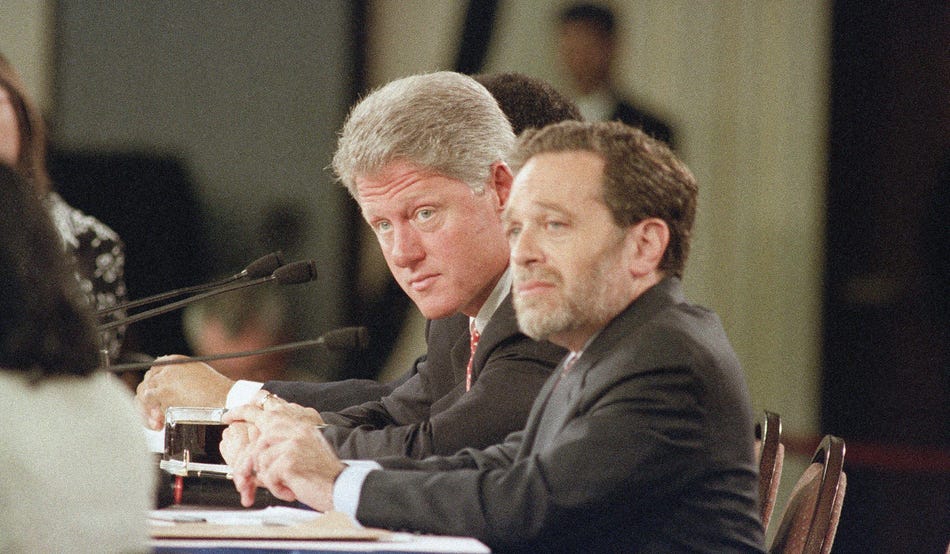
Later, he would meet fellow Rhodes scholar Bill Clinton on a transatlantic ship on their way to the University of Oxford. The young Clinton offered the seasick Reich a comforting bowl of chicken soup. They would later agonise over whether to avoid being drafted to fight in Vietnam, which would have cut their overseas studies short. Reich narrowly missed out due to his height (one inch too short), while Clinton had to manufacture a more complex excuse, one which would later haunt him politically. They later attended Yale Law School together, where Reich introduced Clinton to Hillary Rodham, and the rest is political history.
(Reich with Bill Clinton, 1993. Image: Associated Press / Alamy)
 |
Another of their classmates, Clarence Thomas, now sits as a conservative justice on the Supreme Court. According to Reich, “Clarence’s hand was never in the air. I don’t recall him saying anything, ever.” Meanwhile, “Bill was never in class.”
From there, Reich bounced from government to academia and back again, becoming more progressive as his prominence grew. But with greater access to the halls of power came a creeping sense of alienation from a Washington machine that seemed to be increasingly oiled by large corporate donors and ever more amenable to their demands. He soon became a thorn in the side of such lobbyists.
The tension was encapsulated in the late 1990s by what was dubbed the “battle of the Bobs”, a long-running disagreement between Reich and Robert “Bob” Rubin, Clinton’s treasury secretary. It was far less acrimonious than the press made it out to be—“I liked Bob. We often had dinner together,” Reich writes—but the two officials nonetheless held “two fundamentally different views, not only about what [Clinton] should do but more generally about the role of government”.
Rubin had spent his career on Wall Street, including 26 years at Goldman Sachs. He commuted to Washington from New York by private jet. He emphasised deficit reduction and deregulation of the financial sector, which he held would boost the economy and eventually enable more social spending. Reich, conversely, advocated for rapid public investments in education, childcare and healthcare, and emphasised the need to arrest widening inequality.
Reich argued his side vigorously, often leveraging the fact he was the only cabinet member small enough to fit in the jump seat of Clinton’s limousine in order to lobby him in private. But Clinton generally sided with Rubin on most matters—“not because [he] had better arguments”, Reich writes, but because “Bill was intimidated by Wall Street”.
Reich was the only cabinet member small enough to fit in the jump seat of Clinton’s limousine, where he could lobby him in private
Reich eventually stepped down from Clinton’s cabinet to spend more time with his children, which allowed him to air his concerns more publicly. Yet when recounting his transition from Democratic establishment sage to vocal critic, Reich’s tone is almost brooding. In trying to confront the economic bullies, Reich believes his generation of Democrats “came up short”. This is where his polemical edge returns—his memoir does not retell his life, and through it the recent history of American liberalism, for the fun of it. Instead, it is a cautionary tale for the next generation, whom he believes have been let down by even their well-meaning forebears. Reich’s argument is that, since Ronald Reagan’s election, American liberalism has failed to check the forces of Wall Street—and has too often been seduced by them.
His career has been a lonely struggle to avert this outcome and push the Democratic party’s economic agenda to the left. When telling his story, Reich resists the obvious metaphor of David and Goliath—a small man up against big business. But his ultimate defeat seems to weigh heavily on him. Reich laments the missed opportunities and instances where he could have more effectively changed minds. The fourth section of his book, dedicated to his time in government, is titled simply “Failure”.
This failure, he argues, caused the Democratic party to lose its working-class supporters, many of whom became primed for the demagoguery of the Maga movement.
He puts the price of this failure in unceremonious terms, calling Trump a “neo-fascist” forging a “dictatorship”—“and I use the term dictatorship advisedly”, he tells me. Born to a Jewish-American family in 1946, Reich is filled with the sinking feeling that history is approaching a full-circle moment.
Though he now spends much of his time in rural California (earlier attempts to interview Reich had been thwarted by the intermittent wi-fi, a byproduct of frequent windstorms), Reich maintains a connection with Berkeley, where he taught for 17 years until his retirement in late 2023. His academic career lasted more than four decades, including teaching at Harvard and Brandeis. Surrounded by dusty books and an old globe, he looks and sounds almost professorial again.
But Reich conveys a good deal more feeling than the average public policy professor, which he expresses principally with his hands. In The Last Class, a documentary on his final semester teaching at Berkeley, he laments that too many students are “used to absorbing data to regurgitate on exams”. Instead, Reich tries to use data to tap into their emotions. When the subject is the divergence of the super-rich and everyone else over the last 40 years, who can blame him?
“Since Reagan, American liberalism has failed to check the forces of Wall Street—and has too often been seduced by them,” Reich says.
Now, Reich has turned his attention to raising the consciousness of the next generation—and not merely in the classroom. He starred in the 2017 Netflix documentary Saving Capitalism and even made a cameo on The Simpsons, explaining the decline of the American middle class. And, despite being a near octogenarian, he has become something of a TikTok star, with more than 1.4m followers. For these he has his son to thank—Sam Reich suggested shortform video would be a more effective means than books of communicating his ideas to a younger generation. “I believe, but have no way of proving, that I am the oldest person to fastdance on TikTok,” Reich confesses. The video in question, in which he dances to an audio sample titled “pretty young twerkalator” beneath text reading, “Is he a ‘radical lefty’ or does he just think billionaires should pay more in taxes than schoolteachers?”, has been viewed more than 2.2m times.
Much of his credibility among this younger audience derives from the sense that he was prophetic on the dangers of inequality—or, as he puts it in Coming Up Short, “unfortunately prescient”. The book even contains a memorandum to Clinton, dated 2nd October 1994, in which he wrote: “Profitable companies must share part of the burgeoning profits with their employees.” The memo received no response.
But was Reich really so consistently sceptical of the Washington Consensus as he now suggests? Last year in the American Prospect (no affiliation to these pages), a magazine that Reich helped create, his co-founder Paul Starr wrote, “[Reich] doesn’t say much in his memoir about the considerable change in his politics since he burst into national prominence.” Starr argues that Reich was perhaps more neoliberal in his mindset in the 1990s and more in favour of the North American Free Trade Agreement (Nafta) than it might seem from his book.
When I put this criticism to Reich, he counters that he was “always concerned” about the agreement, which enabled US industries to outsource manufacturing jobs from the Rust Belt to Mexico. But “I couldn’t publicise my concerns because I was se