| |  | | | | | | Did someone forward this newsletter to you? Sign up here to get it in your inbox. In today’s issue: - Why health care is at the center of the Texas Senate race
- Why Hims & Hers CEO Andrew Dudum thinks health care in America is “too paternalistic” — and what his company plans to do about it
- How the Enhanced Games blur the line between athletic competition, longevity culture and health-tech marketing
Welcome to Health Brief. Good afternoon; I’m your health policy host Megan Wilson. There will be a lot to unpack about the Texas Senate race and the overall midterms environment for health policy — but I’m starting with an opening salvo today. → Programming note: The newsletter is only publishing today and Friday this week. But I’m still working! Do you have a tip for me? You can find me at megan.wilson@washpost.com, or message me securely on Signal at megan.434. | 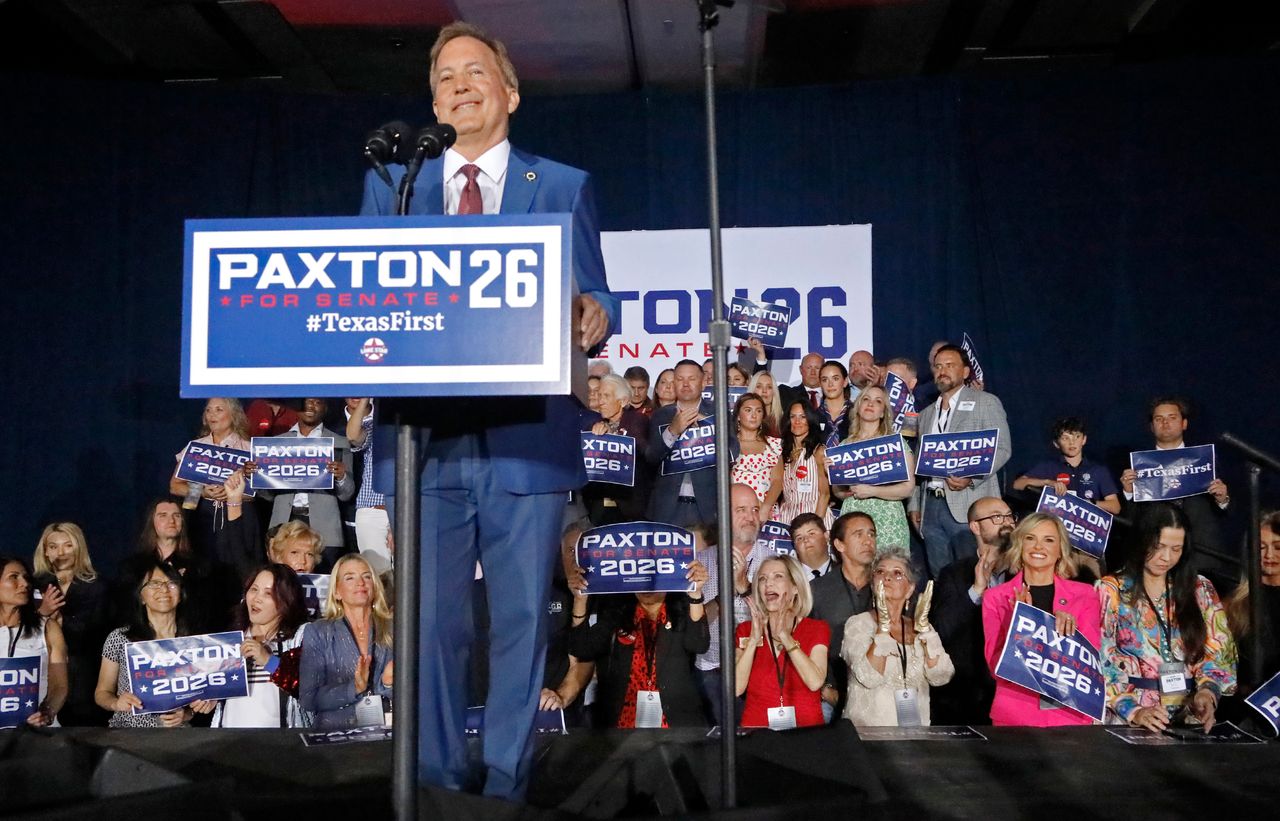 | | Texas Attorney General Ken Paxton speaks at an election night watch party held by the Lone Star Liberty PAC on Tuesday. (Stewart F. House/Getty Images) | | | |  | The Lead Brief | Texas Attorney General Ken Paxton’s decisive runoff victory over longtime Sen. John Cornyn (R-Texas) has transformed the state’s Senate race into one of the most volatile of the cycle, with major implications for health policy and control of the chamber. Paxton, a hard-line conservative backed by President Donald Trump, has spent years at the center of legal fights against the federal government’s health agenda. He previously led a coalition of 20 states in an effort to overturn the Affordable Care Act and challenged several Biden-era rules. Paxton’s primary victory moves the contest for Texas’s Senate seat into a “fully competitive race” after shifting its rating from “likely” to “lean” Republican, according to the nonpartisan Cook Political Report, which tracks elections and rates how competitive races are. → Now, he’s set to face Democratic challenger James Talarico, a Texas state senator whose health care platform includes proposals to expand the government’s drug negotiation powers and to offer universal health coverage to Americans. Talarico’s crossover appeal, having garnered some support from Republicans in the state, gives Democrats hope they can flip the seat and send the first Texas Democrat to the Senate in decades. That optimism has already reached K Street. Democratic lobbyists at Forbes Tate Partners and Crossroads Strategies — two lobbying firms with high-powered health clients — have already scheduled a fundraiser for Talarico next week, according to an invitation I obtained. Talarico Victory Fund, a fundraising committee, does not accept corporate PAC donations, the invitation reminds prospective guests. → While Talarico garnered support from at least 80 percent of Democrats in an imaginary race against Paxton or Cornyn, Republican voters in Texas hadn’t rallied around either of their potential nominees, a University of Texas/Texas Politics Project poll found in April. Just 63 percent of Texas Republicans chose Paxton in the hypothetical matchup, 11 percent said they’d vote for Talarico, and 20 percent said they didn’t have an opinion on the race. Of course, there’s a long time until Nov. 3, and the overall political math is still difficult for Democrats in deep-red Texas, where Talarico’s more progressive policy ideas may face headwinds from voters. → But Talarico is amassing a war chest. His campaign committee raised more than $40 million by the end of March, according to the most recently available federal election records, and had $9 million left in the bank at the time. Paxton, meanwhile, raised $7.6 million through May 6. He’s got roughly $2.3 million cash on hand. | | | | | | Industry Rx | Hims & Hers CEO Andrew Dudum has placed a bet on more consumer-driven health care, Christopher Rowland explains in a profile for The Washington Post. “I do believe that the traditional health care system has moved in a way that is too paternalistic,” said Dudum, who founded the company in 2017. “It doesn’t have room for consumer flexibility.” Dudum pointed to a moment after asking a physician about supplements — when he was told, “I can’t help you with that” — as emblematic of a system he says is failing to meet growing consumer demand for personalization and preventive care. Health Secretary Robert F. Kennedy Jr.’s support for peptides, which are a central focus of the wellness and longevity movement, has opened up an opportunity for Hims & Hers. Kennedy has been critical of FDA restrictions on peptides, saying he personally used one to help recover from an injury. Kennedy has ordered regulators to change the status of roughly a dozen different peptides to pave the way for Americans to access them more readily, and the FDA has begun the process to do so. → Hims & Hers has been positioning itself to capitalize on the shift. The company acquired a manufacturing facility in Menlo Park, California, last February to explore peptides for “preventive health, metabolic optimization, cognitive performance, recovery science, and biological resistances,” while also using the site to research other products. Underlying the business case is the belief that consumers increasingly want to intervene earlier in aging and health decline, particularly as they watch older generations experience chronic disease and functional deterioration. The potential market is enormous. Many adults have watched their parents age “ungracefully” after years of unhealthy behavior, Dudum said, and they don’t like what they see. Dudum said the key to selling peptides, if authorized by the FDA, will be building trust with customers. Purchases now are taking place on the internet, with no physician oversight and zero supply-chain transparency, he said. “We believe patients should have access to this type of responsible path,” he said, adding that there will have to be “physician oversight” and “a supply chain that is bulletproof.” Hims & Hers, which went public in 2021, generated $2.35 billion in revenue in 2025, up 59 percent from the year before. It spent nearly $1 billion on marketing. It’s also become more active in Washington, contributing $1 million to Trump’s second-term inaugural fund last year. The company spent nearly $1.2 million on lobbying last year — a massive increase from the $30,000 it spent on lobbying in 2023, prior to building out its own in-house advocacy operation. Read the full story: “Hims & Hers CEO is plotting new ways to upend traditional health care.” | | | | | | Document Drop | Sen. Bill Cassidy (R-Louisiana) wrote to Hims & Hers in a letter dated May 21, asking for more information about a recent data breach that may have exposed some consumer information to hackers. Cassidy, who leads the Senate Health, Education, Labor and Pensions Committee, released the letter publicly on Tuesday. → Hims & Hers disclosed the attack to its customer service platform in a February filing sent to federal regulators, saying that the company “promptly initiated our cybersecurity response plans,” including isolating the impacted systems and launching an investigation “with the assistance of external cybersecurity advisors.” The company said that electronic medical records systems were not accessed, though “the unauthorized third party may have gained access to customer data regarding category of treatment and other information included in their communications with customer service.” → Cassidy asked the company for specifics about what data had been accessed and what steps it’s taken to improve its security to prevent another breach, among other questions. Hims & Hers has a June 8 deadline to respond. | | | |  | From our notebook | The Enhanced Games, which took place over the weekend, tested a provocative premise that athletes — placed on supervised regimens of testosterone, human growth hormone, peptides and other substances — could push the boundaries of human performance. The athletes trained for weeks in Abu Dhabi, using performance-enhancing substances banned in traditional sporting contests, and about $20 million was spent to build a temporary venue on the Las Vegas Strip to host the games. → The reporting from Las Vegas by The Washington Post’s Rick Maese and Elizabeth Dwoskin offers vignettes of the competitors that makes the article worth the read in itself — but I wanted to focus on the connections to health policy. My colleagues Rick and Elizabeth described the games as part competition, part longevity conference, part product launch and part fever dream. The games conjured a memory of the decades-old “Saturday Night Live” sketch about the “All-Drug Olympics,” they wrote. Christian Angermayer, a Silicon Valley billionaire and biohacker, funded the event. He’s the co-founder of and executive chairman of the company Enhanced, which seeks to study and develop performance-enhancing products. → It attracted attendees with Trump administration ties: Calley Means, an adviser to the health secretary, and Kennedy’s son William Finbar “Finn” Kennedy, who recently founded a venture capital fund to invest in health care companies aligned with the Make America Healthy Again movement. The Enhanced Games lands in the middle of a broader policy debate over whether to regulate some of the substances, including experimental peptides that have been used by Americans to enhance workout performance and speed recovery. → Despite calls for more testing of these products, the elder Kennedy is pushing for the Food and Drug Administration to loosen the rules surrounding certain peptides and make them more widely accessible. An FDA advisory committee is set to have a meeting in July to discuss making some available to consumers through compounding pharmacies. → Beyond the competition itself, the Enhanced Games also points to a larger commercial strategy. Organizers have described ambitions that extend into telehealth, including the sale of testosterone, peptides and related supplements directly to consumers — effectively turning the event into a marketing platform as much as a sporting one. As one analyst noted during the broadcast, “It’s not just racing, but we’re selling product as well. That’s a big part of it.” Do yourself a favor and read the full story: “Peptides and banned swimsuits: Welcome to the doping Olympics.” | | | | | | What We’re Reading | “U.S. to send Americans exposed to Ebola to makeshift hospital in Kenya,” The Post’s Lena H. Sun writes. “Doctor evacuated from Congo feels ‘helpless’ watching colleagues die of Ebola,” The Post’s Lauren Weber reports. “Trump admin shutting key US researchers out of global virus response talks, documents and sources reveal,” CNN’s Sarah Owermohle reports exclusively. “CDC asks staff to volunteer to help with Ebola screenings at airports amid DRC outbreak,” write Youri Benadjaoud, Morgan Winsor, Dada Jovanovic, David Brennan and Mary Kekatos write at ABC News. “ICE detainees are dying by suicide at an ‘alarming’ rate, an AP investigation finds” Ryan J. Foley, Michael Biesecker and Morgan Lee report at the Associated Press. This newsletter is published by WP Intelligence, The Washington Post’s subscription service for professionals that provides business, policy and thought leaders with actionable insights. WP Intelligence operates independently from The Washington Post newsroom. Learn more about WP Intelligence. | | | | | | | | |


_tstmp_1756933376-1920-1080.png)






