| | In this edition, why Democrats don’t have Trump envy, and Texas Senate nominee Paxton forecasts his ͏ ͏ ͏ ͏ ͏ ͏ |
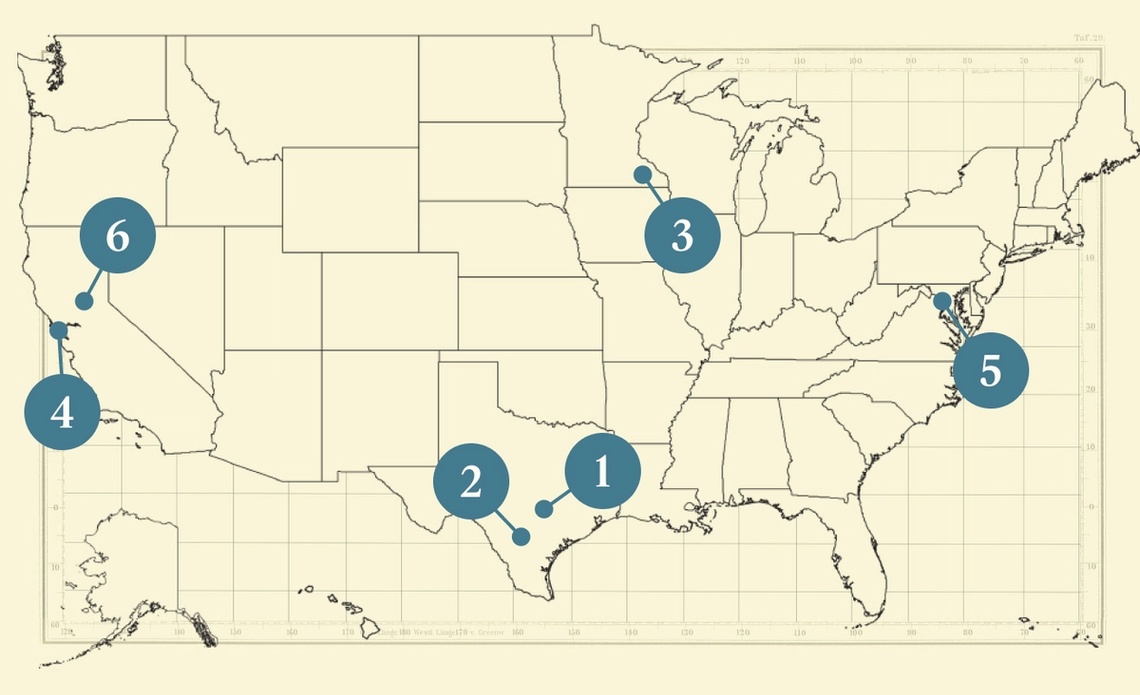
| |  Rochester Rochester |  San Antonio San Antonio | San Francisco |
 | Americana |  |
| |
|
 - Paxton’s November preview
- Lone Star bright spot
- Un-conventional Dems
- Pay for play
- Trump’s base wavers
- Becerra vs. Steyer on air
|
|
 The major US political parties are best understood by looking at Texas and California, whose 2026 primaries tell a clear story: Republicans are run from the top, while Democrats aren’t run at all. Texas Republicans did what the president asked them to on Tuesday, nominating state Attorney Gen. Ken Paxton for the job now held by Sen. John Cornyn. A 40-year scandal-free career in Texas politics is over after pro-Cornyn groups spent close to $100 million to defend him, simply because President Donald Trump said so. The polar-opposite dynamic is on view in California, where Democrats will likely send one of their gubernatorial candidates to the November election against Republican Steve Hilton. They have struggled to even accomplish that, however, after Gov. Gavin Newsom declined to endorse a successor. It’s going to be a long primary season with the gulf this wide between Republican and Democratic decision-making. The president can intervene to pick a winner in almost any GOP contest, as he has since the start of his first term. Meanwhile, his opponents have no figure who even wants to play a Trump-style kingmaker role. At the root of that reluctance among senior Democrats is the enduring toxicity of the party’s own leadership class. Many candidates panic if they’re accused of being the choice of DC leaders. Georgia Rep. Clay Fuller even told NOTUS before winning the GOP nomination to replace Marjorie Taylor Greene that if Trump had endorsed somebody else, he “would have gotten out of the race and supported that candidate.” I’ve recently started asking Democrats how they feel about their party’s messiness, and whether they wish they had a leader who could settle primaries with a single post. The most popular answers I get are, basically, “it is what it is” and “no.” “No one should envy the Republican cult around Trump,” said Neera Tanden, president of the Center for American Progress. “Trump and the GOP are like Thelma and Louise, joined at the hip and driving off the cliff together. Democratic primary voters in swing states and districts still value who can win the general election, and that is the most important thing.” |
|
Texas Sen. nominee forecasts Talarico attack line |
 Evan Garcia/Reuters Evan Garcia/ReutersTexas Attorney General Ken Paxton defeated Sen. John Cornyn in a runoff landslide on Tuesday, leading a sweep of state GOP runoffs by arch-conservative, pro-Trump candidates. “Change was on the ballot and change won,” Paxton told supporters in Plano. He went after Democratic Senate nominee James Talarico right away, as a “vegan who thinks God is nonbinary.” Conceding defeat, Cornyn did not mention Paxton, portrayed as amoral by his camp in a multimillion-dollar ad campaign. “I’ve always supported the Republican ticket, and I will do so in this upcoming election,” he said, noting how few people had turned out for their rematch. Trump’s endorsed candidates won their races down the ballot, though some of the president’s strategists had worked for Cornyn’s super PAC — while helping defeat Rep. Thomas Massie in Kentucky last week. State Sen. Mayes Middleton won the GOP’s nomination to succeed Paxton, defeating Rep. Chip Roy after his campaign portrayed the Hill Country congressman as disloyal to Trump. Paxton and his allies previewed their attacks to come on Talarico during Plano remarks that largely focused on past progressive statements by the Democrat. The Republican nominee’s camp is particularly exercised about a 2023 interview in which Talarico, asked who he loved, praised “trans kids” who protested at the state Capitol against anti-LGBTQ bills. |
|
Texas Dems reject antisemite (and incumbents) |
 Maureen Galindo (left) and Johnny Garcia. Katina Zentz/San Antonio Express-News via Getty. Maureen Galindo (left) and Johnny Garcia. Katina Zentz/San Antonio Express-News via Getty.Elsewhere in Tuesday’s Texas runoffs, Democrats avoided disaster in one race while dispatching incumbents in two others. The race for the new 35th District, an area outside of San Antonio that supported Trump in 2024, got national attention after a therapist and anti-Israel activist named Maureen Galindo placed first in the March primary. Lead Left, a mysterious PAC that used a GOP donation portal — but that no Republican has taken credit for — spent $1 million on ads depicting Galindo as a strong progressive. A coalition of centrist groups rushed in to combat that and promote her moderate Democratic opponent Johnny Garcia, who defeated her. “I interpret that as $1 million of Republican dirty tricks having an impact,” said Brian Romick, the chair of the DMFI PAC. “They know anti-Israel candidates are losers in the seats we need to win to take back the House.” The gerrymander that created the new 35th District also packed urban Democrats into fewer seats. In the Dallas area, Rep. Julie Johnson lost to former Rep. Colin Allred, who had given up a nearby (and now redrawn) seat to run for Senate in 2024. In Houston, freshman Rep. Christian Menefee defeated longtime Rep. Al Green. Menefee had won the first round of the primary, and got help in the second round — namely, millions of dollars in spending from the crypto industry’s Fairshake PAC, including one ad starring Texas Rep. Jasmine Crockett. |
|
Why some Dems want to rethink state assemblies |
 Jim West/UCG/Universal Images Group/Getty Images Jim West/UCG/Universal Images Group/Getty ImagesOne month after delegates left Detroit, Michigan Democrats are still bruised from their party convention. Progressives nominated one of their own for state attorney general, prompting questions about the accuracy of the vote count. Rep. Haley Stevens, one of the Democrats running for US Senate, got booed for the entirety of her speech. Democrats now worry that these awkward scenes could repeat in Minnesota on Friday, when members of the Democratic Farmer-Labor Party meet in Rochester for their convention. Rep. Angie Craig, whom many establishment Democrats see as the most electable Senate candidate, has badly trailed in local conventions ahead of the statewide meeting. As she’s campaigned, she’s apologized for supporting the Laken Riley Act immigration law; her primary rival, Lt. Gov. Peggy Flanagan, has linked it to the empowerment of ICE operations in Minneapolis. The same story played out in Colorado’s statewide Democratic assembly, where Rep. Diana DeGette nearly lost ballot access and Sen. John Hickenlooper pulled out with a plan to face primary voters directly. Not every state allows candidates to compete in primaries if they don’t compete in conventions, which is why some Democrats want to scale them back. “I’m perilously close to devoting the rest of my life to seeing these conventions ended,” said Joe Radinovich, a former state legislator and longtime Democratic strategist in Minnesota who supports Craig. |
|
How secret money distorts US politics |
 Screenshots/Instagram/@theshaderoom and @foosgonewild Screenshots/Instagram/@theshaderoom and @foosgonewildTom Steyer’s campaign for governor of California has paid hundreds of thousands of dollars to influencers, getting flattering coverage about his progressive agenda on the social media platforms most used by young people.Steyer isn’t the first candidate to pay influencers, or even celebrities, for positive statements and coverage. But California’s expansive disclosure rules have revealed more than was known before about what the money pays for. A brief shared with Semafor’s Max Tani included the issues Steyer wanted creators to highlight, including his policy plans for taxes, housing, and combating federal immigration enforcement. Steyer has said he would find ways, as governor, to prosecute rogue ICE agents.The brief also clarified the audiences that Steyer, who ran for president in 2020 but has never held elected office, was hoping to reach. They included 18-to-54-year-old women, Black voters, and liberals in the LA and San Francisco metro areas. “The more liberal the target — liberal, not leftist — the better. Think Pod Save America listeners,” the brief said. Read the full story from Semafor media editor Max Tani. → |
|
|
Explaining Democrat midterm advantages |
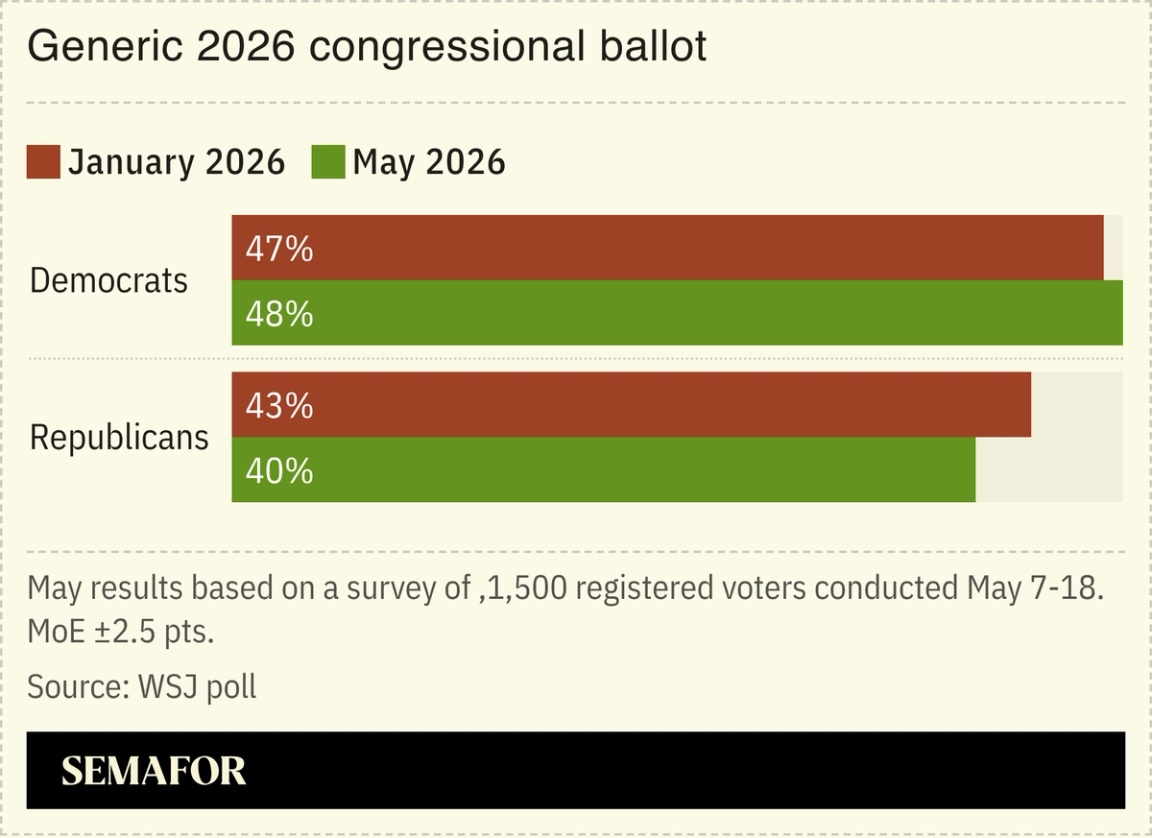 Outraised, disorganized, and distracted by primaries, Democrats continue to benefit from frustration that the president isn’t lowering prices like he said he would in 2024. Since Feb. 28, when the US and Israel launched airstrikes on Iran, the Democratic lead in midterm polling has grown by around three points. In The Wall Street Journal’s polling, the shift is driven by Republicans, who have become less intense in their support for Trump. “Strong” Trump support among GOP voters was 72% in January, before the Iran war. It’s down to 57% now. That’s been more than enough for Trump to demolish Republicans who’ve crossed him — first in Louisiana, then in Kentucky, and now in Texas. But a crucial share of Republican voters are less engaged now, and the current GOP plan to get them back is mostly warning about how Democrats would halt Trump’s agenda. |
|
California Gov. hopefuls clash over healthcare |
 Tom Steyer/YouTube Tom Steyer/YouTubeThe final stretch of the California gubernatorial primary has pitted Tom Steyer’s money against Xavier Becerra’s perceived momentum. Polling showed Becerra surging after Eric Swalwell quit the race, and large donors began funding Becerra’s super PAC, the poetically named Working Families for Healthy Communities Supporting Becerra for Governor 2026. Steyer, working with the progressive populist ad firm Fight Agency, is closing with spots like Won’t Back Down, which dings Becerra for endorsing single-payer healthcare in Congress but “telling industry lobbies he’s against it.” The Steyer campaign put out Virginia, featuring a member of the California Nurses Association (a Steyer endorser) explaining how single-payer could have changed her life. TV and YouTube viewers are seeing more of Steyer’s ads than anyone else’s, but the Becerra super PAC’s response conspicuously ignores the charge that he’s backed off of single-payer. Called Protect Your Healthcare, it’s a rundown of Becerra’s career (“he defended Obamacare in court against Trump’s attacks”), which promises he’ll “protect your healthcare and fight Trump’s cuts.” |
|
 On Wednesday, June 10, Charina Chou, chief operating officer of Google Quantum AI, will join Semafor Tech in San Francisco to unpack the tech breakthroughs that are leading to new economic and geopolitical consequences. Understanding innovation requires first-principles thinking — breaking complex problems down to their core inputs, constraints, and incentives — then rebuilding from the ground up to see what comes next. Semafor will host conversations with Aaron Levie, co-founder & CEO, Box; Jeetu Patel, president and chief product officer, Cisco; Qasar Younis, co-founder and CEO, Applied Intuition; Max Hodak, co-founder and CEO, Science Corporation; Pete Shadbolt, co-founder and chief scientific officer, PsiQuantum; Glenn Fogel, CEO, Booking Holdings Inc.; and Daphne Koller, founder & CEO, Insitro; to unpack how innovation is reshaping industries, redefining competitive advantage, and transforming the global economy.
June 10 | San Francisco | |
|
|
|


